DIGITAL MARKETING & CUSTOMER MANAGEMENT

Enterprise Architecture

Focus Areas Electronics and mechatronics form the physical–digital bridge of Industry 4.0. They enable machines to sense the environment, make decisions, and act autonomously. In modern manufacturing, especially in aerospace, these disciplines underpin smart factories, intelligent machines, and cyber-physical systems. In aerospace manufacturing, electronics and mechatronics are not just enablers of automation—they are safety-critical systems. For an enterprise like Boeing, every sensor, controller, and actuator must meet strict requirements for reliability, certification, and lifecycle traceability while operating in highly complex production environments. Signal Transduction & Conditioning Signal transduction is the process of converting physical phenomena into electrical signals. For example, a temperature change is converted into a voltage or current. Signal conditioning ensures these signals are usable and reliable. It includes amplification, filtering, noise reduction, and electrical isolation. Without proper conditioning, sensor data can become inaccurate or unusable, especially in electrically noisy industrial environments. Analog, Digital & Mixed-Signal Systems Electronic systems in Industry 4.0 span multiple signal domains. Analog systems process continuous signals such as voltage and current. Digital systems operate on discrete logic levels (0 and 1). Mixed-signal systems combine both, using components such as ADCs, DACs, System-on-Chips (SoCs), and microcontrollers. Most modern industrial electronics are mixed-signal by design. A mixed-signal system is an electronic system that: Processes both analog (continuous, real-world) signals and digital (discrete, 0/1) signals in the same system. Why this matters: The real world is analog. Computers are digital. Mixed-signal systems are the bridge between them. The Building Blocks (Very Important): Mixed-signal systems typically include: Sensors → produce analog signals. ADC (Analog-to-Digital Converter) → analog → digital. Microcontroller / SoC → digital processing. DAC (Digital-to-Analog Converter) → digital → analog. Actuators → respond to analog electrical signals. SoC stands for System on a Chip. An SoC integrates an entire computing system—processor, memory, interfaces, and peripherals—onto a single chip. Instead of many separate chips on a board, an SoC puts them all together. A modern SoC usually includes: CPU (one or more cores). Memory (RAM controllers, cache).  Analog & digital I/O. ADCs / DACs. Communication interfaces (CAN, Ethernet, SPI, I²C, UART). Timers & control units. Often AI / DSP accelerators. This makes SoCs ideal for compact, high-performance embedded systems. AI accelerators and DSP (Digital Signal Processing) accelerators are specialized hardware blocks inside an SoC (or as separate chips) that are designed to process certain types of computations much faster and more efficiently than a normal CPU. AI and DSP accelerators are specialized hardware units that offload signal processing and machine learning computations from the CPU, enabling real-time, low-latency intelligence in embedded and Industry 4.0 systems. In aerospace manufacturing, AI and DSP accelerators enable real-time inspection, vibration analysis, and predictive maintenance directly at the machine or robot level. Accelerators are specialist brains for specialist task. SoCs sit between MCUs and full computers. Microcontroller (MCU) System on Chip (SoC) Simple control tasks Complex computing + control Limited memory & speed High processing power Deterministic control Control + analytics PLC-like behavior Edge-computing capable On the aircraft: Sensors capture strain, temperature, vibration. An SoC-based embedded unit:  Filters and processes data. Runs diagnostics. Encrypts and transmits data. Feeds predictive maintenance and digital twin systems. This is edge intelligence, not just data collection.  On a modern aircraft (for example, at Boeing), the aircraft itself is no longer a passive machine. It is a data-producing, intelligent system.  Edge intelligence refers to the ability of embedded systems on the aircraft to process sensor data locally, run diagnostics, and make decisions before securely transmitting insights to predictive maintenance and digital twin systems. In modern Boeing aircraft, edge intelligence enables real-time health monitoring and predictive maintenance by embedding processing and decision-making directly within the aircraft systems. Sensors + SoC turn the aircraft into a thinking system” Microcontrollers & Embedded Systems Microcontrollers are the core of embedded systems. They integrate a CPU, memory, analog and digital inputs/outputs, and communication interfaces into a single device. Embedded systems control machines, process sensor data, execute control logic, and communicate with higher-level systems such as PLCs, MES, and industrial networks. Embedded Communication Protocols Communication protocols allow embedded systems to exchange data reliably. Common protocols include I²C, SPI, and UART for short-range communication, CAN and CAN-FD for robust industrial and automotive networks, and Industrial Ethernet for high-speed, real-time factory communication. These protocols are essential for system integration and interoperability. Electronic System Design & Manufacturing Electronic system development follows a structured lifecycle. It begins with schematic design, followed by PCB layout, prototyping, testing and validation, and finally manufacturing and assembly. In Industry 4.0, this lifecycle is tightly integrated with digital tools and enterprise systems to ensure quality, traceability, and repeatability. EDA / ECAD Tools EDA and ECAD tools support electronic design by enabling schematic capture, PCB design, design-rule checks, and generation of manufacturing outputs. Popular examples include KiCad and gEDA. These tools help engineers translate functional requirements into manufacturable electronic systems. 1. Enterprise architecture (31/01, 01/02, 07/02, 08/02) 2. Enterprise architecture (2026-02) 2. Enterprise architecture (2026-02) 5 Days Course Plan 1 – https://www.linkedin.com/in/ravi-dhaka-a1b2b456/– https://www.linkedin.com/in/simarjeet-vansal-bb783316/– https://www.linkedin.com/in/shivaprakash-timmapur-ba0805b/– https://www.linkedin.com/in/rohitvikash/– https://www.linkedin.com/in/prashant-borlepawar-8343b9b/ 2 – https://www.linkedin.com/in/ravi-dhaka-a1b2b456/– https://www.linkedin.com/in/simarjeet-vansal-bb783316/– https://www.linkedin.com/in/shivaprakash-timmapur-ba0805b/– https://www.linkedin.com/in/rohitvikash/– https://www.linkedin.com/in/prashant-borlepawar-8343b9b/


University Innovation Leadership Development Program

Innovation Leadership (BUILD PROGRAM) The aviation sector is expanding rapidly, especially in markets like India. When fleet sizes grow: Small inefficiencies multiply, Maintenance delays become costly, Emissions increase significantly. So the focus is not experimental tech — it’s scalable, operationally deployable improvements. This signals a shift from innovation hype → operational performance. Data-driven tools improve: Airplane availability, Reduce unscheduled maintenance, Optimize lifecycle costs. What it means: This is about predicting failures before they happen. Instead of: “Fix when broken”, It becomes:  “Fix before it breaks”. Through: Sensor data, AI-driven diagnostics, Real-time fleet monitoring. For airlines, this means: Fewer grounded aircraft, Better on-time performance, Lower maintenance cost per flight hour. For Boeing, this strengthens: Aftermarket services, Digital solutions business, Long-term customer relationships. Boeing is not just selling aircraft — it is becoming a data and lifecycle services company. https://youtu.be/fFjOjJrI-v8https://youtu.be/Ts1-CEVmpZ4 Improving: Production discipline, Delivery predictability, Quality systems. What it means: Digital thread = a continuous digital record from design → manufacturing → maintenance. Model-Based Engineering = designing aircraft using integrated digital system models instead of isolated documents. Impact: Fewer design errors, Better traceability, Higher production stability, Improved safety compliance. This is particularly important as Boeing increases production rates. They are strengthening manufacturing governance and system control — likely in response to industry scrutiny and the need for delivery reliability. Boeing is aligning with global ESG pressure while keeping solutions commercially viable: Aircraft certified for higher SAF blends, Ongoing work in fuel compatibility, Helping airlines reduce lifecycle emissions. What it means: SAF is currently the most practical near-term decarbonization lever for aviation. Boeing is positioning itself as: Technically ready, Certification-ready, Infrastructure-supportive. This ensures airlines can transition without waiting for hydrogen or electric aircraft. It also shows Boeing shifting from: Pure aircraft manufacturer to Integrated lifecycle + digital + sustainability partner! This statement implies growing demand for skills in: Data analytics in aviation, AI-driven predictive systems, Model-Based Systems Engineering (MBSE), Digital manufacturing, Sustainability & SAF certification, Lifecycle cost optimization. These are the “future-ready capability areas” mentioned in HR communications. The next wave of aerospace advantage will come from digital intelligence, disciplined production systems, and scalable sustainability — not just new aircraft designs. Pillar Why It Matters Digitalization Drives recurring services revenue Production Discipline Restores reliability & trust Sustainability Future-proofs the fleet “India as a sales destination” to “India as an industrial capability partner.” That’s a big shift! 325+ supply chain partners, Strong base already established. India is part of global aerospace supply chain. What it means: India is not just a customer market for Boeing. It is already integrated into the production ecosystem. India contributes in: Aerostructures, Composites, Wiring systems, Advanced machining. This positions India as: A production node in Boeing’s global value chain. After recent global scrutiny around quality in aerospace manufacturing, Boeing is emphasizing: Stability before scale, Capability before capacity. This is about restoring long-term production confidence. “Building durable industrial capability, not expanding footprint alone”. Boeing does not want to: Open facilities just for headlines, Scale too fast without quality discipline. Instead, they prioritize: Certification discipline, Process stability, Execution reliability. They highlight: MRO expansion, Boeing Converted Freighter line in Hyderabad, India Distribution Center. What this means strategically: Aircraft sales are cyclical. Services are recurring. MRO + distribution = long-term revenue + customer lock-in. So Boeing is strengthening: Lifecycle support, Parts availability, Technical capability in-country. This reduces: Aircraft downtime, Import dependency, Service delays. It also deepens India’s role beyond manufacturing → into aftermarket services. It also deepens India’s role beyond manufacturing → into aftermarket services. MRO expansion. Boeing Converted Freighter line in Hyderabad. India Distribution Center: What this means strategically: Aircraft sales are cyclical. Services are recurring. MRO + distribution = long-term revenue + customer lock-in. So Boeing is strengthening: Lifecycle support, Parts availability, Technical capability in-country. This reduces: Aircraft downtime, Import dependency and Service delays. Focus is also on systems-level reliability , not just production output. Tighter process controls. Earlier identification of quality issues. Clearer work instructions. Stronger accountability. And then they quantify results: 40% reduction in defects, 60% reduction in unfinished jobs, What this means: They are signaling: Manufacturing discipline has improved., Quality issues are being caught earlier. Production flow is stabilizing. Earlier detection = fewer downstream disruptions. This improves: Delivery predictability, Assembly line stability, Airline confidence. For India specifically: Aircraft delivered “ready for service” with trained personnel and parts availability.  Theme Strategic Meaning India as Global Node India is embedded in Boeing’s worldwide supply system Capability > Capacity Controlled, disciplined expansion Services Focus Long-term recurring revenue strategy Quality Restoration Rebuilding trust through process control Local Ecosystem Strengthening MSMEs + workforce + logistics integration Boeing’s commitment to India’s aerospace and technology ecosystem took a bold step forward with the announcement of the winners of the fourth edition of the Boeing University Innovation Leadership Development (BUILD) Program 2024–25. Held in Bengaluru in 2025, the event celebrated seven outstanding teams of university students and early-stage entrepreneurs who are shaping the future of aerospace, defence, sustainability, and social impact. What Is the BUILD Program? The BUILD Program is Boeing India’s flagship innovation and incubation initiative. It is designed to: Identify early-stage innovators across India, Provide mentorship from Boeing engineers and global leaders, Offer incubation support through top academic and startup partners, Provide financial grants (INR 10 lakh per winning team) and Convert ideas into scalable, market-ready business solutions. In 2024–25, BUILD received over 2,000 idea submissions from more than 2,700 students and startup founders across Tier 1, 2, and 3 cities — the highest participation since its launch. From these entries: 75 teams were shortlisted for regional boot camps, Finalists received deep mentorship, 7 teams emerged as national winners. Meet the 2024–25 BUILD Winners – The seven winning teams are: Thrustworks Dynetics,  Nexus Power,  Extrive Innovations,  Qualivon Technologies,  Rapha Bionics,  HyPrix Aviation Trishul Space Each team will receive:  INR 10 lakh grant, Ongoing mentorship, Incubation support, Access to Boeing’s knowledge ecosystem. Their solutions span aerospace systems, defence technologies, sustainability innovations, and socially impactful engineering breakthroughs. The Innovation Ecosystem Behind BUILD. BUILD is not just a competition—it is a structured innovation pipeline supported by India’s top academic incubators: Society for Innovation and Entrepreneurship (SINE) Foundation for Innovation and Technology Transfer (FITT) Innovation and Entrepreneurship Center IIT Madras Incubation Cell Foundation for Science Innovation and Development T-Hub KIIT Technology and Business Incubator These incubators ensure that innovation does not remain academic — it becomes commercial, scalable, and industry- Boeing India Academic Innovation Capability Matrix Grid Institution Region States Covered Innovation Role Facilitator Strategic Strength 1 IIT Delhi North Delhi NCR, J&K, Himachal Pradesh, Haryana, Punjab, Uttar Pradesh, Uttarakhand Policy, Research, Deep Tech FITT, IIT Delhi Advanced Aerospace R&D 2 IIT Gandhinagar West-Central Rajasthan, Madhya Pradesh, Gujarat Emerging Tech, Industry Linkages IIEC, IIT Gandhinagar Applied Engineering & Systems 3 IIT Bombay West Maharashtra, Goa Innovation & Startup Ecosystem SINE, IIT Bombay Aerospace Startups & Incubation 4 IISc Bangalore South Karnataka Advanced Research & Technology FSID, IISc Deep Science & Engineering 5 IIT Madras South-East

Cybersecurity

Focus Areas As manufacturing becomes more connected and autonomous, cybersecurity becomes a core engineering and safety concern, not just an IT function. In robotics and automation, cyber incidents can directly affect physical operations, human safety, and production continuity. This module focuses on securing interconnected IT, OT, and ICS environments that underpin Industry 4.0. In aerospace manufacturing, cybersecurity must protect not only data, but also machines, people, and certified processes. For enterprises such as Boeing, cybersecurity failures can lead to production stoppages, quality escapes, regulatory violations, or safety risks. As a result, cybersecurity is tightly integrated with safety engineering and governance. Learning Objectives This module covers cybersecurity fundamentals, Industrial Control System (ICS) security, industrial network security and threat mitigation, network security and cryptography, cybersecurity frameworks and standards, and governance, risk, and compliance in aerospace environments. After completing this module, learners will be able to explain cybersecurity in an industrial context, understand ICS and OT security challenges, identify cyber threats to robotic and automated systems, understand network security and cryptography basics, apply cybersecurity frameworks and standards, and relate cybersecurity to safety and governance in aerospace. What Is Cybersecurity? Cybersecurity in automation environments focuses on protecting robots and autonomous systems, sensors and actuators, control systems, and production data. Because these systems interact directly with the physical world, cyber incidents can have immediate real-world consequences. The term cybersecurity emerged to describe the protection of systems operating in cyberspace—networked, software-controlled environments—distinguishing it from traditional physical security. It’s called cybersecurity because it protects systems that exist in cyberspace — not just physical assets or people. Traditional security protects: Buildings, Equipment, People, Physical access. Cybersecurity protects: Digital systems, Networks, Software-controlled machines, Information and operations in networked, computational space. That “space” is what we call cyberspace.  The term cyberspace was popularized later (1980s), meaning: A virtual space created by interconnected computer systems and networks. So: If something exists only because of computation + networking, it exists in cyberspace and therefore needs cybersecurity. The word cyber comes from Norbert Wiener, who introduced cybernetics in 1948. His book: Cybernetics: Or Control and Communication in the Animal and the Machine. Cybernetics meant: Control and communication in machines and living systems. Key ideas: Feedback loops, Control systems, Communication, Automation. This is the intellectual foundation of: Robotics, Automation, Control theory, And eventually… cybersecurity. Cybersecurity evolved from computer and information security as systems became networked, remote, and cyber-physical, requiring protection beyond physical boundaries. Cybersecurity is the price of autonomy and connectivity Period What Was Happening Terminology 1950s–1960s Mainframes, isolated systems “Computer security” 1970s ARPANET, shared systems “Information security” 1980s Networked computers “Network security” 1990s Internet, remote attacks “Cybersecurity” 2000s+ Critical infrastructure, OT “Cybersecurity (IT/OT/ICS)” In modern industrial systems: Software controls physical motion, Networks connect machines, AI influences decisions. A cyber attack can: Stop production, Damage equipment, Endanger human life. That’s why we now talk about: Cyber-physical security  and IT–OT–ICS cybersecurity. Not just “security”! Industry 4.0 systems are: Connected, Autonomous, Software-defined, Data-driven, Remote-accessible. This creates cyberspace inside factories. And wherever cyberspace exists → cybersecurity is required. In aerospace manufacturing and operations (e.g., Boeing): Robots drill and fasten aircraft, Software controls certified processes, Digital twins guide decisions,  Supply chains are global and digital. A cyber incident can: Break certification, Compromise safety, Stop production, Cause regulatory violations. That’s why cybersecurity is treated as safety engineering, not just IT. Cybersecurity evolved alongside industrial revolutions, becoming critical in Industry 4.0 where networked, software-controlled systems directly influence physical operations and safety. OT includes: Machines, Robots, Sensors, Actuators, Control systems, Industrial networks, Safety systems. Simple real-world analogy OT is like: All systems that make a factory work. Conveyors, robots, machines, power, motion — everything physical. In an aerospace factory (e.g., Boeing): Robots drilling fuselage panels, CNC machines machining parts, Conveyors moving components, Sensors measuring torque and vibration.  All of this is OT. ICS = the control systems that tell OT equipment what to do. ICS is a subset of OT. ICS doesn’t do the physical work itself — it controls the machines that do. ICS includes: PLCs (Programmable Logic Controllers), SCADA systems, DCS (Distributed Control Systems), Safety Instrumented Systems (SIS), HMIs (Human–Machine Interfaces). If it executes control logic → it’s ICS. In the same aerospace factory: PLC controlling robot motion, SCADA monitoring assembly line status, Safety system that stops machines if a guard opens.  These are ICS components inside the larger OT environment. ICS lives inside OT. OT cannot work without ICS. Both interact with physical processes. But they serve different roles. Aspect OT ICS What it is Operational environment Control systems Scope Broad Narrow Function Run physical operations Control physical processes Includes Machines, robots, sensors PLCs, SCADA, SIS Safety role Operational safety Direct safety logic Relationship Superset Subset Cybersecurity In Robotics & Automation RFID (Radio Frequency Identification) enables automatic identification of objects without direct line of sight. In industrial environments, RFID supports asset and part tracking, inventory visibility, and end-to-end traceability. This capability is critical for compliance, quality assurance, and lifecycle management. Industrial Era Core Technology Security Type Why Cybersecurity Matters Industry 1.0 Mechanical power Physical security No digital systems Industry 2.0 Electricity Safety & physical No software control Industry 3.0 PLCs, IT, automation Computer & network security Software controls machines Industry 4.0 IoT, AI, robotics Cybersecurity (IT–OT–ICS) Cyber attacks affect physical world Industrial Control System (ICS) Security Industrial Control Systems include Programmable Logic Controllers (PLCs), Supervisory Control and Data Acquisition (SCADA) systems, Distributed Control Systems (DCS), and Safety Instrumented Systems. Securing these components is critical because they directly control industrial processes and safety functions. People often say “just apply IT security to factories” — that’s wrong. IT, OT, and ICS systems have different priorities, risks, and failure modes. In IT, data loss is bad. In ICS, unsafe behavior is catastrophic. This is why ICS security is the most conservative. In Industrial Control Systems: Systems may run 20–30 years. Patching can: Stop production. Break certification. Introduce unsafe states. Availability > confidentiality. Safety always overrides cybersecurity controls That’s why standards like IEC 62443 exist specifically for ICS. In aerospace manufacturing environments such as Boeing, ICS security is treated as: An engineering discipline, A safety requirement, A governance obligation. Aspect IT Security OT Security ICS Security Primary goal Protect data Protect operations Protect process & safety Main concern Confidentiality Availability Safety + availability Typical systems Servers, PCs, cloud Robots, machines, sensors PLCs, SCADA, DCS, SIS Failure impact Data loss, downtime Production disruption Physical damage, injury Patch frequency Frequent Limited Very restricted Change tolerance High Low Very low Response time Seconds–minutes Real time Deterministic real time Threat surface Internet-facing Plant network Control network Security style Prevent & detect Protect & monitor Engineer & isolate IT security protects data, OT security protects operations, and ICS security protects safety-critical control of

Design For Additive Manufacturing

Focus Areas Design for Additive Manufacturing (DFAM) represents a fundamental shift in how products are conceived and engineered. Instead of designing for traditional subtractive or formative processes, DFAM embraces the freedoms and constraints of additive manufacturing from the outset. This mindset is critical for realizing the full value of AM in Industry 4.0. In aerospace, DFAM must balance innovation with rigor. Designs must satisfy performance goals while meeting strict certification, traceability, and qualification requirements. For enterprises such as Boeing, DFAM is as much about governance and lifecycle integration as it is about geometry and optimization. Learning Objectives This module covers CAD for additive manufacturing, AM-oriented process planning, material representation using DFAM guides, AM modeling concepts, deposition and 3D fiber printing, AM design economics, design rules and structural complexity, topology optimization, and generative design. After completing this module, learners will be able to understand CAD requirements for AM, explain AM-oriented process planning, apply material representation using DFAM guides, understand AM modeling and deposition processes, evaluate AM designs from an economic perspective, apply AM design rules and manage structural complexity, and explain topology optimization and generative design in AM. What Is Design For Additive Manufacturing (DFAM)? Design for Additive Manufacturing means designing for additive from the beginning, rather than adapting conventional designs later. DFAM exploits geometric freedom, integrates function and structure, and aligns design decisions directly with manufacturing and material behavior. CAD For Additive Manufacturing CAD for AM emphasizes parametric and feature-based modeling to enable rapid iteration. It supports lattice and cellular structures that reduce weight while maintaining strength and ensures readiness for simulation and downstream manufacturing analysis. Process Planning In Additive Manufacturing Process planning is an integral part of DFAM. It includes selecting optimal build orientation, defining support structure strategies, choosing layer thickness and scan strategies, and planning post-processing steps such as heat treatment or machining. Material Representation & DFAM Guides Material representation in AM must consider anisotropic properties, layer-wise strength variation, and process-dependent behavior. DFAM guides help designers select appropriate materials, define design allowables, and align designs with qualification and certification data. AM Modeling Concepts AM modeling goes beyond geometry. It includes thermal modeling to understand heat flow, distortion prediction to manage part deformation, and residual stress analysis to ensure dimensional accuracy and structural integrity. Deposition & 3D Fiber Printing Deposition-based AM processes such as Directed Energy Deposition (DED) use wire-fed or powder-fed systems to build or repair parts. Emerging 3D fiber printing technologies embed continuous fibers within printed structures, significantly improving strength-to-weight ratios. AM Design: Economy & Value AM economics focus on total lifecycle value rather than unit cost. Key value drivers include part consolidation, reduced tooling, simplified assemblies, and advantages in low-volume, high-complexity production typical of aerospace applications. Design Rules & Structural Complexity Effective DFAM follows key design rules such as minimum wall thickness, overhang limits, and support accessibility. At the same time, AM enables unprecedented structural complexity, including internal channels, lattice structures, and functionally graded materials. Topology Optimization Topology optimization removes unnecessary material while following load paths to achieve optimal strength and stiffness. The resulting organic geometries are well suited to AM and are often reused across similar design problems. Generative Design In AM Generative design explores a wide range of design alternatives automatically based on constraints and objectives. Leveraging AI and optimization algorithms, it accelerates design space exploration and identifies novel solutions that would be difficult to create manually. Enterprise Perspective (Example: Boeing) From an enterprise perspective, aerospace organizations must ensure certification-ready design allowables, full traceability from CAD to build, integration with traditional manufacturing processes, and strong design governance. DFAM must fit seamlessly into existing product lifecycle management frameworks. Key Takeaways DFAM requires a new way of thinking about design. CAD, process planning, and material behavior are tightly linked. AM economics are driven by lifecycle value rather than part cost alone. Topology optimization and generative design unlock significant lightweighting potential. In aerospace, DFAM adoption must be carefully governed to balance innovation with certification and safety.

Additive Manufacturing

Focus Areas Additive Manufacturing (AM) is a cornerstone technology of Industry 4.0. By enabling digital, layer-by-layer fabrication, AM transforms how aerospace components are designed, produced, and sustained. It supports rapid innovation, complex geometries, and data-driven manufacturing practices that align closely with smart factory concepts. From an enterprise perspective, AM is not just a production technology—it is a strategic capability. In aerospace, it impacts supply-chain resilience, sustainability goals, certification approaches, and integration with traditional manufacturing. Enterprises such as Boeing evaluate AM across its entire lifecycle impact, from powder sourcing to end-of-life considerations. Learning Objectives This module covers sustainable additive manufacturing, AM’s impact on supply chains and laser innovations, Powder Bed Fusion versus Binder Jetting, residual stress in advanced AM processes, metal powder processing, and AM machine and design considerations. After completing this module, learners will be able to explain sustainable additive manufacturing concepts, understand AM’s impact on aerospace supply chains, compare Powder Bed Fusion and Binder Jetting processes, explain residual stress challenges in metal AM, understand metal powder processing and handling, and identify AM machine types and design constraints. What Is Additive Manufacturing? Additive Manufacturing builds parts layer by layer directly from digital models. This approach enables complex geometries that are difficult or impossible to achieve with subtractive methods, reduces material waste, and supports rapid design iteration and customization. Sustainable Additive Manufacturing Sustainable AM enables reduced material waste through near-net-shape production, lightweight designs that improve fuel efficiency, localized production that lowers transportation emissions, and reduced tooling requirements compared to conventional manufacturing. AM & Supply Chain Transformation Additive Manufacturing transforms supply chains by enabling digital inventories, reducing dependency on long and fragile supplier networks, supporting on-demand production of parts, and significantly shortening lead times. These capabilities are particularly valuable in aerospace, where spares availability and lifecycle support are critical Laser Innovations In Additive Manufacturing Recent laser innovations include higher-power and multi-laser systems, improved beam control, enhanced melt-pool monitoring, and increased build speeds. These advancements improve productivity, consistency, and quality in metal additive manufacturing processes. Powder Bed Fusion (PBF) Powder Bed Fusion uses fine metal powder spread across a build platform, where a laser selectively melts regions according to the digital design. PBF offers very high precision and material density, making it suitable for complex, high-performance aerospace components. Binder Jetting Binder Jetting selectively deposits a binder to join powder particles layer by layer. Unlike PBF, it does not use a high-energy laser during printing and requires post-processing steps such as sintering. Binder Jetting is well suited for higher-volume production scenarios. Aspect Powder Bed Fusion Binder Jetting Energy source Laser Binder Density Very high Medium–High Post-processing Moderate Extensive Production volume Low–Medium Medium–High Each process serves different aerospace and industrial needs depending on performance, scale, and cost requirements. Residual Stress In Metal AM Residual stress in metal additive manufacturing arises from rapid heating and cooling cycles, steep thermal gradients, and the inherent layer-by-layer deposition process. If not managed, residual stress can lead to distortion, cracking, or reduced component performance. Managing & Analyzing Residual Stress Residual stress can be mitigated through careful process parameter optimization, strategic build orientation, post-build heat treatment, and the use of simulation and in-situ monitoring to predict and control thermal behavior during printing Metal AM – Powder Processing Metal powder quality is critical to AM success. Key considerations include particle size and distribution, flowability, contamination control, and powder reusability. Poor powder management directly impacts part quality, repeatability, and certification. AM Machines & Design Considerations AM machines vary in build volume, energy source, and material compatibility. Effective Design for Additive Manufacturing (DfAM) requires consideration of support structures, topology optimization, and thermal behavior. In AM, design and process decisions are tightly coupled. Enterprise Perspective (Example: Boeing) From an enterprise perspective, aerospace organizations must address certification and qualification, repeatability and traceability, cost versus performance trade-offs, and seamless integration of AM with traditional manufacturing processes. Governance and standards are essential to scaling AM safely and effectively. Key Takeaways Additive Manufacturing enables complex and lightweight designs that are difficult to achieve with conventional methods. Sustainability and supply-chain resilience are key drivers for AM adoption. Powder Bed Fusion and Binder Jetting serve different production needs. Residual stress must be carefully managed, and in AM, design and process considerations are inseparable.

Robotics & Autonomous Systems

Focus Areas Robotics and autonomous systems are at the heart of Industry 4.0. They transform machines from rigid, pre-programmed tools into adaptive systems capable of sensing their environment, making decisions, and acting safely with minimal human intervention. These capabilities are essential for modern manufacturing, inspection, and operational efficiency. In aerospace environments, robotics and autonomy must meet the highest standards of safety, reliability, and certification. For enterprises such as Boeing, autonomous systems are deployed not only to improve productivity, but also to enhance quality, enable inspection at scale, and support human workers in complex and hazardous tasks. Learning Objectives This module covers robot control fundamentals, path planning and obstacle avoidance, PID and advanced model-based control, force control and collaborative robots, the Robot Operating System (ROS), mobile robots and aerial systems, sensors for autonomy, localization and mapping, SLAM, and perception and navigation pipelines. After completing this module, learners will be able to explain robot control and motion fundamentals, understand path planning and obstacle avoidance, differentiate PID and model-based control approaches, explain force control and collaborative robots, understand ROS as a robotics middleware, explain sensors used in autonomous systems, describe localization, mapping, and SLAM, and understand perception and navigation pipelines. What Are Robotics & Autonomous Systems? Robotics focuses on machines that can sense their environment, make decisions, and act through controlled motion. Autonomous systems extend this concept by operating with minimal human intervention. Levels of autonomy vary depending on risk, environment, and regulatory constraints, especially in safety-critical industries. Control Of Robots – Fundamentals Robot control is based on a closed-loop system. Sensors provide feedback about the robot’s state, controllers process this information and decide actions, and actuators execute motion. Together, these elements ensure stable, accurate, and predictable behavior. PID Control PID control is one of the most widely used control techniques in robotics. The proportional term responds to current error, the integral term accounts for accumulated past error, and the derivative term anticipates future error based on the rate of change. PID controllers are simple, robust, and effective for many industrial applications. Despite advances in AI, PID controllers remain essential because they: Address immediate error (Proportional), Eliminate long-term drift (Integral), Predict instability (Derivative). Key insight:  PID is not obsolete—it is the baseline layer upon which advanced control is built. Modern systems often:  Use PID at low levels. Add adaptive or AI layers above it. Feedback and adaptive control systems form the core of modern automation, enabling stability, precision, and responsiveness through real-time self-correction. As environments become more dynamic, control systems are evolving from static logic to adaptive, predictive, and learning-based architectures. Hybrid approaches that combine classical control theory with AI, edge intelligence, and digital twins are emerging as the dominant paradigm, balancing performance with safety. The future of robotics, autonomous systems, and industrial automation lies in resilient, self-optimizing feedback intelligence governed by strong systems engineering and safety constraints. Traditional control assumes: Known conditions. Fixed parameters. Reality: Environments change, Systems wear, Loads vary. Adaptive control addresses this by: Adjusting parameters in real time, Learning system behavior during operation. Examples: Drones adjusting altitude in turbulence, Robots compensating for material variation, HVAC systems responding to occupancy and weather, Insight: Adaptation turns control from reactive to resilient. Advanced Model-Based Control Advanced control techniques use mathematical models of robot dynamics to predict future behavior. Model Predictive Control (MPC) and optimal control strategies enable smoother motion, better constraint handling, and improved performance in complex or highly dynamic systems. Model Predictive Control (MPC) introduces a major leap: Uses system models, Forecasts future states, Optimizes actions before instability occurs. This enables: Constraint handling, Safer operation, Better performance under limits. Insight: Prediction is the bridge between control theory and autonomy. The trajectory outlined is clear: From static control → adaptive control, From adaptive → learning control, From learning → cognitive control architectures. Emerging areas: Self-healing systems, Quantum control for complex dynamics, Large-scale autonomous coordination. A critical (often misunderstood) takeaway: AI does not replace feedback control. AI enhances it by enabling: Learning, Adaptation, Optimization under uncertainty. Examples highlighted: Reinforcement learning for control policies, Neural controllers tuning parameters, Hybrid physics + data-driven models. Key insight: The future is hybrid control, not “AI-only control”. Modern trends include: Controllers that detect degradation. Automatic fault correction. Performance optimization without human intervention. This leads to: Higher availability, Lower maintenance cost, Greater autonomy. Insight: Control systems are evolving from fixed logic to adaptive intelligence. Running control intelligence at the edge enables: Ultra-low latency, Decentralized decision-making, Real-time autonomy. This is essential for: Robotics, Autonomous vehicles, Industrial automation. Insight: Centralized intelligence cannot meet real-time physical control needs. Digital twins enable: Simulation of feedback behavior, Validation of adaptive controllers, Risk-free testing before deployment. Key insight: You no longer deploy control logic directly to reality—you validate it virtually first. Force Control Force control allows robots to regulate interaction forces rather than just position. This enables safe physical interaction with humans, precision assembly, and surface-following tasks such as polishing or sealing. Force control is essential for tasks where contact quality matters. The final, strategic takeaway is strong: Future enterprises will compete on autonomous feedback intelligence. This implies: Investment in hybrid AI + control architectures, Strong systems engineering foundations, Integration of data science with control theory. Collaborative Robots (Cobots) Collaborative robots are designed to work alongside humans in shared spaces. They use force, torque, and vision sensing to detect interaction and ensure safety. Cobots support flexible, human-centered automation, particularly in low-volume, high-mix manufacturing environments. Path Planning Path planning determines how a robot moves from one point to another while avoiding collisions. Planning algorithms compute collision-free and often optimal trajectories. Common methods include graph-based approaches such as A* and D*, and sampling-based approaches such as RRT and PRM. Obstacle Avoidance Obstacle avoidance enables robots to react to dynamic environments. Using real-time sensor feedback, robots detect obstacles and adjust motion instantly. This capability is critical in shared human–robot workspaces and changing factory layouts. Introduction To Ros (Robot Operating System) ROS is a widely used robotics middleware that provides standardized communication and software infrastructure. It introduces concepts such as nodes, topics, and services, and offers a rich ecosystem of reusable packages for perception, control, and navigation. Wheeled Robots Wheeled robots commonly use differential drive or Ackermann steering mechanisms. They are widely used for logistics, inspection, and material transport due to their efficiency, simplicity, and suitability for structured environments such as factories and warehouses. Quadrupeds & Drones Quadruped robots are designed to navigate uneven terrain and confined spaces where wheeled robots struggle. Drones provide aerial inspection capabilities, enabling access to hard-to-reach or

XR, AR, VR, and Haptics

Focus Areas Extended Reality (XR) and haptics are transforming how humans interact with machines, data, and digital environments. In Industry 4.0, these technologies enhance perception, training, collaboration, and control by blending physical and digital worlds and by reintroducing the sense of touch into human–machine interactionThe Internet of Things (IoT) and Digital Twins are foundational technologies of Industry 4.0. Together, they connect physical assets to digital systems, enabling real-time visibility, simulation, prediction, and optimization. In modern manufacturing, IoT provides the data, while Digital Twins transform that data into actionable intelligence. In aerospace manufacturing and operations, IoT and Digital Twins must operate at enterprise scale while meeting stringent requirements for safety, security, certification, and traceability. For organizations such as Boeing, these technologies enable smarter factories, predictive maintenance, and digitally connected operations across the product lifecycle. In digital manufacturing and smart factories, XR and haptics are not entertainment technologies—they are productivity, safety, and quality enablers. Enterprises deploying automation and robotics increasingly rely on immersive visualization and tactile feedback to support workers, reduce errors, and improve system usability at scale. Learning Objectives This module covers AR, VR, MR, and XR fundamentals; applications of XR in digital manufacturing and smart factories; pilot implementations of VR in BIM; haptics for robotics and biomedical applications; vibrotactile sensitivity; human touch mechanoreceptors; and human-in-the-loop systems. After completing this module, learners will be able to differentiate AR, VR, MR, and XR; explain XR usage in digital manufacturing and smart factories; understand VR applications in BIM pilot implementations; explain the role of haptics in robotics and biomedical systems; understand vibrotactile sensitivity; and describe human mechanoreceptors relevant to haptic devices Key Concepts Augmented Reality (AR) overlays digital information onto the real world.Virtual Reality (VR) immerses users in fully virtual environments.Mixed Reality (MR) enables interaction between physical and digital objects.Extended Reality (XR) is an umbrella term encompassing AR, VR, and MR. These concepts represent different points on the reality–virtuality continuum. XR In Digital Manufacturing & Smart Factories XR enables guided assembly and maintenance by overlaying instructions directly onto physical equipment. It supports remote expert assistance, immersive training for complex tasks, and digital work instructions that adapt in real time. These capabilities improve accuracy, reduce downtime, and shorten learning curves in smart factories. VR In BIM – Pilot Implementations Virtual Reality combined with Building Information Modeling (BIM) enables immersive design reviews, early clash detection, layout validation, and collaborative decision-making. Stakeholders can experience facilities at full scale before construction or modification begins. Value From XR Pilot Implementations XR pilot programs consistently reveal early design and process issues, improve spatial understanding, reduce late-stage change costs, and increase alignment among engineering, operations, and business stakeholders. These pilots help validate value before large-scale rollout Introduction To Haptics Haptics introduces the sense of touch into digital systems. It provides force feedback, tactile feedback, and kinesthetic interaction, allowing users to feel resistance, texture, and motion rather than relying on vision alone. Haptics In Robotics Applications In robotics, haptics supports teleoperation, precision manipulation, training and simulation, and safety-critical control. Operators can feel contact forces and adjust actions intuitively, improving accuracy and safety when controlling robots remotely or collaboratively. Haptics In Biomedical Applications Biomedical applications of haptics include surgical simulation, rehabilitation devices, prosthetics, and skill training. Haptic feedback enables realistic practice, improved motor learning, and more natural interaction with assistive devices. Vibrotactile Sensitivity Vibrotactile feedback uses vibration to convey information such as alerts, boundaries, or guidance. The effectiveness of vibrotactile cues depends on frequency and amplitude and is widely used in wearables, controllers, and handheld devices. Human Touch Mechanoreceptors Human touch perception is enabled by specialized mechanoreceptors.Merkel cells detect pressure and texture.Meissner corpuscles respond to light touch.Pacinian corpuscles are sensitive to vibration.Ruffini endings detect skin stretch. Understanding these receptors is critical for designing effective haptic systems. XR + Haptics In Human-In-The-Loop Systems When XR and haptics are combined in human-in-the-loop systems, they improve situational awareness, reduce cognitive load, enable safer human–robot collaboration, and support factory flow simulation. Humans remain active decision-makers, supported by immersive and tactile feedback. Enterprise Perspective (Example: Boeing) From an enterprise perspective, organizations such as Boeing must consider worker safety, ergonomics, certification and compliance, and cost–benefit validation when adopting XR and haptics. Governance ensures these technologies enhance performance without introducing new risks. Key Takeaways XR enhances perception, training, and collaboration. VR supports early design validation and stakeholder alignment. Haptics reintroduces touch and control into digital systems. Human physiology plays a critical role in system design. Enterprise adoption of XR and haptics must be governed to ensure safety, value, and scalability.

IoT & Digital Twin

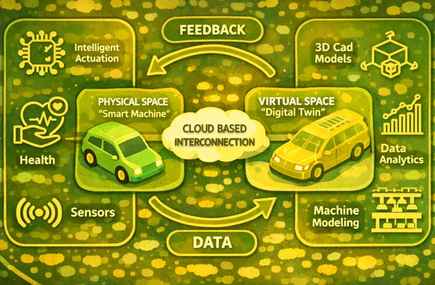
Focus Areas The Internet of Things (IoT) and Digital Twins are foundational technologies of Industry 4.0. Together, they connect physical assets to digital systems, enabling real-time visibility, simulation, prediction, and optimization. In modern manufacturing, IoT provides the data, while Digital Twins transform that data into actionable intelligence. In aerospace manufacturing and operations, IoT and Digital Twins must operate at enterprise scale while meeting stringent requirements for safety, security, certification, and traceability. For organizations such as Boeing, these technologies enable smarter factories, predictive maintenance, and digitally connected operations across the product lifecycle. Learning Objectives This module covers IoT fundamentals, RFID and localization technologies, IoT protocols with a focus on MQTT, RFID and MQTT integration patterns, IoT integration architectures, Digital Twin concepts and real-life scenarios, Eclipse Ditto as a Digital Twin implementation platform, and AI-assisted mitigation using Generative AI. After completing this module, learners will be able to explain IoT concepts and enterprise value, understand RFID and localization applications, describe IoT protocols with emphasis on MQTT, explain RFID and MQTT integration patterns, understand IoT integration architectures, explain Digital Twin concepts and real-world use cases, understand Eclipse Ditto as a Digital Twin platform, and relate IoT data to AI-driven mitigation and decision support. Internet Of Things (IoT) – Fundamentals The Internet of Things connects physical devices, sensors, and actuators to digital platforms through networks. These connections enable applications and analytics systems to monitor, analyze, and act on real-world events in near real time. IoT forms the data foundation for smart manufacturing and cyber-physical systems. RFID – Identification & Tracking RFID (Radio Frequency Identification) enables automatic identification of objects without direct line of sight. In industrial environments, RFID supports asset and part tracking, inventory visibility, and end-to-end traceability. This capability is critical for compliance, quality assurance, and lifecycle management. Localization & Its Applications Localization technologies determine the real-time position of assets, tools, and people. Common approaches include RFID-based Real-Time Location Systems (RTLS), Wi-Fi or BLE positioning, and ultra-wideband (UWB) systems. These technologies are used for tool and asset location, worker safety, and optimization of material flow across large factories. IoT Protocols – Overview IoT systems rely on lightweight communication protocols optimized for constrained devices and unreliable networks. Common protocols include MQTT, HTTP/REST, CoAP, and AMQP. Each protocol serves different use cases depending on latency, reliability, and scalability requirements. MQTT – Message Queuing Telemetry Transport MQTT is a lightweight, publish/subscribe-based messaging protocol designed for low bandwidth and unreliable networks. It uses a broker-based architecture, decoupling data producers from consumers. These characteristics make MQTT well suited for large-scale industrial IoT deployments. RFID + MQTT Integration A common Industry 4.0 integration pattern combines RFID and MQTT. RFID readers capture identification or movement events and publish them to an MQTT broker. Subscribed systems consume these events, feeding analytics platforms and Digital Twins. This pattern enables scalable, real-time traceability across the enterprise. MQTT For Mitigation Using Generative AI In advanced architectures, IoT events flowing through MQTT are analyzed by AI and ML models to detect anomalies. Generative AI can then explain the situation in natural language and recommend mitigation actions. Final decisions remain human-in-the-loop, ensuring safety, accountability, and trust. IoT Integration Architecture A typical IoT integration architecture consists of four layers. The device layer includes sensors, RFID readers, and actuators. The connectivity layer handles protocols and networks. The platform layer manages data ingestion, messaging, and device management. The application and analytics layer provides visualization, insights, and decision support. Digital Twin – Concept A Digital Twin is a digital representation of a physical asset, process, or system. It is continuously updated using IoT data and is used for monitoring, simulation, prediction, and optimization. Digital Twins bridge the physical and digital worlds. Digital Twin – Real-Life Scenarios (Example: Boeing) Real-life Digital Twin scenarios include aircraft assembly line twins for throughput optimization, tooling and robot cell twins for simulation and validation, predictive maintenance twins for health monitoring, and factory flow simulations for capacity planning and risk reduction. Eclipse Ditto is an open-source Digital Twin framework that manages digital representations of devices and assets. It integrates with IoT platforms and messaging systems, making it suitable for implementing scalable Digital Twin solutions in industrial environments. Enterprise Perspective (Example: Boeing) From an enterprise perspective, IoT and Digital Twin implementations must address cybersecurity, data governance, safety and certification, and scalability and resilience. In aerospace, governance and architecture discipline are as important as the underlying technology. Key Takeaways IoT provides real-time data from the physical world. RFID and localization enable traceability and visibility. MQTT supports scalable and reliable messaging. Digital Twins enable simulation and optimization across the lifecycle. Strong governance is essential for safe and effective adoption in aerospace environments.

Analytics, AI, ML, Generative AI & Agentic Systems

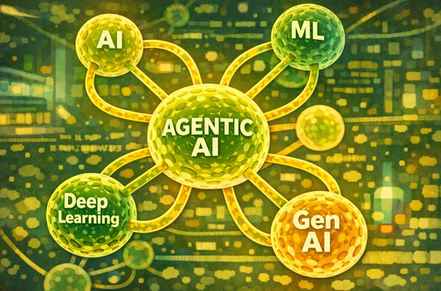
Focus Areas Artificial Intelligence (AI), Machine Learning (ML), and Analytics are core enablers of modern robotics and automation. In Industry 4.0 environments, they transform machines from rule-following systems into intelligent, adaptive, and autonomous entities capable of learning, predicting, and supporting complex decisions. In aerospace manufacturing and operations, AI and ML must operate under strict constraints of safety, reliability, explainability, and certification. For enterprises such as Boeing, AI is not just about optimization—it is about trustworthy intelligence embedded across design, manufacturing, and operational lifecycles. Learning Objectives This module explores Machine Learning fundamentals and types of ML, analytics for monitoring and reporting, differences between RPA and AI, Generative AI, Agentic AI and intelligent agents, agent-based modeling, and the role of AI-enabled autonomy in Industry 4.0. After completing this module, learners will be able to explain the roles of AI, ML, and analytics in automation, understand ML basics and learning types, differentiate RPA, AI, and Agentic AI, explain Generative AI and intelligent agents, understand agent-based modeling, and apply AI/ML for monitoring and reporting. AI, ML & Analytics – Big Picture Analytics, Machine Learning, and Artificial Intelligence form a layered intelligence stack. Analytics extracts insights from data. Machine Learning identifies patterns and learns from data. Artificial Intelligence uses those insights to support reasoning, decision-making, and action. Together, they enable intelligent automation. Analytics For Monitoring & Reporting Analytics provides structured understanding of operational data. Descriptive analytics explains what happened. Diagnostic analytics explains why it happened. Predictive analytics estimates what may happen next. Prescriptive analytics recommends what actions should be taken. In Industry 4.0, these analytics power dashboards, alerts, and decision support systems. Machine Learning Basics Machine Learning systems learn patterns from historical data rather than relying on explicitly coded rules. Over time, ML models improve their predictions as more data becomes available. This makes ML especially valuable in complex, variable manufacturing environments. Machine learning is not rule-based programming and not memorization of data. The core idea of ML is learning from data and generalizing to unseen data. ML relies heavily on mathematical concepts and data-driven algorithms. Typical ML problems include spam detection, weather forecasting, recommendation systems, face grouping, robotics navigation, and stock market prediction. Machine learning is applied in areas that replicate human capabilities such as vision, speech, language understanding, and decision-making, as well as in fields like finance, science, sports analytics, and e-commerce. Machine learning is neither procedural programming nor memorization, but a data-driven approach that learns patterns and generalizes to unseen data. The key components of machine learning are data, algorithms, generalization, and mathematics. Types Of Machine Learning Supervised learning uses labeled data to learn known outcomes, such as defect classification. Machine learning algorithms learn from labeled examples of spam and non-spam messages to automatically classify new emails or messages as spam or legitimate. Using historical weather data such as rainfall, humidity, pressure, and temperature, machine learning models predict whether it will rain on a future day. Based on a user’s viewing history and preferences, machine learning models recommend movies that the user is likely to enjoy, resulting in personalized suggestions. Machine learning analyzes user behavior, connections, and similarities to suggest new people a user may know or want to connect with on social or professional platforms. Machine learning models learn patterns in audio signals to separate vocals and instrumental sounds from a mixed music track. Machine learning models analyze past stock data and trends to predict future price movements, learning and adapting based on feedback over time. Unsupervised learning discovers hidden patterns or anomalies without labeled data. By analyzing facial features, machine learning groups photos containing the same person, even across different poses, lighting conditions, and backgrounds. Reinforcement learning enables systems to learn through reward and feedback, making it suitable for adaptive control and robotics. A robot learns how to move in an environment by taking actions and receiving feedback, improving its navigation through trial and error rather than fixed rules. Reinforcement learning enables robots to learn optimal motion strategies through interaction and feedback, extending traditional control into adaptive, autonomous decision-making.  Labels present → Supervised. Only grouping / similarity → Unsupervised. Actions + rewards + feedback → Reinforcement Learning A robot learns how to navigate by making movement decisions and receiving feedback from the environment. An action such as moving forward may be correct in one situation but incorrect in another, so the robot cannot rely on fixed rules. Instead, it learns through trial and error, improving its decisions based on experience. This illustrates a more complex form of machine learning where learning occurs through interaction with the environment rather than from predefined examples. A robot navigation problem where learning occurs through trial-and-error feedback, makes it a more complex form of machine learning based on experience. Reinforcement learning is revolutionizing motion planning by shifting control systems from static, rule-based logic to adaptive, experience-driven intelligence. By learning through state–action–reward interactions, robots can optimize movement, adapt to dynamic environments, and extend autonomy into complex nonlinear domains. Simulation, careful reward design, and safety constraints are essential to real-world deployment. As reinforcement learning integrates with classical control, sensor fusion, and multi-agent coordination, it is becoming the foundation of intelligent, self-optimizing autonomous systems across robotics, transportation, manufacturing, and beyond. Reinforcement learning enables robots to learn optimal motion strategies through interaction and feedback, extending traditional control into adaptive, autonomous decision-making. Reinforcement Learning represents a fundamental shift from predefined control logic to experience-driven intelligence. Traditional control relies on fixed rules and manual tuning. RL enables systems to learn optimal behavior through interaction. Robots are no longer just controlled — they improve themselves.  This mirrors human learning: act → observe → learn → adapt. Example What the model does ML Paradigm Spam Email / SMS Detection Classifies messages as spam or non-spam using labeled data Supervised Learning Rainfall Forecasting Predicts future rainfall using historical weather data Supervised Learning Movie Recommendation Systems Predicts user preferences based on past behavior Supervised Learning (often combined with Unsupervised) Friend Suggestions (Social Networks) Suggests potential connections based on similarity patterns Supervised / Unsupervised Learning Voice–Instrument Separation Learns to separate mixed audio signals Supervised Learning Face Grouping in Photo Galleries Groups images of the same person without knowing identities Unsupervised Learning Robot Navigation

Electronics & Mechatronics

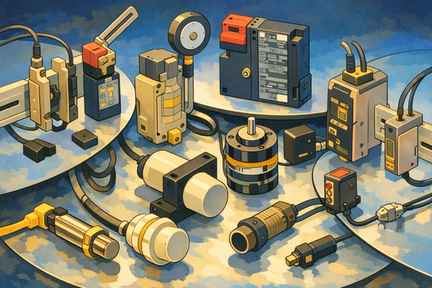
Focus Areas Electronics and mechatronics form the physical–digital bridge of Industry 4.0. They enable machines to sense the environment, make decisions, and act autonomously. In modern manufacturing, especially in aerospace, these disciplines underpin smart factories, intelligent machines, and cyber-physical systems. In aerospace manufacturing, electronics and mechatronics are not just enablers of automation—they are safety-critical systems. For an enterprise like Boeing, every sensor, controller, and actuator must meet strict requirements for reliability, certification, and lifecycle traceability while operating in highly complex production environments. Learning Objectives This module covers key Industry 4.0 building blocks, including sensors and actuators, signal transduction and conditioning, analog and digital electronics, embedded communication protocols, electronic system design and manufacturing, EDA/ECAD tools, machine vision, and integrated mechatronic systems. After completing this module, learners will be able to explain sensors and actuators used in Industry 4.0, understand signal transduction and conditioning, differentiate analog, digital, and mixed-signal systems, describe embedded communication protocols, understand electronic system design and manufacturing, apply EDA/ECAD concepts, explain machine vision in automation, and understand mechatronic system integration. Sensors & Actuators For Industry 4.0 Sensors and actuators enable machines to interact with the physical world. Sensors measure physical parameters such as temperature, pressure, vibration, proximity, position, vision, and force. These measurements provide real-time data for monitoring, control, and optimization. Actuators convert electrical signals into physical motion or force. Common examples include electric motors, pneumatic and hydraulic actuators, and servo and stepper systems. Together, sensors and actuators form the foundation of automation and robotics. Signal Transduction & Conditioning Signal transduction is the process of converting physical phenomena into electrical signals. For example, a temperature change is converted into a voltage or current. Signal conditioning ensures these signals are usable and reliable. It includes amplification, filtering, noise reduction, and electrical isolation. Without proper conditioning, sensor data can become inaccurate or unusable, especially in electrically noisy industrial environments. Analog, Digital & Mixed-Signal Systems Electronic systems in Industry 4.0 span multiple signal domains. Analog systems process continuous signals such as voltage and current. Digital systems operate on discrete logic levels (0 and 1). Mixed-signal systems combine both, using components such as ADCs, DACs, System-on-Chips (SoCs), and microcontrollers. Most modern industrial electronics are mixed-signal by design. A mixed-signal system is an electronic system that: Processes both analog (continuous, real-world) signals and digital (discrete, 0/1) signals in the same system. Why this matters: The real world is analog. Computers are digital. Mixed-signal systems are the bridge between them. The Building Blocks (Very Important): Mixed-signal systems typically include: Sensors → produce analog signals. ADC (Analog-to-Digital Converter) → analog → digital. Microcontroller / SoC → digital processing. DAC (Digital-to-Analog Converter) → digital → analog. Actuators → respond to analog electrical signals. SoC stands for System on a Chip. An SoC integrates an entire computing system—processor, memory, interfaces, and peripherals—onto a single chip. Instead of many separate chips on a board, an SoC puts them all together. A modern SoC usually includes: CPU (one or more cores). Memory (RAM controllers, cache).  Analog & digital I/O. ADCs / DACs. Communication interfaces (CAN, Ethernet, SPI, I²C, UART). Timers & control units. Often AI / DSP accelerators. This makes SoCs ideal for compact, high-performance embedded systems. AI accelerators and DSP (Digital Signal Processing) accelerators are specialized hardware blocks inside an SoC (or as separate chips) that are designed to process certain types of computations much faster and more efficiently than a normal CPU. AI and DSP accelerators are specialized hardware units that offload signal processing and machine learning computations from the CPU, enabling real-time, low-latency intelligence in embedded and Industry 4.0 systems. In aerospace manufacturing, AI and DSP accelerators enable real-time inspection, vibration analysis, and predictive maintenance directly at the machine or robot level. Accelerators are specialist brains for specialist task. SoCs sit between MCUs and full computers. Microcontroller (MCU) System on Chip (SoC) Simple control tasks Complex computing + control Limited memory & speed High processing power Deterministic control Control + analytics PLC-like behavior Edge-computing capable On the aircraft: Sensors capture strain, temperature, vibration. An SoC-based embedded unit:  Filters and processes data. Runs diagnostics. Encrypts and transmits data. Feeds predictive maintenance and digital twin systems. This is edge intelligence, not just data collection.  On a modern aircraft (for example, at Boeing), the aircraft itself is no longer a passive machine. It is a data-producing, intelligent system.  Edge intelligence refers to the ability of embedded systems on the aircraft to process sensor data locally, run diagnostics, and make decisions before securely transmitting insights to predictive maintenance and digital twin systems. In modern Boeing aircraft, edge intelligence enables real-time health monitoring and predictive maintenance by embedding processing and decision-making directly within the aircraft systems. Sensors + SoC turn the aircraft into a thinking system” Microcontrollers & Embedded Systems Microcontrollers are the core of embedded systems. They integrate a CPU, memory, analog and digital inputs/outputs, and communication interfaces into a single device. Embedded systems control machines, process sensor data, execute control logic, and communicate with higher-level systems such as PLCs, MES, and industrial networks. Embedded Communication Protocols Communication protocols allow embedded systems to exchange data reliably. Common protocols include I²C, SPI, and UART for short-range communication, CAN and CAN-FD for robust industrial and automotive networks, and Industrial Ethernet for high-speed, real-time factory communication. These protocols are essential for system integration and interoperability. Electronic System Design & Manufacturing Electronic system development follows a structured lifecycle. It begins with schematic design, followed by PCB layout, prototyping, testing and validation, and finally manufacturing and assembly. In Industry 4.0, this lifecycle is tightly integrated with digital tools and enterprise systems to ensure quality, traceability, and repeatability. EDA / ECAD Tools EDA and ECAD tools support electronic design by enabling schematic capture, PCB design, design-rule checks, and generation of manufacturing outputs. Popular examples include KiCad and gEDA. These tools help engineers translate functional requirements into manufacturable electronic systems. Machine Vision In Automation Machine vision enables automated systems to “see” and interpret visual information. It supports inspection and quality control, object detection, alignment and guidance, and defect detection. In smart factories, machine vision replaces manual inspection and enables real-time quality assurance. Mechatronics Systems Mechatronics integrates mechanical systems, electronics, embedded software, and control systems into a single cohesive solution. This integration enables intelligent machines such as robots, CNC systems, and autonomous