


16. PARTIAL OR EXCESSIVE ACTION
The principle of “Partial or Excessive Actions” suggests intentionally performing an action either partially or excessively to achieve a specific benefit or result. Implement an anti-lock braking system (ABS) that partially releases and re-applies brakes rapidly, preventing complete wheel lock-up during hard braking. Inkjet printers often employ partial actions where tiny droplets of ink are precisely deposited, allowing for high-resolution printing while conserving ink. Use drip irrigation systems that provide water directly to the root zone of plants, focusing on specific areas instead of excessive watering across the entire field. LED lighting systems can be designed to emit light in specific directions (partial action), ensuring effective illumination with lower energy consumption compared to traditional incandescent bulbs. Implement dynamic power management that partially reduces the performance of certain components when not in heavy use, extending battery life without compromising essential functions.
A: If it is difficult to obtain 100% of a desired effect, achieve more or less of the desired effect (with or without introducing a compensatory or protective action to offset the undesired effects, introduce or use left-digit-bias).
B: Trim or level a substance or energy or property after applying it in excess to obtain more or less the desired effect (use or introduce leveling and/or sharpening effect in any order, eliminate unit bias, introduce or use less-is-better effect). Trim or leveling could also mean simplifying, generalizing, minimizing, homogenizing etc. Applying in access could mean maximizing, optimizing, highlighting, emphasizing, contrasting, sharpening etc
C: Obtain the desired effect at a proximal or subsequent time if precise control at the desired time and location is difficult (introduce telescoping effect, eliminate or avoid illusion of control).
SYNONYMS: More or Less, Slightly Less or Slightly More, Partial or Overdone, Do slightly less or more than needed
EXAMPLE: Eye Lens Power, Extra Packaging, Safety Margins, Dip or Spray Painting, Air Pressure in Tires, “Buy 1+1 Free” Campaigns (partial gains while promotion or preempting competition for suppliers and excessive for customers at the same time), Top-Off/Up (under or over) Fillings, Over Spray & Remove Access (Using Stencils)
ACB:
The principle of “Partial or Excessive Actions” suggests intentionally performing an action either partially or excessively to achieve a specific benefit or result. Implement an anti-lock braking system (ABS) that partially releases and re-applies brakes rapidly, preventing complete wheel lock-up during hard braking. Inkjet printers often employ partial actions where tiny droplets of ink are precisely deposited, allowing for high-resolution printing while conserving ink. Use drip irrigation systems that provide water directly to the root zone of plants, focusing on specific areas instead of excessive watering across the entire field. LED lighting systems can be designed to emit light in specific directions (partial action), ensuring effective illumination with lower energy consumption compared to traditional incandescent bulbs. Implement dynamic power management that partially reduces the performance of certain components when not in heavy use, extending battery life without compromising essential functions.
A: If it is difficult to obtain 100% of a desired effect, achieve more or less of the desired effect (with or without introducing a compensatory or protective action to offset the undesired effects, introduce or use left-digit-bias).
This principle suggests that if achieving the desired effect fully is challenging, it’s more beneficial to attain a partial effect rather than none at all. When faced with difficulties in achieving the full desired effect, it’s pragmatic to settle for a partial accomplishment rather than abandoning the goal altogether. This approach acknowledges that obtaining 100% success may be impractical or unattainable in certain situations. By accepting partial success and implementing compensatory measures to mitigate any undesired effects, one can still make progress towards the overall objective. Consider a manufacturing process aiming for zero defects in product output. Achieving 100% perfection may be unrealistic due to various factors such as machine limitations, material variability, and human error. Instead of striving for absolute perfection, the manufacturer could adopt statistical quality control methods to ensure that defects are minimized to an acceptable level. By setting achievable quality targets and implementing measures like regular inspections, process adjustments, and employee training, the manufacturer can maintain product quality at an acceptable standard while acknowledging the practical limitations of achieving perfection in every unit produced.
B: Trim or level a substance or energy or property after applying it in excess to obtain more or less the desired effect (use or introduce leveling and/or sharpening effect in any order, eliminate unit bias, introduce or use less-is-better effect). Trim or leveling could also mean simplifying, generalizing, minimizing, homogenizing etc. Applying in access could mean maximizing, optimizing, highlighting, emphasizing, contrasting, sharpening etc
This principle advocates for adjusting a substance, energy, or property after initially applying it in excess to achieve the desired effect more effectively. When dealing with substances, energy, or properties, it’s sometimes necessary to refine or adjust them after an initial application to achieve the desired outcome optimally. This approach involves initially applying the element in excess, maximizing or emphasizing its effects, and then subsequently trimming or leveling it to reach the desired level. By employing techniques such as simplification, generalization, or homogenization, and eliminating biases like unit bias or promoting the “less-is-better” effect, one can fine-tune the substance or energy to achieve the intended result efficiently. In a wastewater treatment plant, excess chemicals are often used to ensure thorough purification of the water. However, applying these chemicals in excess can lead to inefficiencies and unnecessary costs. To address this, the plant can employ a trimming or leveling approach by initially dosing the water with a slightly higher concentration of chemicals than required for purification. After allowing the chemicals to react and maximize their effectiveness, the system can then adjust the dosage levels downward to achieve the desired purification level without wastage. By incorporating this principle, the treatment plant can optimize its chemical usage, reduce operating costs, and maintain water quality at the desired standard.
C: Obtain the desired effect at a proximal or subsequent time if precise control at the desired time and location is difficult (introduce telescoping effect, eliminate or avoid illusion of control).
This principle suggests achieving the desired effect either nearby or at a later time if precise control at the desired time and location is challenging. When precise control over the desired effect at a specific time and location is impractical or difficult to achieve, it’s beneficial to obtain the effect either nearby in time or space or at a later point. This approach acknowledges the limitations of controlling variables in complex systems and emphasizes flexibility in achieving the desired outcome. By introducing a telescoping effect, where the effect can be realized at a proximal or subsequent time, and avoiding the illusion of control, which may lead to unrealistic expectations, one can navigate challenges and still achieve the intended result effectively. Consider a weather forecasting system tasked with predicting rainfall accurately in a specific region. Due to the inherent complexity of weather patterns and the unpredictability of atmospheric conditions, achieving precise control over rainfall prediction at a precise time and location is challenging. In such cases, the system can employ a telescoping effect by providing forecasts for a broader timeframe or a larger geographical area. By offering predictions for the proximal time frame or adjacent regions, the system can still provide valuable insights to users, even if precise control over rainfall prediction at a specific time and location remains elusive. This approach allows users to make informed decisions based on the available forecast information while acknowledging the inherent uncertainties in weather prediction.
At an abstract level, the principle refers to intentionally utilizing actions in a system to a certain degree—either partially or excessively—to modulate the intensity or extent of certain actions to achieve an optimal balance and resolve inherent conflicts without being too precise in measurement or computations. Evaluate the trade-offs associated with partial or excessive actions and choose strategies that maximize benefits while minimizing negative consequences. It involves finding the right degree of action to achieve the desired outcome without causing negative side effects or unnecessary overhead of complex optimization. dentify critical actions in a system and consider deliberately scaling them up or down based on the specific requirements and constraints. Explore how partially or excessively performing certain actions can lead to a more favorable resolution. Consider the interplay between different actions and elements in a system to ensure that adjustments contribute positively to overall system performance. The abstract level of this principle emphasizes the importance of thoughtful and purposeful adjustments in the execution of actions within a system.
The principle of “Partial or Excessive Actions” can be applied to address contradictions in both technical and business contexts, leading to solutions that optimize certain actions to achieve desired outcomes without introducing unnecessary complexities or drawbacks. Achieving effective lubrication without excessive use of lubricants leading to contamination. Develop self-lubricating bearings that release lubrication only when wear is detected, addressing the contradiction between the need for lubrication and the avoidance of contaminants. Maximizing storage capacity without excessive power consumption. Implement dynamic storage allocation mechanisms that allocate power to storage units based on usage, partially powering down less-used storage components. Achieving precision without excessive material removal. Utilize advanced machining techniques, such as laser machining, that selectively remove material only where necessary, addressing the contradiction between precision and material conservation. Providing sufficient brightness without excessive battery consumption. Implement adaptive brightness control that adjusts the screen brightness dynamically based on ambient light conditions, partially reducing brightness in well-lit environments.
Business Contradictions could be considered such as maximizing employee productivity without excessive stress or burnout. Introduce flexible work hours or remote work options to partially alleviate the pressure on employees, addressing the contradiction between productivity and well-being. Ensuring prompt customer service without excessive operational costs. Implement automated chatbots for routine inquiries, partially handling customer queries instantly, and freeing up human agents for more complex issues. Optimizing supply chain efficiency without excessive inventory holding costs. Adopt just-in-time inventory management, partially reducing the need for extensive warehouse storage and minimizing holding costs. Achieving widespread marketing reach without excessive advertising expenditures. Utilize targeted marketing strategies that focus on specific demographics or channels, partially reducing the need for broad-based advertising. Offering product customization without excessive manufacturing complexity and costs. Implement modular production processes that allow for partial customization without significantly impacting overall manufacturing efficiency.
The scenario method is a creative problem-solving technique that involves the creation and exploration of hypothetical future scenarios to generate ideas, anticipate potential challenges, and develop innovative solutions. It allows individuals and organizations to be proactive in navigating uncertainty and building resilience. The scenario method is widely used in fields such as business, strategic planning, and public policy to enhance decision-making and prepare for a range of potential futures.
This method is particularly useful when dealing with complex and uncertain situations, allowing individuals or teams to envision different possible futures and plan accordingly. Here’s a general outline of how the scenario method works: (1) Clearly define the problem or issue you are addressing. Determine the scope of the scenario method application, such as a specific project, industry, or organizational challenge. (2) Identify the key variables and uncertainties that may influence the future of the problem or situation. These could include technological advancements, market trends, social changes, economic factors, etc. (3) Develop multiple hypothetical scenarios representing different possible futures. These scenarios should cover a range of outcomes, from optimistic to pessimistic, and consider various influencing factors. (4) For each scenario, explore the implications and consequences for the identified problem or challenge. Consider how each scenario might impact the goals, objectives, and stakeholders involved. (5) Use the insights gained from the scenario exploration to generate ideas and strategies. Consider how to capitalize on positive scenarios and mitigate risks associated with negative ones. (6) Based on the generated ideas, develop action plans that are flexible and adaptive to different potential futures. Consider contingency plans and strategies that can be adjusted based on how the actual future unfolds. (7) Regularly monitor the factors influencing the scenarios and update the plans accordingly. The scenario method is an ongoing process that allows for adjustments based on emerging trends and developments.
Benefits of the Scenario Method: Helps in strategic planning by considering a range of possible futures. Facilitates risk management by anticipating challenges and uncertainties. Encourages innovative thinking and the development of creative solutions. Promotes flexibility in decision-making and adaptation to changing circumstances. Provides a holistic perspective on the problem by considering various influencing factors. Supports long-term vision and planning by looking beyond immediate concerns.
The telescoping effect, also known as temporal displacement or time compression, refers to the phenomenon where events that occurred in the past are remembered as more recent than they actually were. In technical systems, this effect can manifest in various ways, particularly in the context of data storage, retrieval, and processing. Consider a computer system that logs user activity for security purposes. Due to the telescoping effect, the timestamps associated with user actions may be inaccurately recorded, leading to discrepancies in the perceived timing of events. For instance, suppose a user accesses a sensitive file on a company’s server at 9:00 AM. However, due to a glitch in the system or errors in timestamp recording, the event is logged with a timestamp of 10:00 AM. When security analysts review the logs later, they may mistakenly interpret the file access as occurring an hour later than it actually did. This telescoping effect can have significant implications for forensic investigations, compliance audits, and other scenarios where the accurate timing of events is crucial. It underscores the importance of robust timestamping mechanisms and data integrity controls in technical systems to mitigate the risk of temporal distortion and ensure the reliability of chronological data records.
The Telescoping Effect refers to the tendency of events to be perceived as more recent or more distant than they actually are. It often occurs when individuals recall past events or dates. For example, events that occurred a long time ago may feel like they happened more recently, while recent events may feel like they happened further back in time. This cognitive bias can lead to inaccuracies in memory and perception, affecting how people interpret and recall past experiences. It can also influence decision-making and judgments based on the timing of events. While this principle may not directly address the cognitive bias itself, it encourages considering alternative perspectives and timeframes, which can help mitigate the effects of telescoping in problem-solving and decision-making processes.
The Telescoping Effect can lead to inaccuracies in memory recall (memory distortion) with events being misperceived as occurring either more recently or further in the past than they actually did. This bias can affect individuals’ judgments about the timing of events (misjudgment of time), potentially leading to errors in decision-making or planning. When applied to historical events or timelines, the Telescoping Effect may contribute to misconceptions about the sequence and timing of important historical occurrences (historical inaccuracies). Overall, while the Telescoping Effect may have some benefits in terms of memory accessibility and emotional impact, its potential for memory distortion and misjudgment of time underscores the importance of critically evaluating one’s perceptions and memories The Telescoping Effect can make distant memories feel more accessible and vivid, allowing individuals to relive past experiences more easily (Enhanced accessibility). Memories that feel more recent may evoke stronger emotions, leading to a greater sense of connection to past events (Emotional impact). Perceiving older events as more recent may help individuals learn from past experiences and apply lessons to their present circumstances (Facilitates learning).
Unit bias is a cognitive bias where individuals have a tendency to perceive a single unit of consumption as the appropriate or standard amount, regardless of whether it is appropriate for the situation or context. This bias can lead individuals to consume larger portions or quantities than necessary simply because it is perceived as a “normal” or acceptable amount. By addressing unit bias proactively, individuals and organizations can improve decision-making, optimize resource utilization, and enhance the effectiveness of technical systems and solutions. In technical systems or problem-solving contexts, unit bias can manifest in several ways: Resource Allocation: When allocating resources for technical projects or initiatives, individuals may default to standard or predetermined units of measurement without considering whether they are appropriate for the specific requirements of the project. This bias can lead to inefficiencies in resource utilization and missed opportunities for optimization. System Design: In designing technical systems or products, engineers may default to standard units or specifications without considering whether they are suitable for the intended application or user needs. This bias can result in over-engineered solutions or features that exceed the requirements of the end-user, leading to unnecessary complexity and costs. Data Analysis: In analyzing data from technical systems or experiments, individuals may default to standard units of measurement without considering whether alternative units or metrics would provide more meaningful insights. This bias can lead to misinterpretation of data or overlook important trends or patterns that are not captured by the chosen units. Energy Consumption: In managing energy consumption in technical systems or facilities, individuals may default to standard units of measurement (e.g., kilowatt-hours) without considering alternative metrics or approaches for evaluating energy efficiency. This bias can result in missed opportunities for optimizing energy usage and reducing costs.
To address unit bias in technical systems and problem-solving, it is essential to: Encourage critical thinking and awareness of the potential biases inherent in unit selection and measurement. Consider alternative units or metrics that may be more appropriate for the specific requirements or objectives of the project. Promote flexibility and adaptability in resource allocation, system design, and data analysis to accommodate varying needs and contexts. Provide education and training on best practices for unit selection and measurement in technical fields, emphasizing the importance of considering the broader context and objectives.
The “less is better” effect, also known as the “less is more” principle, refers to the idea that simplifying or reducing the number of choices, options, or features can lead to a more positive perception or experience for individuals. This effect is rooted in the concept that too much complexity or variety can overwhelm decision-makers and detract from the overall quality or value of a product, service, or experience. By applying the “less is better” principle in technical systems and problem-solving, individuals and organizations can enhance user satisfaction, improve performance, and achieve greater efficiency and effectiveness in their endeavors.
In technical systems or problem-solving contexts, the “less is better” effect can manifest in several ways: Simplified Design: In designing technical systems or products, engineers may apply the “less is better” principle by prioritizing simplicity and minimizing unnecessary complexity. By focusing on essential features or functionalities, engineers can create systems that are easier to understand, use, and maintain, leading to improved user satisfaction and performance. Streamlined Processes: In optimizing technical processes or workflows, individuals may apply the “less is better” principle by eliminating redundant steps, reducing decision points, or simplifying procedures. This streamlining can lead to increased efficiency, reduced errors, and faster turnaround times, enhancing overall productivity and effectiveness. Reduced Cognitive Load: Excessive complexity in technical systems or interfaces can overwhelm users and increase cognitive load, leading to frustration, errors, and decreased performance. By applying the “less is better” principle, designers and engineers can reduce cognitive load by presenting information more clearly, minimizing distractions, and simplifying interactions, resulting in a more intuitive and user-friendly experience. Optimized Resource Allocation: When allocating resources for technical projects or initiatives, individuals may apply the “less is better” principle by focusing on essential priorities and avoiding unnecessary expenditures or investments. By prioritizing high-impact activities and minimizing waste, organizations can maximize the return on investment and achieve better outcomes with fewer resources.
To leverage the “less is better” effect in technical systems and problem-solving, it is essential to: Prioritize simplicity and clarity in design, focusing on essential features and functionalities that provide the most value to users. Conduct user testing and feedback sessions to identify areas of complexity or confusion and streamline processes accordingly. Continuously evaluate and refine technical systems and processes to eliminate unnecessary complexity and optimize performance. Foster a culture of simplicity and efficiency within organizations, where individuals are encouraged to question assumptions, challenge complexity, and seek opportunities for improvement.
The illusion of control is a cognitive bias where individuals overestimate their ability to control or influence outcomes that are actually determined by chance or external factors beyond their control. This bias leads people to believe that they have more control over events than they actually do, often resulting in excessive confidence or unrealistic expectations about their ability to predict or affect outcomes. By addressing the illusion of control proactively, individuals and organizations can improve decision-making, enhance risk management practices, and achieve better outcomes in technical systems and environments.
In technical systems or problem-solving contexts, the illusion of control can manifest in several ways: Risk Management: Individuals may exhibit the illusion of control when assessing risks in technical projects or initiatives, believing that they have more control over potential outcomes than is warranted. This bias can lead to underestimating the probability of negative events or overestimating the effectiveness of risk mitigation strategies. Decision-Making: The illusion of control can influence decision-making in technical systems by causing individuals to prefer options or strategies that they believe will give them a sense of control, even if those options are not objectively the most effective or efficient. This bias can lead to suboptimal decisions and missed opportunities for innovation or improvement. System Monitoring: Individuals may experience the illusion of control when monitoring technical systems or processes, believing that their interventions or adjustments can significantly influence system performance or outcomes. This bias can lead to excessive monitoring or micromanagement, which may be unnecessary or counterproductive. Automation Bias: In systems where automation is used to control processes or operations, individuals may still experience the illusion of control, believing that they have more influence over automated systems than they actually do. This bias can lead to overreliance on automated controls and a failure to recognize when human intervention is necessary.
To mitigate the impact of the illusion of control in technical systems and problem-solving, it is essential to: Promote awareness and recognition of the bias, helping individuals understand the limitations of their control and the influence of chance or external factors on outcomes. Encourage a realistic and evidence-based approach to risk assessment and decision-making, emphasizing the importance of considering objective data and probabilities. Foster a culture of humility and openness to feedback, where individuals feel comfortable questioning assumptions and seeking input from others. Implement checks and balances in technical systems and processes to prevent overconfidence and minimize the potential consequences of the illusion of control.
The left-digit bias, also known as the left-digit effect or left-digit preference, is a cognitive bias that describes the tendency for individuals to focus more on the leftmost digit of a number when evaluating quantities or making decisions. This bias leads people to perceive numbers with lower leftmost digits as smaller or more significant than they actually are. For example, when presented with prices, individuals tend to perceive a price of $9.99 as significantly lower than $10.00, even though the difference is only one cent. Similarly, in numerical sequences such as test scores or product ratings, people may assign greater importance to the leftmost digit, leading them to overemphasize the difference between numbers that vary only in the digits to the right. The left-digit bias has several implications: Pricing Perception: Retailers often use prices ending in 99, 95, or 98 to create the perception of lower prices and attract customers. Consumers may perceive these prices as more appealing or affordable, even if the difference from a rounded price is minimal. Numerical Judgments: In contexts beyond pricing, such as numerical sequences or statistics, individuals may subconsciously prioritize the leftmost digit when comparing numbers. This can affect perceptions of magnitude, significance, or value. Decision Making: The left-digit bias can influence decision-making processes, leading individuals to make choices based on perceived differences that may not be objectively significant. This can affect consumer behavior, investment decisions, and other areas where numerical information is important. Overall, the left-digit bias demonstrates how cognitive biases can shape perceptions and judgments related to numerical information, influencing behavior and decision making in various contexts. In industries where dynamic pricing algorithms are used, such as transportation or hospitality, algorithms can be designed to account for the left-digit bias when adjusting prices. By considering how consumers perceive prices based on the leftmost digit, algorithms can optimize pricing strategies to maximize revenue while maintaining competitive pricing.
Insensitivity to Sample Size: Insensitivity to sample size is a cognitive bias where individuals fail to adequately consider the size of a sample when drawing conclusions from data. In the context of designing a technical system, this bias might lead designers to base decisions on small or unrepresentative samples of user feedback or usage data, resulting in design choices that do not accurately reflect the needs or preferences of the broader user population. For example, if designers rely on feedback from a small group of early adopters to inform design decisions, they may inadvertently overlook the needs of more diverse user segments. Similarly, when solving technical problems, individuals affected by insensitivity to sample size may draw conclusions based on limited data without considering the potential for variability or error. To mitigate this bias, designers and problem solvers should strive to collect and analyze data from representative samples that accurately reflect the diversity of the target user population or problem domain.
Positivity Effect: The positivity effect is a cognitive bias where individuals tend to focus more on positive information and memories while minimizing or overlooking negative ones. In the context of designing a technical system, the positivity effect might lead designers to emphasize the benefits and advantages of certain features or functionalities while downplaying or ignoring potential drawbacks or limitations. This could result in the development of overly optimistic design specifications that fail to adequately address user needs or account for potential risks. Similarly, when solving technical problems, individuals affected by the positivity effect may be inclined to overlook warning signs or red flags in favor of more positive interpretations of the situation. To mitigate this bias, designers and problem solvers should strive to maintain a balanced perspective, considering both positive and negative aspects of technical solutions or problem-solving approaches.
Illusion of Validity: The illusion of validity is the tendency for individuals to overestimate the accuracy or predictive power of their judgments or assessments, based on limited or incomplete information. In the context of designing a technical system, this bias might lead designers to rely too heavily on subjective evaluations or intuition, without conducting rigorous testing or validation of design decisions. Similarly, when solving technical problems, individuals might be overly confident in their ability to assess the effectiveness of proposed solutions, leading to premature conclusions or suboptimal problem-solving strategies. To mitigate the impact of the illusion of validity, it’s important for designers and problem solvers to seek out objective evidence and feedback, conduct thorough testing and validation, and remain open to revising their judgments or approaches based on new information.
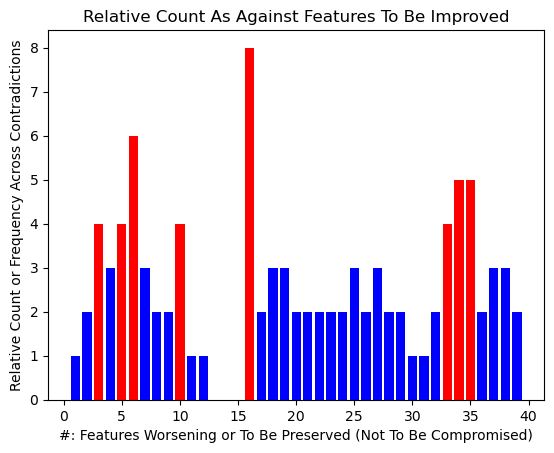
3: Length of the moving object: [’35: Adaptability’, ’38: Level of automation’]
5: Area of the moving object: [’17:Temperature’, ’33: Convenience of use’]
6: Area of the non-moving object: [’24: Information loss’, ’32: Convenience of manufacturing’, ’33: Convenience of use’, ’34: Convenience of repair’, ’35: Adaptability’]
7: Volume of the moving object: [’22: Energy loss’, ’29: Accuracy of manufacturing’, ’38: Level of automation’]
8: Volume of the non-moving object: [’25: Time loss’, ’27: Reliability’]
9: Speed: [’37: Complexity of control and measurement’]
10: Force: [’20: Energy consumption of the non-moving object’]
11: Tension, Pressure: [‘4: Length of the non-moving object’, ’32: Convenience of manufacturing’]
12: Shape: [’27: Reliability’, ’36: Complexity of the structure’]
13: Stability of the object: [’10: Force’, ’18: Brightness, Visibility’, ’34: Convenience of repair’]
14: Strength: [’28: Accuracy of measurement’]
15: Action time of the moving object: [’10: Force’, ’29: Accuracy of manufacturing’, ’31: Harmful internal factors’]
16: Action time of the non-moving object: [‘2: Mass of the non-moving object’, ’21: Power’, ’23: Material loss’, ’25: Time loss’, ’39: Productivity’]
17:Temperature: [’18: Brightness, Visibility’, ’34: Convenience of repair’, ’36: Complexity of the structure’, ’38: Level of automation’]
18: Brightness, Visibility: [‘3: Length of the moving object’, ’22: Energy loss’, ’34: Convenience of repair’, ’39: Productivity’]
19: Energy consumption of the moving object: [’10: Force’, ’26: Amount of substance’, ’35: Adaptability’]
20: Energy consumption of the non-moving object: [’37: Complexity of control and measurement’]
21: Power: [’16: Action time of the non-moving object’, ’18: Brightness, Visibility’, ’19: Energy consumption of the moving object’, ’37: Complexity of control and measurement’]
22: Energy loss: [‘9: Speed’]
23: Material loss: [’16: Action time of the non-moving object’, ’28: Accuracy of measurement’]
24: Information loss: [‘6: Area of the non-moving object’]
25: Time loss: [‘5: Area of the moving object’, ‘8: Volume of the non-moving object’, ’16: Action time of the non-moving object’, ’26: Amount of substance’]
26: Amount of substance: [’19: Energy consumption of the moving object’, ’25: Time loss’]
27: Reliability: [‘5: Area of the moving object’, ’12: Shape’]
28: Accuracy of measurement: [‘3: Length of the moving object’, ‘4: Length of the non-moving object’, ’23: Material loss’]
31: Harmful internal factors: [‘3: Length of the moving object’, ’16: Action time of the non-moving object’]
32: Convenience of manufacturing: [‘1: Mass of the moving object’, ‘6: Area of the non-moving object’, ’16: Action time of the non-moving object’, ’24: Information loss’, ’33: Convenience of use’]
33: Convenience of use: [‘5: Area of the moving object’, ‘6: Area of the non-moving object’, ‘7: Volume of the moving object’, ’16: Action time of the non-moving object’, ’35: Adaptability’]
34: Convenience of repair: [‘6: Area of the non-moving object’, ’19: Energy consumption of the moving object’, ’27: Reliability’, ’30: Harmful external factors’, ’35: Adaptability’]
35: Adaptability: [‘2: Mass of the non-moving object’, ‘4: Length of the non-moving object’, ‘6: Area of the non-moving object’, ’11: Tension, Pressure’, ’16: Action time of the non-moving object’, ’33: Convenience of use’, ’34: Convenience of repair’]
36: Complexity of the structure: [‘5: Area of the moving object’, ‘8: Volume of the non-moving object’, ’10: Force’]
37: Complexity of control and measurement: [‘3: Length of the moving object’, ‘6: Area of the non-moving object’, ‘7: Volume of the moving object’, ‘9: Speed’, ’17:Temperature’, ’20: Energy consumption of the non-moving object’, ’21: Power’]
38: Level of automation: [‘7: Volume of the moving object’]
39: Productivity: [’16: Action time of the non-moving object’]
3/35 3/38 5/17 5/33 6/24 6/32 6/33 6/34 6/35 7/22 7/29 7/38 8/25 8/27 9/37 10/20 11/4 11/32 12/27 12/36 13/10 13/18 13/34 14/28 15/10 15/29 15/31 16/2 16/21 16/23 16/25 16/39 17/18 17/34 17/36 17/38 18/3 18/22 18/34 18/39 19/10 19/26 19/35 20/37 21/16 21/18 21/19 21/37 22/9 23/16 23/28 24/6 25/5 25/8 25/16 25/26 26/19 26/25 27/5 27/12 28/3 28/4 28/23 31/3 31/16 32/1 32/6 32/16 32/24 32/33 33/5 33/6 33/7 33/16 33/35 34/6 34/19 34/27 34/30 34/35 35/2 35/4 35/6 35/11 35/16 35/33 35/34 36/5 36/8 36/10 37/3 37/6 37/7 37/9 37/17 37/20 37/21 38/7 39/16
Example: The concept of energy conservation in space travel involves intentionally adjusting the use of energy to achieve specific mission objectives while minimizing constant energy expenditure. It is an application of principle where actions are strategically modulated to address the unique challenges of space exploration. The concept of energy conservation or loss involves strategic maneuvers and actions to optimize the use of fuel. This approach is often employed to achieve longer mission durations, conserve fuel, by modulatin the speed intentionally.
Contradiction (22/9): Manage to cover longer duration or distance (9) by conserving or consuming less fuel or energy resources (22)
Solution: Putting spacecraft or certain systems in a low-energy state during non-critical mission phases. Spacecraft can enter hibernation or low-energy states during long interplanetary journeys or periods of inactivity. This partial action conserves energy and resources, enabling the spacecraft to allocate power to essential systems when needed. Spacecraft may execute propulsion maneuvers at specific points in their orbits to maximize the efficiency of trajectory changes. This partial action minimizes constant energy consumption and strategically uses energy when it offers the most significant benefits. Spacecraft can reduce the frequency or intensity of communication with Earth during non-critical mission phases, conserving power for essential functions. This partial action optimizes the use of onboard energy resources.