


14: SPHEROIDALITY (CURVATURE, Curve, Curvilinear): (A) Replace linear parts and edges with curvilinear parts, flat surfaces with spherical or curved surfaces, and cube (parallelepiped) shapes with ball shapes (B) Use rollers, balls, domes, arches, spirals or in general spherical objects (C) Replace linear or ‘back and forth’ motion with rotational motion (or vice-a-versa) i.e. introduce or utilize centrifugal force.
EXAMPLE: Push/Pull versus Rotary Control Switches, Paper Sheets versus Running Rolls, Ball Point Pens (smooth ink distribution), Arches & Domes Structures in Architectures, Spiral Gear, Screw versus Nail, Threaded Cap versus Push-In Stopper, Wheels, Ferris Wheel, Pulley System, Bicycle Pedaling, Mixer, Grinder, Washing Machine Dryer, Computer Mouse Ball, Cloth Spinning, Spherical Casters instead of Cylindral wheels etc
SYNONYMS: CURVATURE, Curve, Curvilinear, Centrifugal, Straight lines become curves
ACB:
The Spheroidality Principle emphasizes the transformation of objects or systems into a more spherical or ellipsoidal shape. This principle is often applied to improve the efficiency, strength, or other characteristics of an object or system. Transform objects or systems to a more spherical or ellipsoidal shape to enhance their performance, strength, or other desired characteristics. Irregular or complex shapes may lead to inefficiencies in various processes. Transforming objects into more spherical or ellipsoidal shapes can reduce resistance, streamline flow, and improve efficiency in activities such as fluid dynamics or transportation. Objects with irregular shapes may have weak points or stress concentrations. Spherical or ellipsoidal shapes distribute stress more uniformly, enhancing strength and durability. This principle is often employed in designing pressure vessels, containers, or structural elements. Irregular shapes may impede effective heat dissipation. Spherical shapes offer better heat dissipation characteristics, making them suitable for applications where efficient cooling is essential.
Objects with non-streamlined shapes may experience increased air or fluid resistance. In transportation or aerodynamics, adopting more spherical or streamlined shapes reduces drag and improves fuel efficiency. Irregular shapes may lead to uneven wear on surfaces. Spherical shapes can exhibit more uniform wear patterns, contributing to increased longevity and reliability in rotating or moving parts. Irregular shapes may result in inefficient use of space. Spherical or ellipsoidal objects can maximize the use of available space, making them suitable for storage or packaging. The Spheroidality Principle underscores the advantages of adopting more rounded or ellipsoidal forms in various engineering and design applications. By doing so, it aims to resolve contradictions related to efficiency, strength, heat dissipation, resistance, wear, and space utilization.
The application of the spheroidality principle often involves optimizing shapes for specific purposes, considering factors such as aerodynamics, stress distribution, and overall performance. The principle of spheroidality involves transforming objects or structures into a more spherical or ellipsoidal shape. This can be applied to various fields to improve certain characteristics or address specific contradictions. Designing ball bearings or roller bearings with spherical elements reduces friction and allows smoother rotational motion. Utilizing spherical or ellipsoidal fuel tanks can minimize sloshing and provide better stability.Designing safety barriers with a more rounded, spheroidal shape helps dissipate energy and reduce the severity of collisions.
Designing projectiles with a more streamlined, spheroidal shape improves aerodynamics and accuracy. Modeling joints with more spherical or ellipsoidal structures allows for increased range of motion and improved flexibility. Using spherical or ellipsoidal tank designs helps distribute stress more evenly and provides better structural integrity. Traditional car designs may face air resistance and reduced fuel efficiency. Designing concept cars with more aerodynamic, spheroidal shapes improves fuel efficiency and reduces drag.
Opposite of prior action could also be at times about introducing non-linearity or spheroidality in the process outcome too. JIT stands for “Just-In-Time,” and it is a manufacturing or production strategy where items are produced or delivered precisely when they are needed in the production process (introduces non-linearity inventory related cost structures) , reducing the need for inventory and associated costs. This principle suggests moving from a linear, rectilinear, or flat form to a curved or spheroidal form. In the context of JIT, the idea is to optimize the flow and timing of materials, minimizing delays and eliminating excess inventory. The flow becomes smoother and more dynamic, akin to the streamlined efficiency associated with spheroidality or curvature. Applying this principle to JIT manufacturing can involve designing production processes, material flows, and supply chains in a way that reduces unnecessary steps, delays, and excess inventory, aligning with the streamlined efficiency suggested by the spheroidality principle. Hence wherever the relationship between input or feature or design variables/parameter with the target variable or outcome is better to be defined as non-linear for optimal outcomes, it makes sense to allow such a non-linearity in the design of the system as well.
The Principle of Curvature in suggests that any action or parameter change is most effective when it follows a curved trajectory rather than a linear one. This principle is directly opposite to forcing linear regression in statistical modeling upon a system which in reality is a non-linear system in terms of its behviour. This principle is associated with the concept that real-world relationships and phenomena often exhibit non-linear behavior. In linear regression, the goal is to model the relationship between a dependent variable and one or more independent variables by fitting a linear equation to the observed data. The linear nature implies a straight-line relationship, and linear regression is effective when the relationship is approximately linear. On the other hand, the Principle of Curvature emphasizes the idea that changes or actions are often more effective when they follow a curved path. This concept is more aligned with non-linear relationships and dynamic, complex systems. Machine learning models that capture non-linear relationships and complex patterns may be more relevant to the Principle of Curvature. Support Vector Machines (SVM), Decision Trees, Random Forests, and Neural Networks are examples of machine learning techniques capable of capturing non-linear patterns in data. Linear regression focuses on linear relationships, while this principle of curvature suggests that non-linear approaches may be more effective in certain situations. Machine learning techniques capable of handling non-linear patterns align more closely with the idea behind this principle of curvature or spheroidality (multiple dimensions).
In the case of the incandescent lamp filament, coiling increases the surface area of the filament exposed to the gas inside the bulb, enhancing the efficiency of light production. The increased surface area allows for better heat dissipation and radiation, resulting in improved performance compared to a straight filament. Therefore, the application of the “Curvature” principle is evident in the decision to coil the filament, contributing to the overall efficiency of the incandescent lamp. The examples you provided highlight the application of the TRIZ principle known as “Transition to a Micro-Level” (Principle 15). This principle suggests that during the evolutionary process of a technical system, there is a transition from rigid structures to more flexible or micro-level structures. The development of rolls of film allowed for a more compact and portable form of photography. The transition from large, rigid photographic plates to flexible film rolls also represents a shift to a more micro-level, flexible structure. The transition from saw-like, reciprocating edges to rotating blades in mowing machines represents a shift to a more flexible and efficient micro-level structure, enhancing the functionality of the machines. The adoption of a more spheroidal and micro-level structures contribute to the improvements in portability and efficiency of the design.
The PDCA (Plan-Do-Check-Act) cycle, also known as the Deming Cycle or Shewhart Cycle, is a continuous improvement framework used for managing and optimizing processes. It was developed by Walter A. Shewhart, an American physicist and statistician, in the 1920s, and later popularized by W. Edwards Deming, a renowned statistician and quality management guru. The PDCA cycle consists of four key stages: Plan: Define the problem, set goals, and plan the improvement. Identify the problem, gather data, analyze the situation, and develop a plan for improvement. Do: Implement the plan. Execute the planned changes on a small scale, often in a controlled environment, to test their effectiveness. Check: Assess the results and compare them against the expected outcomes. Measure and monitor the results of the implemented changes, analyze data, and evaluate if the objectives were met. Act: Decide on the next steps based on the evaluation of results. If successful, standardize the changes and integrate them into regular processes. If unsuccessful, adjust the plan and repeat the cycle.
The PDCA cycle is a fundamental concept in quality management and continuous improvement. It provides a systematic and iterative approach to problem-solving and process optimization. The cyclic nature of the PDCA cycle reflects the idea that improvement is an ongoing and dynamic process. As one cycle completes, another begins, allowing organizations to continuously refine and enhance their processes. Processes that are cyclic in nature, involving repeated iterations or improvement cycles, are well-suited for the PDCA approach. This includes various business processes, production processes, service delivery, and quality management systems. The PDCA cycle is widely used in industries such as manufacturing, healthcare, information technology, and more, where continuous improvement is essential for achieving and maintaining high-quality standards.
1: Mass of the moving object: [’12: Shape’]
2: Mass of the non-moving object: [‘8: Volume of the non-moving object’, ’12: Shape’]
3: Length of the moving object: [’27: Reliability’, ’35: Adaptability’, ’39: Productivity’]
4: Length of the non-moving object: [‘8: Volume of the non-moving object’, ’11: Tension, Pressure’, ’12: Shape’, ’14: Strength’, ’25: Time loss’, ’39: Productivity’]
5: Area of the moving object: [‘3: Length of the moving object’, ‘7: Volume of the moving object’, ’14: Strength’, ’36: Complexity of the structure’, ’38: Level of automation’]
6: Area of the non-moving object: [‘2: Mass of the non-moving object’, ’23: Material loss’]
7: Volume of the moving object: [’14: Strength’, ’27: Reliability’]
8: Volume of the non-moving object: [‘2: Mass of the non-moving object’, ‘3: Length of the moving object’, ‘4: Length of the non-moving object’, ’14: Strength’]
9: Speed: [‘3: Length of the moving object’, ’14: Strength’, ’22: Energy loss’]
10: Force: [’14: Strength’, ’22: Energy loss’, ’26: Amount of substance’]
11: Tension, Pressure: [‘4: Length of the non-moving object’, ’19: Energy consumption of the moving object’, ’21: Power’, ’26: Amount of substance’, ’39: Productivity’]
12: Shape: [‘4: Length of the non-moving object’, ‘7: Volume of the moving object’, ’11: Tension, Pressure’, ’14: Strength’, ’15: Action time of the moving object’, ’17:Temperature’, ’19: Energy consumption of the moving object’, ’22: Energy loss’, ’25: Time loss’]
13: Stability of the object: [’22: Energy loss’, ’23: Material loss’]
14: Strength: [‘4: Length of the non-moving object’, ‘7: Volume of the moving object’, ‘8: Volume of the non-moving object’, ‘9: Speed’, ’10: Force’, ’39: Productivity’]
15: Action time of the moving object: [’12: Shape’, ’39: Productivity’]
17:Temperature: [’12: Shape’, ’21: Power’]
19: Energy consumption of the moving object: [’11: Tension, Pressure’, ’17:Temperature’]
21: Power: [’12: Shape’, ’17:Temperature’]
22: Energy loss: [’13: Stability of the object’]
23: Material loss: [‘3: Length of the moving object’, ’10: Force’, ’13: Stability of the object’]
25: Time loss: [‘4: Length of the non-moving object’]
26: Amount of substance: [‘3: Length of the moving object’, ‘5: Area of the moving object’, ’10: Force’, ’11: Tension, Pressure’, ’12: Shape’, ’14: Strength’]
27: Reliability: [‘3: Length of the moving object’, ‘5: Area of the moving object’, ‘7: Volume of the moving object’]
35: Adaptability: [‘9: Speed’, ’13: Stability of the object’]
36: Complexity of the structure: [‘5: Area of the moving object’]
38: Level of automation: [‘3: Length of the moving object’, ‘5: Area of the moving object’]
39: Productivity: [‘4: Length of the non-moving object’, ’11: Tension, Pressure’, ’12: Shape’]
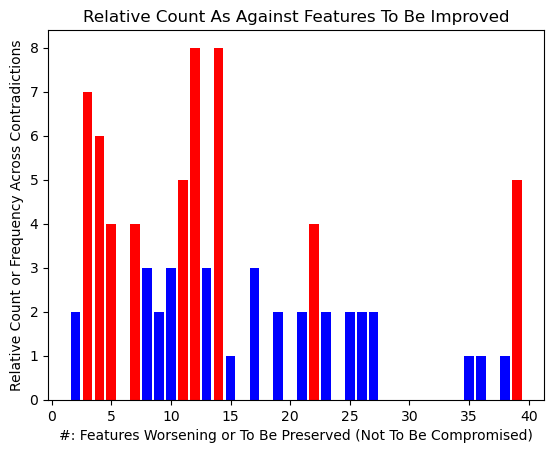
1/12 2/8 2/12 3/27 3/35 3/39 4/8 4/11 4/12 4/14 4/25 4/39 5/3 5/7 5/14 5/36 5/38 6/2 6/23 7/14 7/27 8/2 8/3 8/4 8/14 9/3 9/14 9/22 10/14 10/22 10/26 11/4 11/19 11/21 11/26 11/39 12/4 12/7 12/11 12/14 12/15 12/17 12/19 12/22 12/25 13/22 13/23 14/4 14/7 14/8 14/9 14/10 14/39 15/12 15/39 17/12 17/21 19/11 19/17 21/12 21/17 22/13 23/3 23/10 23/13 25/4 26/3 26/5 26/10 26/11 26/12 26/14 27/3 27/5 27/7 35/9 35/13 36/5 38/3 38/5 39/4 39/11 39/12
EXAMPLE: Washing machine with circular motions. Bidirectional motors in washing machines operate by rotating in both clockwise and counterclockwise directions. This bidirectional movement offers several advantages in terms of washing efficiency and time reduction: The bidirectional motor allows the agitator or drum to move back and forth, creating a scrubbing action. This motion helps dislodge dirt and stains from clothes more effectively than a unidirectional motion. When properly designed and engineered, bidirectional motors do not necessarily reduce the lifespan of the washing machine. In fact, the improved efficiency and reduced wear on clothes may contribute to an overall longer life for the machine.
Contradictions (15/39): Enables effective cleaning (15) by reaching all parts of the clothes, providing a thorough wash. The bidirectional motion addresses the contradiction of one-directional motion potentially missing some areas (39).
Solution: Washing machines use an agitator or drum that moves in circular motions, both clockwise and anticlockwise, to agitate clothes. This ovement helps in dislodging dirt and stains. Clothes are lifted and dropped during the washing process, ensuring better penetration of water and detergent into the fabric fibers. Bidirectional motion provides a more dynamic washing action, which is particularly effective in tackling stubborn stains. The back-and-forth movement helps to agitate the clothes, increasing the likelihood of stain removal. The bidirectional motion, along with advances in washing machine technology, allows for shorter wash cycles. The efficient cleaning action means that clothes can be effectively cleaned in less time compared to traditional unidirectional washing machines. Bidirectional washing can be gentler on fabrics compared to aggressive unidirectional agitation. The back-and-forth movement is designed to reduce wear and tear on clothes while maintaining effective cleaning. Bidirectional motors contribute to better load distribution within the drum. This helps prevent an imbalance during the spin cycle, reducing vibrations and noise during operation.