


4: ASYMMETRY (Imbalance creates strength): (A) Change or replace symmetrical form (s) with asymmetrical form (s), (B) Vary the degree of asymmetry, if an object (or system) is already asymmetrical, change an object’s (or system’s) or property or form to suit the asymmetry in the external environment
EXAMPLE: Electric furnace with asymmetrically placed electrodes, Encryption System, Key- Lock, Contact Lens or Multi-Focal Lens Spectacles, Bulb- Socket (Threads), Ergonomic Seat (Back-Support) or Pillow or Mouse, Dust Filters, Asymmetrical Cement Mixing Vessel.
SYNONYMS: Wab-Sabi, Ergonomics, Proportionality, Alignment
ACB:
The “Asymmetry” principle focuses on deliberately introducing or utilizing asymmetry in various dimensions—such as time, outcome, throughput, form, and alignment with external environments—to achieve specific goals, solve problems, or generate innovative solutions. Asymmetry involves intentionally breaking away from symmetrical patterns or configurations to achieve desired outcomes. Creating asymmetry in the outcome or throughput dimension by generating greater benefits, results, or value with fewer resources, inputs, or efforts. This principle emphasizes the efficiency gained through asymmetrical relationships between inputs and outputs. It advocates embracing deliberate imbalances, non-uniformities, or variations in different dimensions to achieve desired outcomes, drive innovation, and overcome challenges.
For instance, in the design of aircraft and vehicles, asymmetrical shapes are sometimes used to optimize aerodynamics and improve fuel efficiency. Asymmetry can be introduced in the structure of buildings or bridges to enhance stability and address specific load-bearing requirements. Asymmetry is sometimes used in the design of consumer products to enhance aesthetics, ergonomics, or functionality. Asymmetrical designs can lead to improved efficiency in various systems, such as fluid dynamics, where asymmetrical shapes may reduce drag.
Asymmetrical designs allow for customization to meet specific individual needs while maintaining a degree of uniformity in overall function. This is evident in customized medical implants or prosthetics. Asymmetry allows for complexity in certain regions of a system while maintaining simplicity in others. This is applied in designs where specific areas require intricate features while the overall system remains straightforward. Asymmetrical materials or structures can provide resistance to external forces in one direction while allowing flexibility or deformation in another direction. This is applied in impact-resistant materials. Asymmetry in tools or instruments allows for precision in specific tasks while maintaining adaptability for a range of applications. Surgical instruments with asymmetrical features are an example. Asymmetrical designs in clothing or equipment for varying environmental conditions. For instance, asymmetrical ventilation or insulation in sportswear to adapt to different weather conditions.
Traditional computer mouse often feature an asymmetrical design, where the shape is contoured to better fit the right hand, providing a comfortable and ergonomic grip. This asymmetry is intentional to accommodate the natural contours of the hand. The need for a comfortable and ergonomic grip vs. the symmetrical design of traditional objects. Asymmetry addresses this contradiction by tailoring the shape to the natural contours of the hand, enhancing comfort during prolonged use. The asymmetrical shape aligns with the natural position of the hand, reducing strain and discomfort during extended usage. Users experience a more natural and comfortable grip, leading to improved usability and reduced fatigue. The contoured design enhances precision and control, as the mouse fits more naturally into the user’s hand.
In the case of mouse design, asymmetry is applied to better match the hand’s anatomy and improve user experience. Traditional symmetrical designs may sacrifice comfort for the sake of symmetry. Asymmetry resolves this by prioritizing user comfort over strict symmetry. Asymmetrical designs challenge conventional shapes but enhance usability by better accommodating the user’s hand.Asymmetry in mouse design exemplifies user-centric design principles, prioritizing the user’s comfort and natural hand movements over rigid symmetrical aesthetics. Over time, mouse designs have evolved to consider the asymmetry principle, with variations that cater to both left-handed and right-handed users. The intentional introduction of asymmetry in mouse design enhances ergonomics, usability, and user satisfaction.
Introducing asymmetry in product design can lead to cost-effective solutions that maintain or even enhance quality. For instance, using different materials or components strategically in different parts of the product can achieve the desired quality outcome while minimizing costs. Achieving high levels of customization can be resource-intensive. Asymmetry can be used to tailor specific features or components while keeping the core design standardized, striking a balance between customization and efficiency. Let us take a simple example: The asymmetrical placement of teeth on a hair comb is often designed to follow the contours of the head. This ergonomic design allows for a more comfortable and effective combing experience. The varied lengths and spacing of teeth on an asymmetrical comb cater to different hair types and styling needs. For example, some sections of the comb may have wider gaps for detangling, while others may have closer teeth for finer styling. Asymmetry allows the comb to adapt to the natural patterns and growth of hair. It can easily navigate through the hair without causing discomfort or breakage. The asymmetrical design may also contribute to a more secure grip during use, allowing the user to have better control while styling or detangling.
In engineering, there’s often a trade-off between strength and weight. By using asymmetrical designs that distribute material or stress strategically, solutions can be created that balance these conflicting requirements. Achieving high thermal efficiency can sometimes lead to complex designs. Asymmetry can help by focusing thermal management mechanisms on specific critical areas, reducing overall complexity while maintaining efficiency. Designing components with multiple functions can lead to interference issues. Asymmetry can help by adapting the shape or structure of components to ensure compatibility and smooth interaction.
The Asymmetry principle encourages creative thinking to break away from symmetrical approaches and harness the power of intentional imbalances to solve complex problems and address contradictions:
(1) The shape of airplane wings is asymmetrical. This design enhances aerodynamics and lift, addressing the contradiction between stability and maneuverability. Symmetrical airfoils are indeed known for their balance and suitability for applications where lift generation at zero angles of attack is important, such as inverted flight or aerobatics. On the other hand, non-symmetrical or cambered airfoils are designed to generate lift even at zero angles of attack due to the varying camber between their upper and lower surfaces. This characteristic makes them well-suited for conventional flight and applications like commercial aviation. (2) Musical instruments often employ asymmetrical designs to achieve desired acoustic properties. For example, the curves and openings of wind instruments are asymmetrical to optimize sound resonance.
(3) Asymmetrical data transmission protocols, such as ADSL, prioritize download speed over upload speed, addressing the contradiction between the need for fast downloads and the lower demand for uploads. (4)In sports equipment design, asymmetry is used to optimize performance. For example, asymmetrical patterns on the soles of athletic shoes can provide better grip and stability. (5) Asymmetrical antenna structures are used to achieve directional radiation patterns for better signal reception in specific directions, addressing the contradiction between signal strength and directionality. (6) Asymmetrical layouts in user interfaces can lead to more efficient interactions by grouping commonly used features together while keeping less frequently used elements separate.
In healthcare, the application of the asymmetry principle is evident in various contexts where intentional imbalances or non-uniform designs are employed to enhance performance, address specific needs, or optimize treatment. Surgical instruments may feature asymmetrical designs to improve precision and functionality. For example, asymmetrically shaped forceps or scissors can facilitate better access to specific anatomical structures during surgeries. Implants, such as hip prosthetics or knee replacements, may incorporate asymmetry to better mimic natural joint movement. This design approach can improve biomechanical compatibility and patient outcomes. Hearing aids often have asymmetrical shapes to accommodate the unique contours of the ear. Customized asymmetrical fittings can enhance comfort and optimize the device’s performance for individual users. Dental braces and orthodontic appliances may use asymmetry to apply targeted forces to teeth, addressing specific misalignments or malocclusions. Artificial limbs and orthotic devices may employ asymmetry to replicate the natural movements of joints more effectively. Customized designs can enhance mobility and comfort for individuals with limb differences. The application of the asymmetry principle in healthcare underscores the importance of tailored and innovative solutions that consider the unique requirements of patients, medical procedures, and devices.
Wabi-sabi is a Japanese aesthetic and philosophical concept that celebrates the beauty of imperfection, impermanence, and the acceptance of the natural cycle of growth and decay. It is a worldview that finds beauty in the transient, imperfect, and incomplete nature of life. The term is derived from two concepts: Wabi (侘): It conveys simplicity, humility, and living in tune with nature. Wabi reflects the beauty found in the rustic, unrefined, and modest aspects of life. Sabi (寂): It refers to the passage of time, the wear and tear of existence, and the patina that develops on objects with age. Sabi embraces the beauty that comes with weathering and the subtle signs of decay. Together, wabi-sabi emphasizes finding beauty in the asymmetrical, the irregular, and the unpretentious. It encourages an appreciation for the transient nature of things and an understanding that perfection is not static but rather found in the evolving and impermanent aspects of life.
In various forms of art, design, and lifestyle, wabi-sabi may be expressed through: Embracing simplicity (imperfections including partial or execussion action), asymmetry, and natural materials in paintings, pottery, or other forms of art. Incorporating weathered or imperfect materials and designs that blend with the natural surroundings. Appreciating the beauty of simple, unadorned food and the transient nature of seasonal ingredients. Embracing the acceptance of life’s imperfections, the transience of beauty, and the wisdom that comes with aging. It encourages people to find joy in the present moment, appreciate the beauty of the imperfect, and recognize the value of simplicity and humility in all aspects of life.
The use of progressive income tax slabs, where individuals with higher incomes pay a higher percentage of their income in taxes, is a deliberate choice made by many countries for several reasons. While it may seem disproportionate on the surface, the progressive tax system aligns with certain principles, including aspects of asymmetry. It is to balance the distribution of wealth and addressing income inequality. A progressive tax system helps redistribute wealth by imposing higher tax rates on those with higher incomes. This is an asymmetrical approach that aims to bridge the wealth gap and promote social and economic equity. It is to balance the tax burden based on individuals’ ability to pay. The progressive tax system recognizes that individuals with higher incomes have a greater capacity to contribute more to public services and government functions. It asymmetrically considers the ability to pay as a factor in determining tax rates. Progressive taxation provides a more substantial revenue source for funding government services, infrastructure, and social welfare programs. By taxing higher incomes at higher rates, it addresses the asymmetry in financial contributions to the collective well-being. The asymmetry in tax rates reflects a commitment to social justice, where those who benefit more from economic opportunities contribute a larger share to support society.
Ergonomics, also known as human factors engineering, is the scientific discipline that focuses on designing and arranging products, systems, and environments to fit the capabilities and limitations of the people who use them. The goal of ergonomics is to enhance human well-being and overall system performance by improving the interaction between people and the elements of a system. Physical Ergonomics is concerned with the design of physical tasks, tools, equipment, and workspaces to minimize physical strain and discomfort. This includes considerations for posture, movement, force exertion, and repetitive tasks. Cognitive Ergonomics focuses on mental processes such as perception, memory, decision-making, and attention. It aims to optimize the design of interfaces, displays, and information systems to enhance cognitive performance and reduce mental workload. Organizational Ergonomics deals with the optimization of social and organizational factors in the workplace. This includes the design of work schedules, teamwork, communication, and job rotation to improve overall efficiency and job satisfaction.
Examples of ergonomic design principles include: Adjustable Furniture like chairs, desks, and computer workstations that can be adjusted to accommodate different body sizes and preferences. Ergonomic Tools such as tools with handles designed to reduce hand fatigue and minimize the risk of musculoskeletal disorders. User-Friendly Interfaces designed for ease of use, reducing cognitive load and improving user experience. Proper Lighting arrangements that minimize glare and eye strain, promoting a comfortable and productive work environment. Safety Considerations in the design that prioritize safety, reducing the risk of accidents and injuries.
One common technical ergonomic challenge is related to the design of computer keyboards and the occurrence of musculoskeletal disorders, particularly in the hands and wrists. Users who spend extended periods typing on keyboards may experience discomfort or pain due to poor keyboard design. Users often complain of discomfort, fatigue, or even pain in the hands and wrists after extended typing sessions. This can lead to conditions such as carpal tunnel syndrome or repetitive strain injuries.
Poor keyboard design does not consider the natural alignment of the hands and wrists or uses excessive force for key presses or lack of support for the wrists during typing. Ergonomic keyboards often have a split or curved design, allowing users to position their hands in a more natural and comfortable way. This helps in reducing strain on the wrists and shoulders. The keyboard is designed with a negative tilt, where the front edge is lower than the back edge. This promotes a more neutral wrist position and reduces the risk of wrist strain. Keyboards with mechanical key switches require less force for key presses compared to traditional rubber dome switches. This can reduce the amount of force exerted by the fingers, minimizing fatigue. Some ergonomic keyboards come with integrated or detachable wrist rests to provide support and reduce pressure on the wrists during typing. Keyboards that allow users to customize key layouts or programmable keys can help users adapt the keyboard to their specific needs, reducing unnecessary movements. Including a touchpad or an integrated pointing device can reduce the need for users to reach for an external mouse, minimizing arm movements and strain.
In some vehicles, the front and rear wheels may have different recommended air pressures based on the manufacturer’s specifications. This practice is not universal and depends on the vehicle’s design, purpose, and engineering considerations. There are a few reasons why front and rear wheels might have different recommended air pressures: (i) Cars are designed with a particular weight distribution between the front and rear axles. The weight distribution can vary based on factors like the engine placement (front-wheel drive, rear-wheel drive, or all-wheel drive), the design of the vehicle, and the intended purpose (e.g., sports cars, trucks, or sedans). Different weight distributions may lead to different optimal air pressures for the front and rear tires. (ii) ire pressure affects a vehicle’s handling and performance. Manufacturers may specify different pressures for the front and rear tires to optimize handling characteristics, traction, and overall performance. This is particularly important in performance-oriented or specialized vehicles. (iii) The recommended tire pressure can also influence ride comfort. Adjusting the pressure in the front and rear tires differently can contribute to a smoother or firmer ride, depending on the vehicle’s design and intended purpose. (iv) Some vehicles have a higher load-bearing capacity in the rear, especially in trucks or SUVs designed for heavy loads. In such cases, the rear tires may need to be inflated to a higher pressure to support the additional weight. It’s crucial to follow the manufacturer’s recommendations for tire pressures specified in the owner’s manual or on the vehicle’s tire placard. Using the recommended tire pressures helps ensure optimal performance, safety, and fuel efficiency.
The “Rhyme-as-Reason” effect, also known as the “Rhyme-Reason effect,” is a cognitive bias in which statements that rhyme are perceived as more truthful or accurate than those that do not rhyme, regardless of their actual validity. This effect highlights the influence of linguistic fluency and the aesthetic appeal of rhymes on people’s judgments and perceptions. Key characteristics of the Rhyme-as-Reason effect include: Fluency and Memorability: Rhymes are often easier to process and remember due to their rhythmic and repetitive nature. As a result, statements that rhyme may be more readily accepted and retained in memory compared to non-rhyming statements. Perceived Coherence: Rhyming statements may be perceived as more coherent or meaningful because of their linguistic symmetry and aesthetic appeal. This perception of coherence can lead individuals to assign greater credibility to rhyming statements, even if their content is nonsensical or unsupported. Affect and Persuasion: The Rhyme-as-Reason effect can influence persuasion and communication by enhancing the persuasiveness of rhyming messages. Advertisers, politicians, and public speakers may exploit this effect by using rhymes to make their messages more memorable and compelling. Influence on Decision-Making: Rhyming statements may influence decision-making processes by biasing individuals’ judgments and preferences. People may be more likely to believe or endorse statements that rhyme, leading to biased decision-making outcomes. While the Rhyme-as-Reason effect can enhance the appeal and persuasiveness of rhyming messages, it is important for individuals to critically evaluate the content and validity of such statements rather than relying solely on their linguistic form. By recognizing the influence of this cognitive bias, individuals can make more informed decisions and avoid being unduly swayed by the mere presence of rhymes in communication.
The Weber-Fechner law, formulated by the German physiologist Ernst Heinrich Weber and later refined by the German psychologist Gustav Fechner in the 19th century, describes the relationship between the physical intensity of a stimulus and the perceived intensity or magnitude of sensation resulting from that stimulus. The law states that the magnitude of a sensory experience is proportional to the logarithm of the intensity of the stimulus. In simpler terms, it means that the perception of a stimulus does not increase in direct proportion to the increase in the physical intensity of the stimulus, but rather increases logarithmically. Mathematically, the Weber-Fechner law can be expressed as:
ΔI / I = k Where: ΔI represents the change in intensity of the stimulus, I represents the initial intensity of the stimulus, k is a constant.
This law has been observed in various sensory modalities, including vision, hearing, and touch. For example, consider the perception of brightness of light. If you are in a dimly lit room and the light intensity doubles, you might perceive the brightness as increasing significantly. However, if you are in a brightly lit room and the light intensity doubles again, you might not perceive the same magnitude of change in brightness. The Weber-Fechner law provides important insights into how humans perceive and interpret sensory information, and it has applications in fields such as psychology, neuroscience, and marketing.
The Weber-Fechner law can be relevant in the design of systems and interfaces where sensory perception plays a role. While it may not directly address cognitive biases, understanding the law can help designers create more effective systems that take into account how users perceive and respond to stimuli. Here are a few ways it can be applied: User Interfaces: In user interface design, the law can inform decisions about how to represent information such as volume controls, brightness settings, or temperature adjustments. Designers can use the law to ensure that changes in stimulus intensity (e.g., volume level) are perceived as proportionate by users. Feedback Systems: When designing feedback mechanisms in systems, such as notifications or alerts, designers can consider the principles of the Weber-Fechner law to ensure that users perceive changes in stimuli accurately and consistently. Product Packaging and Branding: Understanding the law can be useful in product packaging and branding design. For instance, designers can use it to determine the optimal contrast or color combinations to make key information stand out and be perceived more effectively by consumers. Gamification and Reward Systems: In gamified systems or applications that use reward mechanisms, designers can apply the principles of the law to ensure that users perceive the rewards or feedback accurately and find them motivating. Accessibility: Applying the law can also be beneficial in designing interfaces and systems to be accessible to users with sensory impairments. Designers can adjust the presentation of information to accommodate variations in perception and ensure equitable user experiences. While the Weber-Fechner law may not directly address cognitive biases, its application in system design can contribute to reducing potential biases by ensuring that users perceive stimuli accurately and consistently, leading to more effective interactions and decision-making processes.
Distinction bias is a cognitive bias that occurs when individuals focus too much on the differences between options, leading them to perceive options as more different than they actually are. This bias can influence decision-making processes by causing people to overemphasize minor distinctions between choices, leading to suboptimal decisions. Here’s how distinction bias might manifest in various scenarios: Consumer Choices: When comparing products or services, individuals may place excessive importance on minor differences in features or attributes, even if these differences have little practical significance. For example, someone might choose an expensive brand of clothing over a more affordable one because of minor differences in design or branding, even though both options provide similar functionality. Investment Decisions: Investors may fall prey to distinction bias when evaluating different financial assets. They might focus too much on minor differences in returns or risk profiles between investment options, overlooking broader market trends or fundamental factors that could impact their portfolio’s performance. Policy Decisions: Decision-makers in government or organizations might prioritize policies or initiatives that appear distinct from existing approaches, even if these new options offer marginal improvements over existing ones. This can lead to inefficient resource allocation or missed opportunities for innovation.
Interpersonal Relationships: In social interactions, individuals may perceive people as more dissimilar than they actually are based on minor differences in appearance, behavior, or background. This can contribute to stereotypes, prejudice, or misunderstandings in relationships. To mitigate the effects of distinction bias, individuals can: Focus on the broader context and consider the overall value or impact of options rather than getting caught up in minor differences. Use decision-making frameworks that emphasize key criteria or objectives to evaluate options objectively. Seek out diverse perspectives and information to gain a more comprehensive understanding of the choices available. Reflect on past decisions to identify instances where distinction bias may have influenced outcomes and adjust decision-making strategies accordingly. By being mindful of distinction bias and taking steps to mitigate its effects, individuals can make more informed and effective decisions in various aspects of life.
The focusing effect, also known as the focusing illusion, is a cognitive bias that occurs when individuals place too much emphasis on one aspect of a situation while neglecting other relevant factors. This bias leads people to overestimate the importance of the focal point and underestimate the significance of other aspects, resulting in flawed judgments and decision-making. Key aspects of the focusing effect include: Disproportionate Attention: Individuals affected by the focusing effect tend to disproportionately focus their attention on a single aspect of a situation, such as a particular feature, event, or outcome. This intense focus can distort perceptions and lead to an exaggerated evaluation of the focal point’s importance. Neglect of Other Factors: As a result of the focusing effect, people may overlook or underestimate the influence of other relevant factors that contribute to the overall context or outcome. This neglect of other factors can lead to incomplete or biased assessments of situations and decisions based on incomplete information. Impact on Decision-Making: The focusing effect can have significant implications for decision-making processes, as it can lead individuals to prioritize the focal point over other considerations when making choices or evaluating options. This can result in suboptimal decisions that fail to account for the full range of relevant factors and potential consequences. Example: An individual might focus intensely on the financial aspects of a job offer, such as salary, while neglecting other factors, such as job satisfaction, work-life balance, or career advancement opportunities. As a result, they may accept a job that offers a higher salary but ultimately proves to be less fulfilling or rewarding overall.
To mitigate the focusing effect, individuals can: Broaden their perspective by considering multiple aspects of a situation and actively seeking out information about factors beyond the focal point. Take a step back and critically evaluate the relative importance of different factors in relation to the overall context and desired outcomes. Seek input from others and engage in collaborative decision-making processes to gain diverse perspectives and insights. Reflect on past experiences and decisions to identify instances where the focusing effect may have influenced judgments and outcomes. By being aware of the focusing effect and taking steps to mitigate its influence, individuals can make more balanced, informed decisions that consider the full range of relevant factors and consequences.
The hard-easy effect refers to the tendency for individuals to allocate more resources or effort to tasks perceived as difficult compared to those perceived as easy. In designing a technical system, this bias might lead designers to over-engineer solutions for complex problems while overlooking simpler, more efficient approaches. When solving technical problems, individuals might prioritize challenging issues over more straightforward ones, resulting in inefficient use of resources or delays in problem resolution.
Clustering Illusion: The clustering illusion is the tendency to perceive patterns or clusters in random or meaningless data. In designing a technical system, this bias might lead designers to mistakenly identify patterns or correlations in data that are not actually present, potentially resulting in the inclusion of unnecessary features or functionalities. When solving technical problems, individuals might focus on apparent patterns or trends in data without considering alternative explanations, leading to misinterpretation or misdiagnosis of the problem.
Mental Accounting Bias: Mental accounting bias is the tendency for individuals to categorize and treat money differently based on various subjective criteria, such as the source of income or the intended use of funds. In the context of designing a technical system, this bias might lead to uneven allocation of resources across different components or features based on arbitrary criteria rather than objective cost-benefit analysis. For example, designers might allocate more resources to certain features perceived as “premium” without considering their actual value to users. When solving technical problems, mental accounting bias might result in suboptimal resource allocation, where resources are disproportionately allocated to certain aspects of the problem without considering their overall impact on the solution.
Illusion of Transparency: The illusion of transparency is the tendency for individuals to overestimate the extent to which their thoughts, feelings, or intentions are apparent to others. In designing a technical system, this bias might lead designers to assume that users will easily understand the system’s interface or functionality, leading to overly complex or unintuitive designs. When solving technical problems, the illusion of transparency might lead individuals to believe that their explanations or instructions are clear and understandable to others, potentially resulting in miscommunication or misunderstandings that hinder problem-solving efforts.
Rosy Retrospection: Rosy retrospection is the tendency for individuals to recall past events or experiences more positively than they were experienced in reality. In the context of designing a technical system, this bias might lead designers to remember previous projects or iterations as more successful or innovative than they actually were, potentially leading to complacency or overconfidence in current design efforts. When solving technical problems, rosy retrospection might lead individuals to underestimate the difficulties or challenges encountered in previous problem-solving attempts, potentially overlooking valuable lessons learned or insights gained from past experiences.
1: Mass of the moving object: [’17:Temperature’]
3: Length of the moving object: [‘5: Area of the moving object’, ‘7: Volume of the moving object’, ‘9: Speed’, ’10: Force’, ’23: Material loss’, ’28: Accuracy of measurement’, ’33: Convenience of use’, ’39: Productivity’]
5: Area of the moving object: [‘1: Mass of the moving object’, ‘3: Length of the moving object’, ‘7: Volume of the moving object’, ‘9: Speed’, ’12: Shape’, ’25: Time loss’]
6: Area of the non-moving object: [’25: Time loss’, ’26: Amount of substance’, ’27: Reliability’, ’33: Convenience of use’]
7: Volume of the moving object: [‘3: Length of the moving object’, ‘5: Area of the moving object’, ‘9: Speed’, ’12: Shape’, ’15: Action time of the moving object’, ’37: Complexity of control and measurement’]
8: Volume of the non-moving object: [’17:Temperature’, ’31: Harmful internal factors’]
9: Speed: [’36: Complexity of the structure’]
11: Tension, Pressure: [’12: Shape’, ’25: Time loss’]
12: Shape: [‘3: Length of the moving object’, ‘5: Area of the moving object’, ‘7: Volume of the moving object’, ’13: Stability of the object’, ’21: Power’]
13: Stability of the object: [’12: Shape’, ’20: Energy consumption of the non-moving object’]
15: Action time of the moving object: [’18: Brightness, Visibility’, ’32: Convenience of manufacturing’, ’36: Complexity of the structure’]
17:Temperature: [‘8: Volume of the non-moving object’, ’34: Convenience of repair’]
20: Energy consumption of the non-moving object: [’13: Stability of the object’, ’32: Convenience of manufacturing’]
21: Power: [’26: Amount of substance’]
25: Time loss: [‘5: Area of the moving object’, ‘6: Area of the non-moving object’, ’11: Tension, Pressure’, ’12: Shape’, ’27: Reliability’, ’32: Convenience of manufacturing’, ’33: Convenience of use’]
26: Amount of substance: [‘6: Area of the non-moving object’]
27: Reliability: [‘3: Length of the moving object’, ‘6: Area of the non-moving object’, ’25: Time loss’]
29: Accuracy of manufacturing: [’31: Harmful internal factors’]
30: Harmful external factors: [‘3: Length of the moving object’]
31: Harmful internal factors: [‘8: Volume of the non-moving object’, ’29: Accuracy of manufacturing’]
32: Convenience of manufacturing: [’15: Action time of the moving object’, ’20: Energy consumption of the non-moving object’, ’25: Time loss’]
33: Convenience of use: [‘8: Volume of the non-moving object’, ’24: Information loss’, ’25: Time loss’]
34: Convenience of repair: [’12: Shape’, ’17:Temperature’, ’35: Adaptability’]
35: Adaptability: [’34: Convenience of repair’]
36: Complexity of the structure: [’15: Action time of the moving object’]
37: Complexity of control and measurement: [‘7: Volume of the moving object’, ‘9: Speed’]
38: Level of automation: [’35: Adaptability’]
39: Productivity: [‘3: Length of the moving object’]
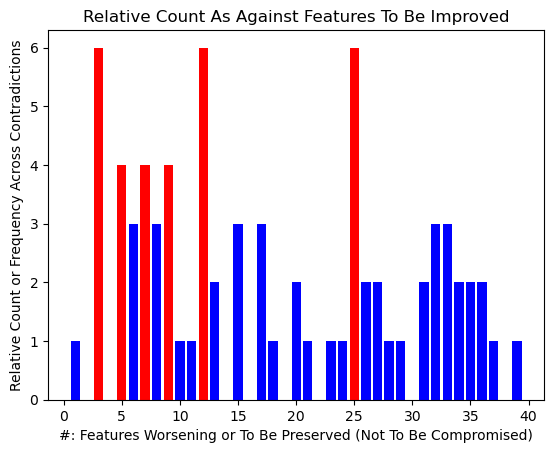
1/17 3/5 3/7 3/9 3/10 3/23 3/28 3/33 3/39 5/1 5/3 5/7 5/9 5/12 5/25 6/25 6/26 6/27 6/33 7/3 7/5 7/9 7/12 7/15 7/37 8/17 8/31 9/36 11/12 11/25 12/3 12/5 12/7 12/13 12/21 13/12 13/20 15/18 15/32 15/36 17/8 17/34 20/13 20/32 21/26 25/5 25/6 25/11 25/12 25/27 25/32 25/33 26/6 27/3 27/6 27/25 29/31 30/3 31/8 31/29 32/15 32/20 32/25 33/8 33/24 33/25 34/12 34/17 34/35 35/34 36/15 37/7 37/9 38/35 39/3
EXAMPLE: The three-pin plug design is an example of asymmetry, and it serves specific purposes for safety and functionality. The asymmetrical design of plug pins in a three-pin plug helps to address and resolve several contradictions, primarily related to electrical safety, standardization, and user-friendly operation.The asymmetrical design prevents reversed polarity, reducing the risk of electrical hazards associated with incorrect wiring. The asymmetrical design is standardized, providing a consistent configuration across electrical devices and sockets. This standardization ensures that users can rely on a uniform system, reducing confusion and errors during installation. The asymmetrical design of plug pins solves the problem of ensuring correct electrical connections and minimizing the risks associated with reversed polarity. It is a safety measure that has become a standard in electrical systems to enhance safety, standardization, and user-friendly operation. evices.
Contradictions (31/29, 6/36) : Ensuring electrical safety while preventing the risk of incorrect wiring. Achieving standardization in electrical connections while minimizing confusion during installation. Designing a plug for ease of use while minimizing the potential for insertion errors. Achieving consistency in electrical configurations while accommodating variable socket designs. Ensuring proper electrical functionality while preventing the negative effects of reversed polarity.
Solution: The asymmetrical design of plug pins in a three-pin plug addresses the problem of ensuring correct electrical connections and preventing potential safety hazards. The key problem solved by this asymmetry is the prevention of reversed polarity in electrical circuits. Reversed polarity can lead to several safety issues and malfunctions, and the asymmetrical design helps mitigate these problems.
The standardized asymmetrical design provides a consistent configuration, reducing confusion and errors in connecting devices. The asymmetry allows the plug to be inserted in only one orientation, making it more user-friendly and reducing the chances of mistakes during plug insertion. The asymmetrical design ensures a consistent arrangement of live, neutral, and ground connections, promoting uniformity across devices and sockets. The asymmetry prevents the live and neutral wires from being swapped, maintaining proper electrical functionality. In summary, the asymmetrical plug design helps resolve contradictions related to safety, standardization, ease of use, consistency, and electrical functionality, contributing to a safer and more reliable electrical system.
The asymmetrical design ensures that the live, neutral, and ground connections are arranged in a specific way. If the plug were inserted in reverse, it could lead to the live and neutral wires being swapped. Reversed polarity can cause electrical appliances to function improperly and pose a risk of electric shock. By allowing the plug to be inserted into the socket in only one orientation, the design minimizes the risk of accidental or intentional insertion in the wrong direction. This helps maintain a consistent and safe electrical connection. The different sizes of the pins contribute to easy identification of the live, neutral, and ground connections. Users can visually distinguish between the pins, making it simpler to connect devices correctly.