Additive Manufacturing (AM) is a cornerstone technology of Industry 4.0. By enabling digital, layer-by-layer fabrication, AM transforms how aerospace components are designed, produced, and sustained. It supports rapid innovation, complex geometries, and data-driven manufacturing practices that align closely with smart factory concepts. From an enterprise perspective, AM is not just a production technology—it is a strategic capability. In aerospace, it impacts supply-chain resilience, sustainability goals, certification approaches, and integration with traditional manufacturing. Enterprises such as Boeing evaluate AM across its entire lifecycle impact, from powder sourcing to end-of-life considerations.
Learning Objectives
This module covers sustainable additive manufacturing, AM’s impact on supply chains and laser innovations, Powder Bed Fusion versus Binder Jetting, residual stress in advanced AM processes, metal powder processing, and AM machine and design considerations. After completing this module, learners will be able to explain sustainable additive manufacturing concepts, understand AM’s impact on aerospace supply chains, compare Powder Bed Fusion and Binder Jetting processes, explain residual stress challenges in metal AM, understand metal powder processing and handling, and identify AM machine types and design constraints.
What Is Additive Manufacturing?
Additive Manufacturing builds parts layer by layer directly from digital models. This approach enables complex geometries that are difficult or impossible to achieve with subtractive methods, reduces material waste, and supports rapid design iteration and customization.
Sustainable Additive Manufacturing
Sustainable AM enables reduced material waste through near-net-shape production, lightweight designs that improve fuel efficiency, localized production that lowers transportation emissions, and reduced tooling requirements compared to conventional manufacturing.
AM & Supply Chain Transformation
Additive Manufacturing transforms supply chains by enabling digital inventories, reducing dependency on long and fragile supplier networks, supporting on-demand production of parts, and significantly shortening lead times. These capabilities are particularly valuable in aerospace, where spares availability and lifecycle support are critical
Laser Innovations In Additive Manufacturing
Recent laser innovations include higher-power and multi-laser systems, improved beam control, enhanced melt-pool monitoring, and increased build speeds. These advancements improve productivity, consistency, and quality in metal additive manufacturing processes.
Powder Bed Fusion (PBF)
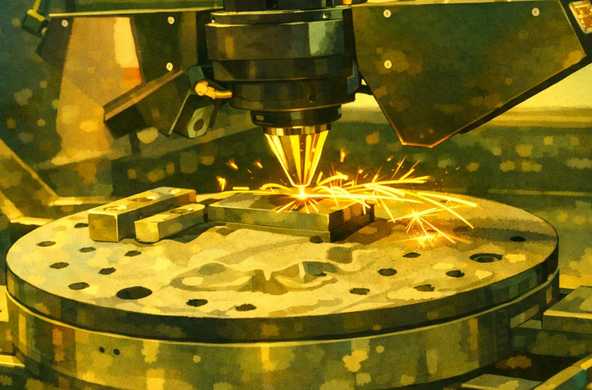
Powder Bed Fusion uses fine metal powder spread across a build platform, where a laser selectively melts regions according to the digital design. PBF offers very high precision and material density, making it suitable for complex, high-performance aerospace components.
Binder Jetting
Binder Jetting selectively deposits a binder to join powder particles layer by layer. Unlike PBF, it does not use a high-energy laser during printing and requires post-processing steps such as sintering. Binder Jetting is well suited for higher-volume production scenarios.
Aspect
Powder Bed Fusion
Binder Jetting
Energy source
Laser
Binder
Density
Very high
Medium–High
Post-processing
Moderate
Extensive
Production volume
Low–Medium
Medium–High
Each process serves different aerospace and industrial needs depending on performance, scale, and cost requirements.
Residual Stress In Metal AM
Residual stress in metal additive manufacturing arises from rapid heating and cooling cycles, steep thermal gradients, and the inherent layer-by-layer deposition process. If not managed, residual stress can lead to distortion, cracking, or reduced component performance.
Managing & Analyzing Residual Stress
Residual stress can be mitigated through careful process parameter optimization, strategic build orientation, post-build heat treatment, and the use of simulation and in-situ monitoring to predict and control thermal behavior during printing
Metal AM – Powder Processing
Metal powder quality is critical to AM success. Key considerations include particle size and distribution, flowability, contamination control, and powder reusability. Poor powder management directly impacts part quality, repeatability, and certification.
AM Machines & Design Considerations
AM machines vary in build volume, energy source, and material compatibility. Effective Design for Additive Manufacturing (DfAM) requires consideration of support structures, topology optimization, and thermal behavior. In AM, design and process decisions are tightly coupled.
Enterprise Perspective (Example: Boeing)
From an enterprise perspective, aerospace organizations must address certification and qualification, repeatability and traceability, cost versus performance trade-offs, and seamless integration of AM with traditional manufacturing processes. Governance and standards are essential to scaling AM safely and effectively.
Key Takeaways
Additive Manufacturing enables complex and lightweight designs that are difficult to achieve with conventional methods. Sustainability and supply-chain resilience are key drivers for AM adoption. Powder Bed Fusion and Binder Jetting serve different production needs. Residual stress must be carefully managed, and in AM, design and process considerations are inseparable.




Pingback: cenforce sildenafil citrate tablets
Pingback: vardenafil dapoxetine india
Pingback: levitra vs viagra
Pingback: orlistat 60mg reviews
Pingback: minoxidil 2% vs 5% side effects
Pingback: minoxidil safety faq
Pingback: minoxidil foam vs liquid differences
Pingback: minoxidil women’s study summary
Pingback: vardenafil 10 mg insights
Pingback: avanafil contraindications
Pingback: vardenafil fatty food effects
Pingback: vardenafil duration factors
Pingback: orlistat food effects
Pingback: augmentin antibiotic details
Pingback: Educational Tmax Resource
Pingback: medical uses of sildenafil
Pingback: sildenafil and tadalafil differences
Pingback: sildenafil information
Pingback: drug safety information for tadalafil