
Focus Areas
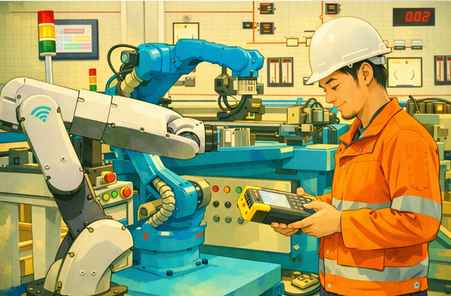
Robotics and autonomous systems are at the heart of Industry 4.0. They transform machines from rigid, pre-programmed tools into adaptive systems capable of sensing their environment, making decisions, and acting safely with minimal human intervention. These capabilities are essential for modern manufacturing, inspection, and operational efficiency. In aerospace environments, robotics and autonomy must meet the highest standards of safety, reliability, and certification. For enterprises such as Boeing, autonomous systems are deployed not only to improve productivity, but also to enhance quality, enable inspection at scale, and support human workers in complex and hazardous tasks.
Learning Objectives
This module covers robot control fundamentals, path planning and obstacle avoidance, PID and advanced model-based control, force control and collaborative robots, the Robot Operating System (ROS), mobile robots and aerial systems, sensors for autonomy, localization and mapping, SLAM, and perception and navigation pipelines. After completing this module, learners will be able to explain robot control and motion fundamentals, understand path planning and obstacle avoidance, differentiate PID and model-based control approaches, explain force control and collaborative robots, understand ROS as a robotics middleware, explain sensors used in autonomous systems, describe localization, mapping, and SLAM, and understand perception and navigation pipelines.
What Are Robotics & Autonomous Systems?
Robotics focuses on machines that can sense their environment, make decisions, and act through controlled motion. Autonomous systems extend this concept by operating with minimal human intervention. Levels of autonomy vary depending on risk, environment, and regulatory constraints, especially in safety-critical industries.
Control Of Robots – Fundamentals
Robot control is based on a closed-loop system. Sensors provide feedback about the robot’s state, controllers process this information and decide actions, and actuators execute motion. Together, these elements ensure stable, accurate, and predictable behavior.
PID Control
PID control is one of the most widely used control techniques in robotics. The proportional term responds to current error, the integral term accounts for accumulated past error, and the derivative term anticipates future error based on the rate of change. PID controllers are simple, robust, and effective for many industrial applications. Despite advances in AI, PID controllers remain essential because they: Address immediate error (Proportional), Eliminate long-term drift (Integral), Predict instability (Derivative). Key insight: PID is not obsolete—it is the baseline layer upon which advanced control is built. Modern systems often: Use PID at low levels. Add adaptive or AI layers above it.
Feedback and adaptive control systems form the core of modern automation, enabling stability, precision, and responsiveness through real-time self-correction. As environments become more dynamic, control systems are evolving from static logic to adaptive, predictive, and learning-based architectures. Hybrid approaches that combine classical control theory with AI, edge intelligence, and digital twins are emerging as the dominant paradigm, balancing performance with safety. The future of robotics, autonomous systems, and industrial automation lies in resilient, self-optimizing feedback intelligence governed by strong systems engineering and safety constraints.
Traditional control assumes: Known conditions. Fixed parameters. Reality: Environments change, Systems wear, Loads vary. Adaptive control addresses this by: Adjusting parameters in real time, Learning system behavior during operation. Examples: Drones adjusting altitude in turbulence, Robots compensating for material variation, HVAC systems responding to occupancy and weather, Insight: Adaptation turns control from reactive to resilient.
Advanced Model-Based Control
Advanced control techniques use mathematical models of robot dynamics to predict future behavior. Model Predictive Control (MPC) and optimal control strategies enable smoother motion, better constraint handling, and improved performance in complex or highly dynamic systems. Model Predictive Control (MPC) introduces a major leap: Uses system models, Forecasts future states, Optimizes actions before instability occurs. This enables: Constraint handling, Safer operation, Better performance under limits. Insight: Prediction is the bridge between control theory and autonomy. The trajectory outlined is clear: From static control → adaptive control, From adaptive → learning control, From learning → cognitive control architectures. Emerging areas: Self-healing systems, Quantum control for complex dynamics, Large-scale autonomous coordination.
A critical (often misunderstood) takeaway: AI does not replace feedback control. AI enhances it by enabling: Learning, Adaptation, Optimization under uncertainty. Examples highlighted: Reinforcement learning for control policies, Neural controllers tuning parameters, Hybrid physics + data-driven models. Key insight: The future is hybrid control, not “AI-only control”. Modern trends include: Controllers that detect degradation. Automatic fault correction. Performance optimization without human intervention. This leads to: Higher availability, Lower maintenance cost, Greater autonomy. Insight: Control systems are evolving from fixed logic to adaptive intelligence. Running control intelligence at the edge enables: Ultra-low latency, Decentralized decision-making, Real-time autonomy. This is essential for: Robotics, Autonomous vehicles, Industrial automation. Insight: Centralized intelligence cannot meet real-time physical control needs. Digital twins enable: Simulation of feedback behavior, Validation of adaptive controllers, Risk-free testing before deployment. Key insight: You no longer deploy control logic directly to reality—you validate it virtually first.
Force Control
Force control allows robots to regulate interaction forces rather than just position. This enables safe physical interaction with humans, precision assembly, and surface-following tasks such as polishing or sealing. Force control is essential for tasks where contact quality matters. The final, strategic takeaway is strong: Future enterprises will compete on autonomous feedback intelligence. This implies: Investment in hybrid AI + control architectures, Strong systems engineering foundations, Integration of data science with control theory.
Collaborative Robots (Cobots)
Collaborative robots are designed to work alongside humans in shared spaces. They use force, torque, and vision sensing to detect interaction and ensure safety. Cobots support flexible, human-centered automation, particularly in low-volume, high-mix manufacturing environments.
Path Planning
Path planning determines how a robot moves from one point to another while avoiding collisions. Planning algorithms compute collision-free and often optimal trajectories. Common methods include graph-based approaches such as A* and D*, and sampling-based approaches such as RRT and PRM.
Obstacle Avoidance
Obstacle avoidance enables robots to react to dynamic environments. Using real-time sensor feedback, robots detect obstacles and adjust motion instantly. This capability is critical in shared human–robot workspaces and changing factory layouts.
Introduction To Ros (Robot Operating System)
ROS is a widely used robotics middleware that provides standardized communication and software infrastructure. It introduces concepts such as nodes, topics, and services, and offers a rich ecosystem of reusable packages for perception, control, and navigation.
Wheeled Robots
Wheeled robots commonly use differential drive or Ackermann steering mechanisms. They are widely used for logistics, inspection, and material transport due to their efficiency, simplicity, and suitability for structured environments such as factories and warehouses.
Quadrupeds & Drones
Quadruped robots are designed to navigate uneven terrain and confined spaces where wheeled robots struggle. Drones provide aerial inspection capabilities, enabling access to hard-to-reach or hazardous areas such as aircraft surfaces, hangars, and infrastructure.
Sensors For Autonomous Systems
Autonomous robots rely on multiple sensors to perceive their environment. Cameras provide visual information, LiDAR measures distances and shapes, IMUs track motion and orientation, and encoders measure joint or wheel movement. Sensor fusion improves accuracy and robustness
Localization & Mapping
Localization answers the question “Where am I?” while mapping answers “What does the environment look like?” Together, these capabilities allow robots to understand their position relative to their surroundings and plan motion accordingly
SLAM (Simultaneous Localization And Mapping)
SLAM enables robots to build a map of an unknown environment while simultaneously localizing themselves within it. This capability is essential for operating in new, changing, or partially known environments without external infrastructure
Visual Odometry & Motion Estimation
Visual odometry estimates robot motion by analyzing camera images over time. Motion estimation combines multiple sensor inputs to track position and orientation continuously, supporting navigation and stability in autonomous systems
Perception & Navigation
Perception allows robots to interpret their environment by recognizing objects, obstacles, and free space. Navigation uses this understanding to decide where to go and how to move safely and efficiently toward goals.
Enterprise Perspective (Example: Boeing)
From an enterprise perspective, aerospace organizations must address safety and certification, reliability and redundancy, effective human–robot collaboration, and governance of autonomous behavior. Autonomy must be carefully bounded, explainable, and auditable to ensure trust and compliance.
Key Takeaways
Robot control ensures stable and accurate motion. Planning and obstacle avoidance enable safe navigation. Sensors and perception provide environmental awareness. SLAM supports operation in unknown environments. In enterprise aerospace contexts, autonomy must always be governed and aligned with safety and regulatory requirements.



Pingback: mesalamine 4gm/60ml enema
Pingback: cipla finpecia review
Pingback: sildenafil brand name
Pingback: bupropion naltrexone weight loss results
Pingback: what is saxenda
Pingback: acular ketorolac administration
Pingback: ketorolac tromethamine drug summary
Pingback: ivermectin rosacea treatment evidence
Pingback: minoxidil mechanism katp channels
Pingback: minoxidil regrowth timeline
Pingback: vardenafil mode of action
Pingback: insurance policy
Pingback: amoxicillin gastrointestinal side effects
Pingback: Cialis Duration Explained
Pingback: Brand vs Generic Alcohol Interaction
Pingback: more information about tadalafil
Pingback: tadalafil regulatory bioequivalence
Pingback: clindamycin oral, topical and vaginal forms