
Focus Areas
Electronics and mechatronics form the physical–digital bridge of Industry 4.0. They enable machines to sense the environment, make decisions, and act autonomously. In modern manufacturing, especially in aerospace, these disciplines underpin smart factories, intelligent machines, and cyber-physical systems. In aerospace manufacturing, electronics and mechatronics are not just enablers of automation—they are safety-critical systems. For an enterprise like Boeing, every sensor, controller, and actuator must meet strict requirements for reliability, certification, and lifecycle traceability while operating in highly complex production environments.
Learning Objectives
This module covers key Industry 4.0 building blocks, including sensors and actuators, signal transduction and conditioning, analog and digital electronics, embedded communication protocols, electronic system design and manufacturing, EDA/ECAD tools, machine vision, and integrated mechatronic systems. After completing this module, learners will be able to explain sensors and actuators used in Industry 4.0, understand signal transduction and conditioning, differentiate analog, digital, and mixed-signal systems, describe embedded communication protocols, understand electronic system design and manufacturing, apply EDA/ECAD concepts, explain machine vision in automation, and understand mechatronic system integration.
Sensors & Actuators For Industry 4.0
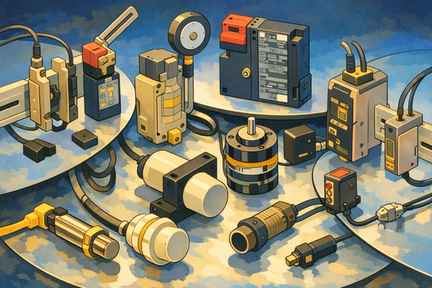
Sensors and actuators enable machines to interact with the physical world. Sensors measure physical parameters such as temperature, pressure, vibration, proximity, position, vision, and force. These measurements provide real-time data for monitoring, control, and optimization. Actuators convert electrical signals into physical motion or force. Common examples include electric motors, pneumatic and hydraulic actuators, and servo and stepper systems. Together, sensors and actuators form the foundation of automation and robotics.
Signal Transduction & Conditioning
Signal transduction is the process of converting physical phenomena into electrical signals. For example, a temperature change is converted into a voltage or current. Signal conditioning ensures these signals are usable and reliable. It includes amplification, filtering, noise reduction, and electrical isolation. Without proper conditioning, sensor data can become inaccurate or unusable, especially in electrically noisy industrial environments.
Analog, Digital & Mixed-Signal Systems
Electronic systems in Industry 4.0 span multiple signal domains. Analog systems process continuous signals such as voltage and current. Digital systems operate on discrete logic levels (0 and 1). Mixed-signal systems combine both, using components such as ADCs, DACs, System-on-Chips (SoCs), and microcontrollers. Most modern industrial electronics are mixed-signal by design.
A mixed-signal system is an electronic system that: Processes both analog (continuous, real-world) signals and digital (discrete, 0/1) signals in the same system. Why this matters: The real world is analog. Computers are digital. Mixed-signal systems are the bridge between them. The Building Blocks (Very Important): Mixed-signal systems typically include: Sensors → produce analog signals. ADC (Analog-to-Digital Converter) → analog → digital. Microcontroller / SoC → digital processing. DAC (Digital-to-Analog Converter) → digital → analog. Actuators → respond to analog electrical signals. SoC stands for System on a Chip. An SoC integrates an entire computing system—processor, memory, interfaces, and peripherals—onto a single chip. Instead of many separate chips on a board, an SoC puts them all together. A modern SoC usually includes: CPU (one or more cores). Memory (RAM controllers, cache). Analog & digital I/O. ADCs / DACs. Communication interfaces (CAN, Ethernet, SPI, I²C, UART). Timers & control units. Often AI / DSP accelerators. This makes SoCs ideal for compact, high-performance embedded systems. AI accelerators and DSP (Digital Signal Processing) accelerators are specialized hardware blocks inside an SoC (or as separate chips) that are designed to process certain types of computations much faster and more efficiently than a normal CPU. AI and DSP accelerators are specialized hardware units that offload signal processing and machine learning computations from the CPU, enabling real-time, low-latency intelligence in embedded and Industry 4.0 systems. In aerospace manufacturing, AI and DSP accelerators enable real-time inspection, vibration analysis, and predictive maintenance directly at the machine or robot level. Accelerators are specialist brains for specialist task. SoCs sit between MCUs and full computers.
| Microcontroller (MCU) | System on Chip (SoC) |
|---|---|
| Simple control tasks | Complex computing + control |
| Limited memory & speed | High processing power |
| Deterministic control | Control + analytics |
| PLC-like behavior | Edge-computing capable |
On the aircraft: Sensors capture strain, temperature, vibration. An SoC-based embedded unit: Filters and processes data. Runs diagnostics. Encrypts and transmits data. Feeds predictive maintenance and digital twin systems. This is edge intelligence, not just data collection.
On a modern aircraft (for example, at Boeing), the aircraft itself is no longer a passive machine. It is a data-producing, intelligent system. Edge intelligence refers to the ability of embedded systems on the aircraft to process sensor data locally, run diagnostics, and make decisions before securely transmitting insights to predictive maintenance and digital twin systems. In modern Boeing aircraft, edge intelligence enables real-time health monitoring and predictive maintenance by embedding processing and decision-making directly within the aircraft systems. Sensors + SoC turn the aircraft into a thinking system”
Microcontrollers & Embedded Systems
Microcontrollers are the core of embedded systems. They integrate a CPU, memory, analog and digital inputs/outputs, and communication interfaces into a single device.
Embedded systems control machines, process sensor data, execute control logic, and communicate with higher-level systems such as PLCs, MES, and industrial networks.
Embedded Communication Protocols
Communication protocols allow embedded systems to exchange data reliably.
Common protocols include I²C, SPI, and UART for short-range communication, CAN and CAN-FD for robust industrial and automotive networks, and Industrial Ethernet for high-speed, real-time factory communication.
These protocols are essential for system integration and interoperability.
Electronic System Design & Manufacturing
Electronic system development follows a structured lifecycle. It begins with schematic design, followed by PCB layout, prototyping, testing and validation, and finally manufacturing and assembly.
In Industry 4.0, this lifecycle is tightly integrated with digital tools and enterprise systems to ensure quality, traceability, and repeatability.
EDA / ECAD Tools
EDA and ECAD tools support electronic design by enabling schematic capture, PCB design, design-rule checks, and generation of manufacturing outputs.
Popular examples include KiCad and gEDA. These tools help engineers translate functional requirements into manufacturable electronic systems.
Machine Vision In Automation
Machine vision enables automated systems to “see” and interpret visual information.
It supports inspection and quality control, object detection, alignment and guidance, and defect detection. In smart factories, machine vision replaces manual inspection and enables real-time quality assurance.
Mechatronics Systems
Mechatronics integrates mechanical systems, electronics, embedded software, and control systems into a single cohesive solution.
This integration enables intelligent machines such as robots, CNC systems, and autonomous production equipment that can sense, decide, and act autonomously.
Enterprise Perspective (Example: Boeing)
From an enterprise perspective, aerospace manufacturers must address safety and certification, reliability and redundancy, EMI/EMC compliance, and full lifecycle traceability.
Electronics and mechatronic systems must be designed not only for performance but also for long-term maintainability and regulatory compliance.
From an enterprise perspective, Industry 4.0 spans multiple layers. It aligns business strategy with processes and operations, is enabled by data and applications, and is executed through technology and infrastructure. Successful adoption requires coherence across all these layers.
Key Takeaways
- Sensors and actuators enable physical interaction with the environment. Signal conditioning ensures data integrity and reliability. Mixed-signal systems dominate Industry 4.0 electronics. Embedded systems connect electronics to automation and enterprise platforms. Mechatronics enables intelligent, autonomous machines that power modern smart factories.