


12. EQUIPOTENTIAL(ITY): (A) Change the conditions of the operation or characteristics of the object (or system) in such a way that the object (or system) doesn’t need to be lifted/raised or lowered e.g. rolling heavy cylindrical objects on the plane surface instead of lifting it up for the transportation.or (B) significantly reduce the need of energy consumption for the operation by equalizing or neutralizing the forces acting upon an object (or system).
EXAMPLE: Wheelchair Ramps, Mid-air Fueling, Spring Enforced Parts, Garage Pits for Car Maintenance, Canal Locks, Skillet Conveyor, Upskilling (Training)
SYNONYMS: Remove hierarchy—no one leads
ACB:
The equipotential surface is defined as the area where all points share the same electric potential. Moving a charge between points on this surface does not necessitate any work. Essentially, any surface characterized by a uniform electric potential at all its points is referred to as an equipotential surface. Points in an electric field that share the same electric potential are referred to as equipotential points. When these points are connected by a line or curve, it is termed an equipotential line. If these points are situated on a surface, that surface is designated as an equipotential surface. Moreover, if these points are dispersed throughout a space or volume, it is identified as an equipotential volume. In electrostatics, an equipotential surface is a surface on which the electric potential is constant. No work is done in moving a charge along an equipotential surface since the electric field is perpendicular to the surface. Equipotential surfaces are often visualized as surfaces perpendicular to the electric field lines. In fluid dynamics, equipotential surfaces can be used to represent the pressure distribution in a fluid. In a steady-state, irrotational flow, surfaces of constant pressure can be considered equipotential surfaces.
At its core, equipotentiality challenges the conventional thinking that some elements are inherently more important or critical than others. It promotes a more democratic approach to problem-solving and innovation, encouraging the exploration of diverse possibilities and breaking away from rigid hierarchies. This principle can be applied across various domains to foster creative thinking and the discovery of unconventional solutions. It encourages viewing elements within a system without assigning hierarchical significance. It aims to eliminate or minimize variations in potential or importance among system components. Consider all elements, components, or parts within a system as having equal importance or potential contribution to the overall function. Discourage the imposition of a hierarchy or prioritization among elements. Resist the tendency to assign unequal importance based on traditional roles or perspectives.
In manufacturing and distribution facilities, conveyor belt systems often have multiple belts running in sync. Synchronization ensures that products smoothly transfer from one section of the conveyor to another, maintaining a continuous flow of materials. In robotic manufacturing systems, multiple robot arms may be synchronized to perform collaborative tasks. Synchronization ensures that the arms move in harmony, allowing for efficient and coordinated assembly or handling of parts. Baggage handling systems at airports use synchronized conveyor belts to transfer luggage from check-in counters to the aircraft. Synchronization ensures a smooth and timely flow of luggage through the various stages of processing. In the printing industry, the rollers in a printing press are synchronized to transfer ink to paper uniformly. This synchronization is crucial for achieving high-quality prints and preventing inconsistencies. In smart traffic management systems, traffic signals at intersections may be synchronized to optimize traffic flow. Synchronization helps reduce congestion and improve the efficiency of traffic movement. Equipotential surfaces also exist in gravitational fields. In a uniform gravitational field, the equipotential surfaces are horizontal planes. Objects on the same equipotential surface experience the same gravitational potential energy.
Mid-air refueling, also known as aerial refueling or air-to-air refueling, involves transferring aviation fuel from one aircraft (the tanker) to another (the receiver) during flight. The concept of equipotentiality can be related to mid-air refueling in the context of maintaining a consistent speed between the tanker and receiver aircraft, even though they may be flying at slightly different altitudes. Equipotentiality in this context means avoiding relative acceleration between the tanker and receiver. Any acceleration difference could lead to unstable and unsafe conditions during refueling.
Avoiding changes in the energy of a system while introducing other changes means maintaining a constant level of energy within the system, even as other modifications or adjustments are made. This principle is rooted in the conservation of energy, which states that energy cannot be created or destroyed but can only be transformed from one form to another. Example: Hydraulic System in Heavy Machinery. Problem: Heavy machinery, such as construction equipment or industrial presses, often relies on hydraulic systems for power transmission and control. One common challenge in hydraulic systems is the need to make adjustments or modifications to machine operations without significantly altering the energy level within the system. For example, when lifting or moving heavy loads, operators may need to adjust the speed or force of hydraulic actuators while ensuring that the overall energy input remains constant. Solution: A proportional control valve is a component commonly used in hydraulic systems to achieve precise control of fluid flow and pressure. This valve adjusts the flow rate of hydraulic fluid to the actuators in proportion to the input signal from the operator or a control system. By modulating the flow of fluid, the valve can vary the speed, force, or position of hydraulic actuators without significantly changing the overall energy input to the system.
Benefits: Precision Control: Proportional control valves allow operators to make fine adjustments to machine operations, such as lifting, lowering, or positioning heavy loads, with high precision and accuracy. Energy Efficiency: By maintaining a constant energy input while adjusting hydraulic parameters, proportional control valves help optimize the energy efficiency of hydraulic systems. This reduces energy consumption and operating costs over time. Safety: Precise control of hydraulic actuators enhances the safety of heavy machinery operations by minimizing the risk of sudden movements or overloads that could pose a danger to operators or nearby personnel. Equipment Longevity: Consistent energy levels within the hydraulic system help reduce wear and tear on components, prolonging the lifespan of hydraulic pumps, actuators, and other system elements.
Equipotentiality in the context of a vehicle, can also be understood as the equalization of pressure among all the tires. Proper inflation ensures that each tire carries an equal load and functions optimally. Deviations from equal pressure could result in uneven wear, reduced fuel efficiency, and compromised handling. Precision in measuring and adjusting tire pressure is essential for achieving equipotentiality among the tires. Modern vehicles often come with recommended tire pressure values specified by the manufacturer. Following these recommendations helps maintain a consistent and balanced pressure level. It ensures that the vehicle responds predictably to steering inputs and maintains stability during acceleration, braking, and cornering. This is particularly important for safety, especially in emergency maneuvers. Balanced tire pressure, or equipotentiality in terms of pressure distribution, also contributes to fuel efficiency. Underinflated or overinflated tires can lead to increased rolling resistance, affecting the vehicle’s fuel economy. Properly inflated tires help optimize fuel efficiency.
Osmosis is the spontaneous movement of solvent molecules (usually water) across a semipermeable membrane from an area of lower solute concentration to an area of higher solute concentration. This movement equalizes the concentration of solute on both sides of the membrane. In osmosis, water molecules move through the membrane, while solute particles are too large to pass through. This results in the dilution of the more concentrated solution and the concentration of the less concentrated solution until an equilibrium is reached. Osmosis is a fundamental process in living cells. It plays a crucial role in processes like nutrient absorption in plant roots and kidney function in animals.
The concept of synchronizing the timings of flights or trains to facilitate smooth connections at hubs can be related to the principle of equipotentiality in a metaphorical sense. While “equipotentiality” is not a term commonly used in the context of transportation scheduling, the idea aligns with achieving a state where various elements (flights or trains) are in sync or have equal potential for efficient connections. Synchronization involves balancing the timing of different transportation services. Flights or trains are scheduled in a way that minimizes delays and allows for efficient connections, preventing one element from being significantly delayed compared to others.
Embrace diverse viewpoints and consider alternative ways in which different elements or components can contribute to achieving the system’s objectives. In the performing arts, dancers may synchronize their movements to create visually appealing and coordinated performances. This synchronization enhances the overall impact and aesthetics of the dance. Facilitate the interchangeability of elements, allowing for flexibility in the system’s design or operation. This can lead to innovative solutions by breaking away from established norms. Reduce constraints that limit the potential contributions of different elements. Aim for a more open and adaptable system that can leverage the full potential of its components. Encourage a holistic perspective where the overall system’s success is viewed as a collective result of the contributions of all elements, rather than the success of individual components.
The concept of equipotentiality can be adapted to business scenarios to represent a philosophy or approach that treats various elements, resources, or strategies as having equal potential or importance. In a business context, equipotentiality might involve considering different departments, teams, or strategies as having equal potential for contributing to the overall success of the organization. It encourages a balanced approach where diverse elements are given fair consideration, and efforts are distributed across various areas without favoring one over the other.
Treating different teams (with members cutting across the hierarchy) within an organization as having equal potential for success. Encouraging collaboration and acknowledging the unique contributions of each team toward common goals. Distributing resources across different departments or projects without favoring one over the others. Ensuring that budgetary allocations, time, and efforts are balanced to optimize overall business performance. Treating various professional development initiatives or training programs as having equal potential for enhancing employee skills and capabilities. Providing diverse opportunities for growth and learning.
Brainwriting is a creative problem-solving technique that involves written idea generation in a group setting. It’s an alternative to traditional brainstorming and aims to encourage a higher volume of ideas from all participants while minimizing potential challenges like dominance by outspoken individuals or fear of judgment. Brainwriting is a valuable method for tapping into the and is particularly useful when a variety of perspectives is needed to address complex problems. It’s adaptable and can be modified based on the specific needs of a team or problem at hand. Brainwriting provides an equal opportunity for all participants to contribute ideas without the dominance of vocal individuals. It minimizes fear of judgment since the initial idea generation is done silently and anonymously. It encourages a higher volume of ideas due to the collective and iterative nature of the process. It allows for a diversity of perspectives and insights as ideas are built upon by different team members. It provides a structured approach to idea generation, making it easier to manage and organize the creative process.
The method provides a structured approach for idea generation and fosters collaboration within a team. Here’s how the brainwriting method typically works: (1) Define the problem or challenge that the group is aiming to solve. (2) Ensure that each participant has access to sheets of paper or a template designed for brainwriting. (3) Participants start by silently writing down their ideas on the given topic on their individual sheets of paper. Each person works independently. (4) After a set period (e.g., 5-10 minutes), participants pass their papers to the person next to them (clockwise or counterclockwise). (5) The person who receives the paper reads the ideas already written and builds on them by adding new ideas or elaborating on existing ones. (6) Repeat the passing and building process at regular intervals, allowing participants to contribute to multiple sheets of ideas. (7) The rotation continues until each participant has had the chance to contribute to every sheet in the group. (8) Once the brainwriting rounds are completed, collect all the sheets and review the ideas as a group. (9) Facilitate a discussion to explore and refine the generated ideas. Participants can highlight interesting concepts or suggest combinations of ideas.
The illusion of asymmetric insight is a cognitive bias where individuals believe that they understand others better than others understand them. This bias leads people to perceive a communication or interaction as unbalanced, with themselves having a deeper understanding of others’ thoughts, feelings, and behaviors compared to what others understand about them. Overestimation of Understanding: Individuals tend to overestimate their own insight into others’ thoughts, emotions, and motivations, believing that they have a clearer understanding of others’ inner experiences than others have of theirs. Underestimation of Others’ Insight: Conversely, individuals underestimate the extent to which others understand them, assuming that others lack the same depth of insight into their own thoughts, emotions, and motivations. Perception of Uniqueness: People often perceive themselves as unique or exceptional in their ability to understand others, while viewing others as more homogeneous or less insightful. Impact on Communication: The illusion of asymmetric insight can influence interpersonal communication and relationships by creating a perceived imbalance in understanding. Individuals may feel frustrated or misunderstood when they believe that others do not fully grasp their perspectives or experiences. Confirmation Bias: Once individuals develop the belief that they understand others better than others understand them, they may selectively interpret or remember interactions in a way that confirms this belief, further reinforcing the bias.
Examples of the illusion of asymmetric insight include: A person in a relationship may believe that they understand their partner’s emotions and motivations better than their partner understands theirs. A team member in a work setting may feel that they have a deeper understanding of their colleagues’ perspectives and work styles than their colleagues have of theirs. A friend may believe that they are more empathetic and insightful than their peers, attributing misunderstandings or conflicts to others’ lack of understanding.
To mitigate the illusion of asymmetric insight, individuals can: Practice active listening and empathy in interpersonal interactions, seeking to understand others’ perspectives without assuming that they know best. Recognize the limitations of their own insight and be open to feedback and perspectives from others. Engage in reflective practices to gain a deeper understanding of their own thoughts, emotions, and motivations, fostering self-awareness and introspection. Foster open and honest communication in relationships, encouraging mutual understanding and empathy. Challenge assumptions and stereotypes about others’ perspectives and experiences, recognizing the diversity and complexity of human cognition.
While the illusion of asymmetric insight is primarily a cognitive bias related to interpersonal understanding, it can indirectly affect technical systems, particularly in the context of human-computer interaction and user experience design. Here are a few ways in which it might relate to technical systems: User Understanding and Empathy (as in design thinking): In designing technical systems such as user interfaces or software applications, developers may fall prey to the illusion of asymmetric insight by assuming they understand users’ needs and preferences better than users themselves do. This can lead to features or designs that are not intuitive or user-friendly because they do not accurately reflect users’ actual behaviors or preferences. Assumptions in Design: Designers and engineers may unconsciously project their own perspectives and assumptions onto users when creating technical systems, leading to features or interfaces that are biased or overlook important user needs. The illusion of asymmetric insight can contribute to designers overestimating their understanding of user behavior and preferences, resulting in less effective or user-friendly designs. Feedback and Iteration: The illusion of asymmetric insight can also affect the feedback loop between users and technical systems. Developers may be less receptive to user feedback or less willing to iterate on designs if they believe they already understand users’ needs perfectly. This can result in slower improvement cycles and missed opportunities for optimization in technical systems. Miscommunication and Misunderstanding: In collaborative technical projects involving multiple stakeholders, the illusion of asymmetric insight can lead to miscommunication and misunderstanding. Team members may assume they understand each other’s perspectives and priorities better than they actually do, leading to conflicts or inefficiencies in the development process. Overall, while the illusion of asymmetric insight is primarily a social and cognitive phenomenon, it can indirectly influence technical systems by shaping designers’ assumptions, communication patterns, and receptiveness to user feedback. By being aware of this bias and actively seeking to overcome it through user research, usability testing, and iterative design practices, developers can create more effective and user-friendly technical systems.
In the realm of design, engineering, and problem-solving, this goal aligns with principles of fairness, inclusivity, and social responsibility. It may involve redesigning systems, processes, or products to mitigate biases, address inequalities, and promote equal access and opportunity. There isn’t a specific technical term that universally encapsulates this concept, but it aligns closely with broader principles of ethical design, social justice, and human-centered approaches to problem-solving. In discussions about system improvement or optimization, you might hear phrases like “promoting fairness,” “achieving equity,” or “ensuring equal access.” Additionally, terms such as “inclusive design,” “socially responsible design,” or “ethical engineering” may be used to describe approaches that prioritize fairness and equity in technical systems.
One example of a balanced technical system is a public transportation network that serves a diverse population in an urban area. Here’s how such a system might demonstrate balance and equity: Accessibility: The transportation network includes various modes of transportation (e.g., buses, trains, subways) and infrastructure (e.g., stations, stops, ramps) that are designed to be accessible to individuals with disabilities, elderly people, and those with limited mobility. This ensures that all members of the community have equal access to transportation options. Equitable Service Distribution: Routes and schedules are designed to serve all neighborhoods and communities within the urban area, regardless of socio-economic status. High-demand areas receive adequate service frequency and capacity, while underserved areas are prioritized for improved connectivity. Affordability: Fare structures are designed to be equitable, with considerations for income levels and affordability. Subsidies, discounted fares for low-income individuals, and fare capping mechanisms ensure that transportation remains accessible to all members of the community, regardless of financial means. Environmental Sustainability: The transportation network incorporates environmentally sustainable practices, such as the use of electric or hybrid vehicles, efficient routing to minimize emissions and congestion, and investments in renewable energy sources for powering infrastructure. This contributes to a balanced approach that considers the long-term environmental impact of the system. Safety and Security: Safety measures are implemented to ensure the well-being of passengers and staff, including surveillance cameras, emergency call boxes, and adequate lighting at stations and stops. Additionally, anti-harassment policies and campaigns promote a safe and inclusive environment for all riders. Community Engagement: Decision-making processes for the transportation network involve meaningful engagement with community members, advocacy groups, and stakeholders to ensure that diverse perspectives and needs are considered. This participatory approach helps to foster trust, transparency, and accountability within the system. By incorporating these elements, a public transportation network can achieve balance and equity by providing accessible, affordable, safe, and sustainable transportation options for all members of the community, regardless of their background or circumstances.
The “curse of knowledge” bias refers to a cognitive phenomenon where individuals who are knowledgeable about a particular topic or concept struggle to understand or communicate that topic to others who have less knowledge or expertise in the subject. This bias arises because knowledgeable individuals have difficulty putting themselves in the shoes of someone who lacks the same level of understanding, leading to ineffective communication and misinterpretation. Difficulty in Simplifying Concepts: Knowledgeable individuals may find it challenging to simplify complex concepts or explain them in a way that is understandable to others who lack the same background knowledge. They may unintentionally use jargon, technical language, or abstract concepts that are unfamiliar to the listener. Assumption of Common Knowledge: Individuals affected by the curse of knowledge bias may mistakenly assume that others share the same level of understanding or background knowledge on a topic. As a result, they may skip over fundamental explanations or fail to provide necessary context, leaving listeners feeling confused or overwhelmed. Failure to Gauge Understanding: Knowledgeable individuals may struggle to accurately gauge the listener’s level of comprehension or awareness of the topic. They may incorrectly assume that the listener understands more than they actually do, leading to miscommunication and misunderstandings. Overestimation of Clarity: Individuals affected by the curse of knowledge bias may overestimate the clarity of their own communication. They may believe that they have effectively conveyed their ideas, unaware that the listener is struggling to grasp the concepts being discussed.
Examples of the curse of knowledge bias include: A professor lecturing to undergraduate students using complex terminology and advanced concepts without providing sufficient explanation or context. An expert software developer explaining technical details of a project to a non-technical stakeholder without adapting the language or level of detail to the listener’s understanding. A doctor using medical jargon and terminology when discussing a diagnosis with a patient, assuming that the patient has a similar level of medical knowledge.
To mitigate the curse of knowledge bias, it’s important for knowledgeable individuals to: Recognize their own level of expertise and actively empathize with the perspective of less knowledgeable individuals i.e. recognize their own expertise and the potential for miscommunication with less knowledgeable individuals. Practice effective communication techniques, such as using plain language, providing concrete examples, and checking for understanding i.e. practice empathy and actively consider the perspective of users or stakeholders with varying levels of technical proficiency. Encourage feedback and questions from listeners to ensure clarity and comprehension. Continuously seek opportunities to improve communication skills and bridge the gap between expert knowledge and lay understanding. Use clear and plain language, provide context and explanations, and avoid unnecessary jargon or technical details when communicating technical information. Solicit feedback and engage in user testing to identify and address usability issues and comprehension barriers in technical systems. Invest in ongoing education and training to improve communication skills and bridge the gap between expert knowledge and lay understanding.
Money illusion refers to the tendency of individuals to misinterpret nominal changes in income or prices without considering the corresponding changes in purchasing power due to inflation or deflation. In other words, people focus on the nominal value of money rather than its real value adjusted for changes in the general price level. For example, if someone receives a 5% increase in their salary but inflation is also 5%, their purchasing power remains the same despite the nominal increase in income. However, they may perceive this as a positive change because they focus on the higher nominal amount without considering the effects of inflation. Similarly, individuals may perceive a decrease in prices as beneficial without realizing that it is accompanied by deflation, which can indicate economic downturns and reduced overall purchasing power.
Money illusion can have various implications: Consumption and Saving: People may make suboptimal consumption and saving decisions if they fail to account for changes in purchasing power. For example, they may spend more during periods of inflation because they feel wealthier due to higher nominal incomes, even though their real purchasing power has not increased. Wage Negotiations: Employees may base their salary expectations on nominal wage increases without considering changes in the cost of living, leading to dissatisfaction if their real wages fail to keep pace with inflation. Economic Policy: Policymakers may need to consider the effects of money illusion when implementing monetary and fiscal policies. For instance, nominal interest rates may need to be adjusted to account for inflation expectations and changes in real interest rates. Investment Decisions: Investors may misinterpret changes in asset prices without considering inflation, leading to incorrect assessments of investment returns and risks.
To mitigate the effects of money illusion, individuals can focus on real, inflation-adjusted measures of income, prices, and returns when making financial decisions. Financial education and awareness campaigns can also help raise awareness of the importance of considering inflation in economic decision-making. Additionally, policymakers can implement measures to control inflation and stabilize prices to reduce the impact of money illusion on individuals’ financial well-being.
1: Mass of the moving object: [’19: Energy consumption of the moving object’, ’21: Power’]
4: Length of the non-moving object: [’21: Power’]
7: Volume of the moving object: [’33: Convenience of use’]
9: Speed: [’33: Convenience of use’]
10: Force: [‘7: Volume of the moving object’, ‘9: Speed’]
15: Action time of the moving object: [’33: Convenience of use’]
19: Energy consumption of the moving object: [‘1: Mass of the moving object’, ‘3: Length of the moving object’, ’12: Shape’, ’22: Energy loss’, ’39: Productivity’]
23: Material loss: [’20: Energy consumption of the non-moving object’]
32: Convenience of manufacturing: [‘5: Area of the moving object’, ’10: Force’, ’21: Power’, ’28: Accuracy of measurement’]
33: Convenience of use: [‘3: Length of the moving object’, ’11: Tension, Pressure’, ’26: Amount of substance’, ’32: Convenience of manufacturing’, ’34: Convenience of repair’, ’36: Complexity of the structure’, ’38: Level of automation’]
34: Convenience of repair: [’33: Convenience of use’]
36: Complexity of the structure: [’39: Productivity’]
37: Complexity of control and measurement: [’34: Convenience of repair’]
38: Level of automation: [’33: Convenience of use’, ’39: Productivity’]
39: Productivity: [’36: Complexity of the structure’, ’38: Level of automation’]
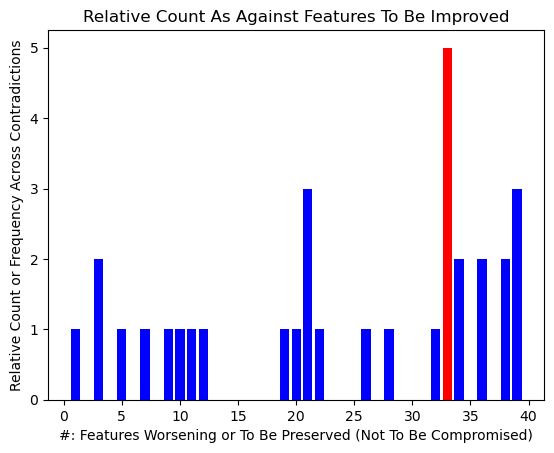
1/19 1/21 4/21 7/33 9/33 10/7 10/9 15/33 19/1 19/3 19/12 19/22 19/39 23/20 32/5 32/10 32/21 32/28 33/3 33/11 33/26 33/32 33/34 33/36 33/38 34/33 36/39 37/34 38/33 38/39 39/36 39/38
EXAMPLE: The application of the equipotentiality principle in the context of a wheelchair ramp involves considering various factors and parameters as having equal potential for improvement to provide accessibility for individuals with mobility challenges. The parameters being addressed in this case include convenience, safety, and inclusivity, and the contradiction being resolved is between providing accessibility and overcoming physical barriers. By applying the equipotentiality principle in the design of a wheelchair ramp, designers and architects can create an inclusive and accessible environment that minimizes the contradiction between the need for accessibility and the presence of physical barriers. The principle encourages a holistic approach, where all design elements are considered equally important in achieving the goal of improving accessibility for individuals with mobility challenges
Contradiction (1/19 and 1/21): Individuals with mobility challenges face obstacles when navigating spaces with elevation changes, such as steps or stairs. The need for accessibility conflicts with the presence of physical barriers that impede the movement of individuals using wheelchairs or other mobility aids. One should be able to pull up heavy item or weight across a height without increasing the need of more power or energy consumption or effort.
Solution: Apply equipotentiality by treating various design elements of the wheelchair ramp as having equal potential for contributing to improved accessibility. This includes slope, surface texture, handrails, and landing areas. View the slope of the ramp as an element with equal potential for improvement. Design the slope to be gradual enough for easy wheelchair navigation while considering safety and space constraints. Treat surface texture and traction as important parameters. Choose materials and designs that provide sufficient grip for wheelchairs and ensure a safe and comfortable ascent or descent.
Consider handrails as equally important components. Optimize handrail placement, height, and design to assist individuals with mobility challenges while ascending or descending the ramp.Treat landing areas and transitions between the ramp and adjacent surfaces as having equal significance. Design these areas to provide smooth and safe transitions for wheelchair users. Embrace an inclusive approach that considers the needs of individuals with various types of mobility challenges. Equipotentiality encourages designers to address the diverse requirements of users, including those using wheelchairs, walkers, or other mobility aids.