
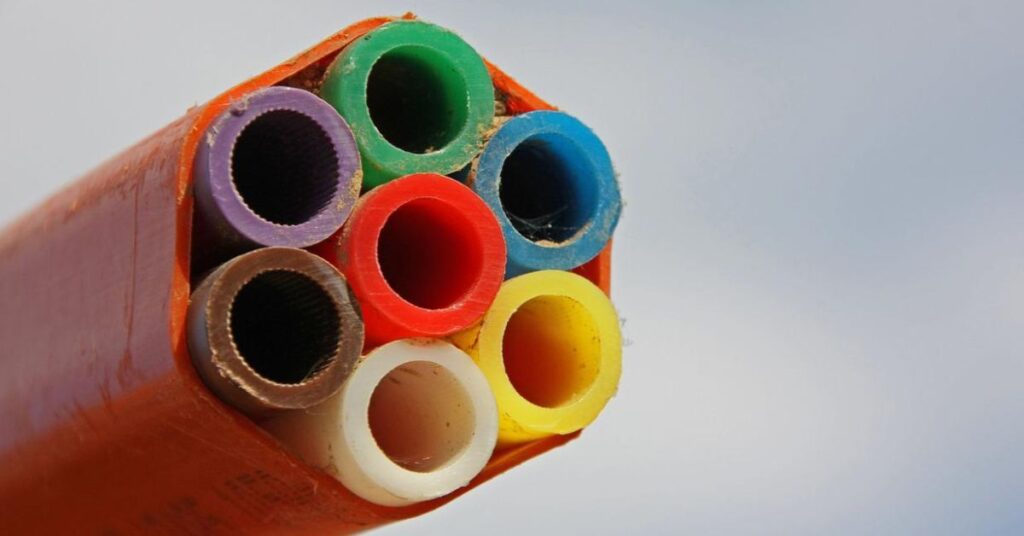

40: COMPOSITE MATERIAL: (A) Replace homogeneous or uniform materials (or objects or systems) with composite (multiple) materials.
EXAMPLE: Aircraft Structures like Wings to provide high strength at low weight, Composite epoxy resin/carbon fiber golf club shafts, Fiberglass surfboards, Fiberglass Reinforced Plastic (FRP) applications like boat hulls, automobile components, aircraft parts, and sports equipment. Carbon Fiber Reinforced Polymer (CFRP) applications like aerospace components, high-performance sports equipment, automotive parts. Metal Matrix Composites (MMC) applications like automotive components, electronic packaging, aerospace structures. Natural Fiber Composites applications like automotive interiors, construction materials, packaging. Concrete with Fiber Reinforcement applications like building construction, infrastructure repair.
SYNONYMS: Composite, Composite Structure, Composite System, Composite Substance, Hybrid Material, Compound Material, Mixed Material, Blended Material, Multimaterial, Multiphase Material, Different strengths combined
ACB:
A composite material is a material made from two or more constituent materials with significantly different physical or chemical properties that, when combined, produce a material with characteristics different from the individual components. The combination of these materials allows for the enhancement of specific properties, making composites versatile and suitable for various applications. It can be a polymer, metal, ceramic, or another type of material as a matrix. The reinforcement materials are embedded within the matrix to enhance specific properties of the composite. Reinforcement materials can be fibers, particles, or other structures. Common types of reinforcement include fiberglass, carbon fiber, aramid (such as Kevlar), and various types of particles. The combination of matrix and reinforcement results in a material that often exhibits improved strength, stiffness, durability, and other desirable properties compared to the individual components. The specific characteristics of a composite material depend on the choice of matrix, reinforcement, and their relative proportions. Composite materials are widely used in various industries due to their versatility and the ability to tailor their properties for specific applications. The design flexibility and performance improvements offered by composites make them valuable in sectors such as aerospace, automotive, construction, sports and recreation, and more.
Both composite materials and alloys offer tailored properties for specific applications, composites involve the combination of distinct materials to create a new material with enhanced properties, and alloys consist of a homogeneous mixture of different elements at the atomic level. Shape memory effects are unique to certain alloys, particularly shape memory alloys, where reversible changes in shape or size occur in response to temperature variations. Composite materials and alloys are both engineered materials with specific properties tailored for particular applications, but they differ in composition, structure, and behavior:
Composite Materials: Composite materials are composed of two or more distinct materials (reinforcement and matrix) combined to create a new material with enhanced properties. The components remain separate and retain their individual characteristics. Examples include fiberglass (glass fibers in a polymer matrix) and carbon fiber composites (carbon fibers in a polymer matrix). Composites often exhibit synergistic properties such as high strength-to-weight ratio, corrosion resistance, and tailored electrical or thermal conductivity. Alloys: Alloys are homogeneous mixtures of two or more metallic elements or a metal and a non-metal. In alloys, the atoms of different elements are intermixed at the atomic level, resulting in a single-phase solid solution. Alloys can exhibit a wide range of properties depending on the composition, including improved strength, hardness, corrosion resistance, and thermal conductivity. Examples include steel (iron-carbon alloy) and brass (copper-zinc alloy). Unlike composites, alloys do not have distinct reinforcement and matrix phases; instead, they form a single, uniform microstructure.
By replacing homogeneous materials with composite ones, engineers can tailor the properties of the materials to meet specific application requirements more precisely. Composite materials offer advantages such as enhanced strength, durability, lightweight, and multifunctionality, making them valuable for a wide range of industrial, automotive, aerospace, and consumer product applications. Replacing homogeneous (uniform) materials with composite ones involves using materials that consist of two or more distinct components with different properties. These components can have the same or different aggregate states, meaning they can be in solid, liquid, or gas phases. Composite materials are engineered to achieve specific performance characteristics that may not be attainable with homogeneous materials alone:
Identify Properties Needed: Determine the desired properties for the application. This could include mechanical strength, thermal conductivity, electrical conductivity, or other specific requirements. Select Components: Choose the components for the composite material based on their individual properties and how they will contribute to the desired characteristics of the composite. These components can be materials with different aggregate states, such as solid fillers in a liquid matrix or gas bubbles dispersed in a solid matrix. Design Composite Structure: Decide on the structure and arrangement of the components within the composite material. This may involve dispersing solid particles, fibers, or flakes within a matrix material, or creating layered structures with alternating layers of different materials. Optimize Composition: Experiment with different compositions and ratios of the components to achieve the desired balance of properties. This may involve adjusting the concentration, size, shape, or orientation of the components within the composite.
Manufacture Composite: Produce the composite material using appropriate manufacturing techniques, such as casting, molding, extrusion, or additive manufacturing methods like 3D printing. Ensure proper mixing and dispersion of the components to achieve uniformity and consistency in the final product. Test and Evaluate: Perform testing and evaluation to assess the performance of the composite material under various conditions. This may include mechanical testing, thermal analysis, electrical conductivity measurements, or other relevant tests to verify that the composite meets the required specifications. Iterate and Refine: Based on the test results, iterate on the design and composition of the composite material as needed to optimize its performance. This may involve making adjustments to the component materials, their proportions, or the manufacturing process to achieve the desired properties more effectively.
This inventive principle suggests using composite materials to improve the characteristics of an object instead of using a single homogeneous material for a given component or structure. The key idea behind is to create a material that possesses the desired combination of properties, such as strength, flexibility, durability, weight or other desirable characteristics.. By carefully selecting and combining different materials, engineers and designers can tailor the characteristics of the composite material to meet specific requirements. At an abstract level, this principle involves the idea of enhancing system performance by combining different materials to create a composite with improved properties. This principle leverages the diverse characteristics of individual materials to address specific challenges and achieve superior results compared to using a single uniform material. It involves the strategic combination of materials to create composites that offer enhanced and tailored properties, leading to innovative solutions in engineering and design:
(1) Incorporating strong fibers (e.g., carbon, glass, or aramid fibers) into a matrix material (e.g., resin) to create a composite material with high strength and light weight. Laminates: Stacking layers of materials with different properties to create laminated structures with enhanced strength, stiffness, or other desirable features. (ii) Using lightweight foam cores sandwiched between layers of materials to create composite structures with high strength-to-weight ratios. Metal Matrix Composites: Introducing reinforcing materials (e.g., ceramic particles or fibers) into metal matrices to enhance the mechanical properties of metals.
(iii) Traditional bicycle frames were often made of a uniform material such as steel or aluminum. Modern bicycles, however, often use composite materials like carbon fiber reinforced polymers. These composite frames are lighter, stiffer, and provide better shock absorption compared to uniform metal frames. (iv) In the automotive industry, composite materials, such as carbon fiber reinforced plastics, are increasingly used to manufacture components like body panels and interior parts. These composites offer a balance of strength, reduced weight, and corrosion resistance. (v) Boat hulls made from a composite of fiberglass and other materials are common. These composite hulls can be designed to be both lightweight and durable, offering advantages over traditional uniform materials like wood or metal. (vi) The addition of carbon fiber reinforcement to concrete can create a composite material that exhibits improved tensile strength and crack resistance. This is particularly useful in applications where traditional concrete may be prone to cracking. (vii) Ski manufacturers often use composite materials in the construction of skis. Hybrid skis may combine materials like wood, metal, and carbon fiber to achieve a balance of stiffness, responsiveness, and lightness.
Combining materials allows for the synergistic utilization of their individual properties. For example, one material may contribute strength, while another contributes flexibility. The resulting composite benefits from a combination of these desirable characteristics: (i) Designers can tailor the properties of composite materials to meet specific requirements. By strategically choosing and arranging different components, it becomes possible to create materials with customized attributes, such as increased strength-to-weight ratio or improved resistance to environmental factors. (ii) The goal is to optimize the functionality and performance of a system by selecting materials that complement each other. This may involve addressing limitations or drawbacks associated with a uniform material through the incorporation of other materials with compensating qualities. (iii) The principle encourages innovative thinking in material selection and design. Engineers are prompted to explore unconventional combinations to achieve breakthroughs in performance, durability, or other critical factors.
Composite materials often exhibit multifunctional properties, where a single material can serve multiple purposes. This versatility can lead to more efficient and compact designs in various applications: (i) Composite materials can be designed to address specific constraints or challenges in a system. For instance, weight reduction in aerospace applications or increased durability in harsh environments. (ii) By optimizing material usage, composite solutions can contribute to economic and environmental sustainability. This involves achieving performance goals with fewer resources or with materials that have less environmental impact.
Composite materials are widely used in various industries due to their unique properties and versatility. Here are some examples of popular composite materials and their applications: Fiber-Reinforced Polymers (FRP): Composition: Typically made of a polymer matrix (such as epoxy, polyester, or vinyl ester) reinforced with fibers (such as carbon, glass, or aramid). Applications: Aerospace: Used in aircraft components, such as fuselages, wings, and empennage structures, due to their lightweight, high strength-to-weight ratio, and resistance to corrosion. Automotive: Used in automotive parts, including body panels, chassis components, and interior trim, to reduce weight and improve fuel efficiency without sacrificing strength or durability. Marine: Commonly used in boat hulls, decks, and other marine structures for their resistance to water, chemicals, and UV degradation.
Carbon Fiber Reinforced Polymers (CFRP): Composition: Consists of carbon fibers embedded in a polymer matrix, often epoxy resin. Applications: Sports Equipment: Widely used in high-performance sports equipment such as bicycles, tennis rackets, golf clubs, and hockey sticks for their lightweight, stiffness, and strength. Automotive: Utilized in high-end automotive applications, including racing cars and luxury vehicles, to reduce weight and enhance performance. Wind Energy: Used in wind turbine blades to withstand high loads and fatigue cycles while maintaining lightweight construction.
Glass Fiber Reinforced Polymers (GFRP): Composition: Comprises glass fibers embedded in a polymer matrix, commonly polyester or epoxy resin. Applications: Construction: Used in construction applications such as bridges, building facades, and reinforcement of concrete structures due to their corrosion resistance, high strength, and lightweight properties. Consumer Goods: Employed in consumer goods like sporting goods, furniture, and electronic enclosures for their durability, impact resistance, and aesthetic appeal. Infrastructure: Utilized in pipes, tanks, and other infrastructure components for their resistance to chemicals, weathering, and corrosion.
Aramid Fiber Reinforced Polymers (AFRP): Composition: Consists of aramid fibers (e.g., Kevlar) embedded in a polymer matrix, often epoxy or phenolic resin. Applications: Ballistic Protection: Used in body armor, helmets, and vehicle armor due to their exceptional strength-to-weight ratio and resistance to penetration by bullets and projectiles. Industrial: Employed in industrial applications such as conveyor belts, hoses, and cables for their high strength, heat resistance, and resistance to abrasion. Aerospace: Utilized in aerospace applications for structural components requiring high stiffness, fatigue resistance, and impact resistance.
These examples illustrate the diverse range of applications for composite materials across industries, driven by their unique combination of properties such as high strength-to-weight ratio, corrosion resistance, durability, and design flexibility.
This principle can be metaphorically extended to business problem-solving by recognizing the diversity of resources, approaches, and strategies that can be combined to address complex challenges. In the business context, this principle encourages organizations to leverage a variety of elements to enhance performance, adaptability, and innovation. By applying this inventive principle in a business context, organizations can creatively address contradictions, optimize their operations, and enhance overall competitiveness through a thoughtful combination of diverse elements. This approach fosters resilience, adaptability, and continuous innovation in the face of complex business challenges.
(i) Combining individuals with diverse skill sets and backgrounds within a team can lead to innovative problem-solving. Each team member contributes unique perspectives and expertise, allowing for a more comprehensive approach to business challenges. Integration of Technologies: Embracing a variety of technologies and tools can lead to more robust and effective business solutions. Integration of different software platforms, automation tools, or communication technologies can enhance overall operational efficiency. (ii) Instead of relying on a single business model, companies may explore composite or hybrid models that blend traditional and innovative approaches. This could involve combining product sales with subscription services, partnerships, or other revenue streams. (iii) Collaborating with diverse partners, suppliers, or other stakeholders can provide businesses with a composite advantage. Strategic partnerships allow companies to access additional resources, markets, or technologies that they might not possess individually.
(iv) Employing a mix of marketing channels, including digital, traditional, and experiential, can create a more comprehensive and effective outreach. This composite marketing strategy can cater to diverse audience preferences and behaviors. (v) Businesses may benefit from adopting composite organizational structures that blend traditional hierarchies with more agile and cross-functional teams. This adaptability allows for efficient response to changing market conditions. (vi) Building a composite innovation ecosystem involves engaging with a variety of stakeholders, including startups, research institutions, and customers. This collaborative approach can accelerate the development of innovative solutions. (vii) Rather than focusing exclusively on short-term gains or long-term strategies, businesses can adopt a composite approach. This involves balancing immediate priorities with sustained efforts for future growth and resilience. (viii) Developing composite risk mitigation strategies involves diversifying risk across various factors, such as markets, products, and investment portfolios. This approach helps businesses navigate uncertainties more effectively. (ix) Combining various customer-centric approaches, such as personalized experiences, data-driven insights, and responsive customer support, can create a composite strategy for customer satisfaction and loyalty.
The use of composite materials often addresses various engineering and manufacturing contradictions by combining different materials to achieve an optimal balance of properties: (I) Traditional materials like metals may offer high strength but come with a significant weight penalty. Composite materials, especially those with high-strength fibers like carbon or aramid in a lightweight polymer matrix, provide a balance between strength and weight. This is crucial in industries like aerospace and automotive. (ii) Metals with excellent structural properties may be prone to corrosion. Composite materials, especially those with non-metallic matrices, can offer both structural integrity and corrosion resistance. For example, fiberglass reinforced composites can be corrosion-resistant in aggressive environments. (iii) Materials with good thermal conductivity often lack insulation properties. Composite materials can be engineered to balance thermal conductivity and insulation. For instance, carbon fiber composites can provide structural strength with lower thermal conductivity. (iv) Materials that are very rigid may lack flexibility, and vice versa. Composite materials allow tailoring flexibility and rigidity by choosing appropriate matrix and reinforcement materials. Fiber-reinforced polymers can offer flexibility along with structural strength.
(v) High-performance materials can be expensive. Composite materials allow for cost-effective solutions by optimizing the use of high-performance materials where needed. For example, using a composite structure in strategic areas of an aircraft can reduce overall weight and enhance performance without using expensive materials throughout. (vi) Durable materials might be heavy. Composite materials can provide durability with reduced weight. Carbon fiber composites, for example, offer high strength and durability with lower density compared to traditional materials like steel. (vii) Complex designs may be challenging to produce efficiently. Composite materials can be molded into complex shapes, allowing for intricate designs. Advanced manufacturing techniques, like resin infusion or automated fiber placement, facilitate the production of complex composite structures. (viii) Materials resistant to harsh chemicals may lack mechanical strength. Composite materials can be engineered for both chemical resistance and mechanical strength. For instance, certain fiber-reinforced composites are known for their chemical resistance and structural integrity.
Anisotropic is a term used to describe a material or substance that exhibits different properties or behaviors in different directions. In other words, the characteristics of an anisotropic material can vary depending on the direction in which they are measured or observed. For example, in the context of materials science and engineering: Mechanical Properties: Anisotropic materials may have different mechanical properties, such as strength, stiffness, or ductility, depending on the direction of applied force or deformation. For instance, wood is an anisotropic material because it is typically stronger and stiffer along the direction of the wood grain compared to perpendicular directions. Electrical Conductivity: Some materials exhibit anisotropic electrical conductivity, meaning they conduct electricity more readily in certain directions than others. Graphite is an example of an anisotropic material with high electrical conductivity along its layers. Thermal Conductivity: Anisotropic materials may also have different thermal conductivity properties in different directions. For instance, heat may transfer more easily along certain crystallographic axes in a crystalline material, resulting in anisotropic thermal conductivity. Optical Properties: Certain materials may exhibit anisotropic optical properties, such as birefringence, where light travels at different speeds in different directions through the material. Liquid crystals are an example of anisotropic materials commonly used in displays and optical devices.
In contrast, isotropic materials have uniform properties in all directions. For example, most metals are considered isotropic because their mechanical, thermal, and electrical properties are generally the same regardless of the direction in which they are measured. Understanding whether a material is isotropic or anisotropic is essential for various engineering applications, such as structural design, heat transfer analysis, and electronic device fabrication, as it can significantly impact the material’s performance and behavior in different conditions.
1: Mass of the moving object: [‘7: Volume of the moving object’, ’11: Tension, Pressure’, ’12: Shape’, ’14: Strength’]
2: Mass of the non-moving object: [’13: Stability of the object’]
3: Length of the moving object: [’27: Reliability’]
4: Length of the non-moving object: [‘2: Mass of the non-moving object’, ‘6: Area of the non-moving object’]
5: Area of the moving object: [’14: Strength’]
6: Area of the non-moving object: [’14: Strength’, ’26: Amount of substance’, ’27: Reliability’, ’31: Harmful internal factors’, ’32: Convenience of manufacturing’]
7: Volume of the moving object: [‘1: Mass of the moving object’, ’27: Reliability’, ’31: Harmful internal factors’, ’32: Convenience of manufacturing’]
8: Volume of the non-moving object: [’13: Stability of the object’]
9: Speed: [’11: Tension, Pressure’]
10: Force: [’12: Shape’, ’23: Material loss’, ’30: Harmful external factors’]
11: Tension, Pressure: [‘1: Mass of the moving object’, ’13: Stability of the object’, ’14: Strength’]
12: Shape: [‘1: Mass of the moving object’, ’10: Force’, ’14: Strength’, ’27: Reliability’, ’29: Accuracy of manufacturing’]
13: Stability of the object: [‘2: Mass of the non-moving object’, ‘8: Volume of the non-moving object’, ’11: Tension, Pressure’, ’23: Material loss’, ’31: Harmful internal factors’, ’39: Productivity’]
14: Strength: [‘1: Mass of the moving object’, ‘2: Mass of the non-moving object’, ‘5: Area of the moving object’, ‘6: Area of the non-moving object’, ’11: Tension, Pressure’, ’12: Shape’, ’17:Temperature’, ’23: Material loss’, ’33: Convenience of use’, ’37: Complexity of control and measurement’]
15: Action time of the moving object: [’26: Amount of substance’, ’29: Accuracy of manufacturing’]
16: Action time of the non-moving object: [‘4: Length of the non-moving object’, ’17:Temperature’, ’27: Reliability’, ’30: Harmful external factors’]
17:Temperature: [‘7: Volume of the moving object’, ’14: Strength’, ’16: Action time of the non-moving object’]
21: Power: [’12: Shape’]
23: Material loss: [‘1: Mass of the moving object’, ’10: Force’, ’13: Stability of the object’, ’14: Strength’, ’30: Harmful external factors’]
26: Amount of substance: [‘6: Area of the non-moving object’, ’13: Stability of the object’, ’15: Action time of the moving object’, ’27: Reliability’, ’31: Harmful internal factors’]
27: Reliability: [‘1: Mass of the moving object’, ‘6: Area of the non-moving object’, ’16: Action time of the non-moving object’, ’26: Amount of substance’, ’30: Harmful external factors’, ’31: Harmful internal factors’, ’33: Convenience of use’, ’37: Complexity of control and measurement’]
29: Accuracy of manufacturing: [’12: Shape’, ’15: Action time of the moving object’]
30: Harmful external factors: [’16: Action time of the non-moving object’, ’23: Material loss’, ’27: Reliability’, ’36: Complexity of the structure’, ’37: Complexity of control and measurement’]
31: Harmful internal factors: [‘6: Area of the non-moving object’, ‘7: Volume of the moving object’, ’10: Force’, ’13: Stability of the object’, ’27: Reliability’]
32: Convenience of manufacturing: [‘6: Area of the non-moving object’, ‘7: Volume of the moving object’]
33: Convenience of use: [’14: Strength’, ’27: Reliability’]
36: Complexity of the structure: [’30: Harmful external factors’]
37: Complexity of control and measurement: [’10: Force’, ’27: Reliability’]
39: Productivity: [’12: Shape’]
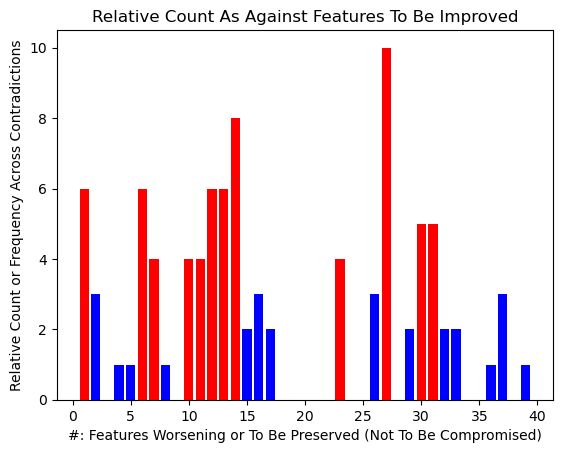
1/7 1/11 1/12 1/14 2/13 3/27 4/2 4/6 5/14 6/14 6/26 6/27 6/31 6/32 7/1 7/27 7/31 7/32 8/13 9/11 10/12 10/23 10/30 11/1 11/13 11/14 12/1 12/10 12/14 12/27 12/29 13/2 13/8 13/11 13/23 13/31 13/39 14/1 14/2 14/5 14/6 14/11 14/12 14/17 14/23 14/33 14/37 15/26 15/29 16/4 16/17 16/27 16/30 17/7 17/14 17/16 21/12 23/1 23/10 23/13 23/14 23/30 26/6 26/13 26/15 26/27 26/31 27/1 27/6 27/16 27/26 27/30 27/31 27/33 27/37 29/12 29/15 30/16 30/23 30/27 30/36 30/37 31/6 31/7 31/10 31/13 31/27 32/6 32/7 33/14 33/27 36/30 37/10 37/27 39/12
EXAMPLE: Modern commercial aircraft, such as the Boeing 787 Dreamliner and Airbus A350, extensively use composite materials in their structures. These aircraft achieve a balance between reduced mass, increased fuel efficiency, and optimal cabin space for passengers and cargo. The lightweight nature of composite materials contributes to improved fuel efficiency, which is a critical factor in the aerospace industry. Composites can provide excellent durability and fatigue resistance, contributing to the long-term structural integrity of the aircraft. Composite materials can be molded into complex shapes, allowing for more aerodynamically efficient and innovative aircraft designs.The durability and corrosion resistance of composites can result in lower maintenance costs over the life of the aircraft. Overall, the use of composite materials in aircraft design addresses the demand for lighter, more fuel-efficient, and technologically advanced aircraft, contributing to advancements in aerospace technology and design.
Contradiction (1/14): Reduce the mass of the aircraft to enhance fuel efficiency and maneuverability. Maintain or increase the volume of the aircraft for passenger capacity and cargo space.
Solution: Instead of using a uniform material for the aircraft structure, composite materials are considered. Traditional aircraft materials like aluminum have a trade-off between weight and strength. Composite materials, such as carbon-fiber-reinforced polymers (CFRP), offer a solution. CFRP combines lightweight carbon fibers with a polymer matrix. Sections of the fuselage are often constructed using composite materials. This helps reduce weight while maintaining structural integrity. Horizontal and Vertical Stabilizers: Composite materials are employed in the tail section to provide necessary strength, stiffness, and durability. The tail components contribute to stability and control during flight. Composite materials are used in the interior for panels, flooring, and other non-structural components. This helps in reducing overall weight and enhancing fuel efficiency. Some aircraft use composites in the construction of seats, providing a balance between strength and weight. Composite materials, including carbon fiber composites, are used in the construction of aircraft engine fan blades. This reduces weight and contributes to the efficiency of the propulsion system. Components of the engine nacelle, including thrust reversers and inlet lips, may also incorporate composite materials for their structural and thermal properties.
Carbon fibers are lightweight and have high strength-to-weight ratios, reducing the overall mass of the aircraft. The design flexibility of composite materials allows for intricate and space-efficient structures, maximizing the internal volume for passengers and cargo. The reduced mass contributes to fuel efficiency, addressing the mass-related contradiction. Composite materials provide high strength, addressing safety concerns associated with reducing traditional materials. The ability to mold composite materials into various shapes optimizes internal space, addressing the volume-related contradiction.
References
“Introduction to Composite Materials Design” by Ever J. Barbero: This book provides a comprehensive introduction to composite materials, covering their design, analysis, and application.
“Mechanics of Composite Materials” by Autar K. Kaw: Focused on the mechanics aspects, this book is widely used in academia to teach the principles of composite materials.
“Composite Materials: Fabrication Handbook #1” by John Wanberg: A practical guide for enthusiasts and professionals involved in the fabrication of composite materials. It covers hands-on techniques.
“Composite Materials: Science and Applications” by Deborah D. L. Chung: This book is suitable for both undergraduate and graduate students, providing a comprehensive overview of composite materials.
“Analysis and Performance of Fiber Composites” by Bhagwan D. Agarwal and Lawrence J. Broutman: It focuses on the analysis and performance of fiber-reinforced composites, making it valuable for engineers and researchers.
“Introduction to Composite Materials” by A. K. Chawla: Aimed at students and professionals, this book covers the basics of composite materials and their applications.
“Principles of Composite Material Mechanics” by Ronald F. Gibson: An in-depth text covering the mechanics and behavior of composite materials, suitable for advanced study.
“Composite Materials: Properties as Influenced by Phase Geometry” by Morton L. Fine: This book explores the influence of phase geometry on the properties of composite materials.
“Composite Materials: Design and Applications” by Daniel Gay: A comprehensive text addressing the design aspects of composite materials along with practical applications.
“Polymer Matrix Composites: Materials Usage, Design, and Analysis” by Suong V. Hoa: Focusing on polymer matrix composites, this book is a valuable resource for those interested in this specific category of materials.


Boa noite, galera! O cassino55bet tem uma boa variedade de slots? Tô querendo jogar umas máquinas novas, mas não sei onde procurar. Se conhecerem, me avisem! Confiram: cassino55bet
The app installation was smooth and the interface is really intuitive. Best experience I have had in a while. Check out 1777betappdownloadapk for a great time.
The APK installation was super simple and the app runs perfectly on my Android. No crashes so far. Get betwinerapk and start winning!