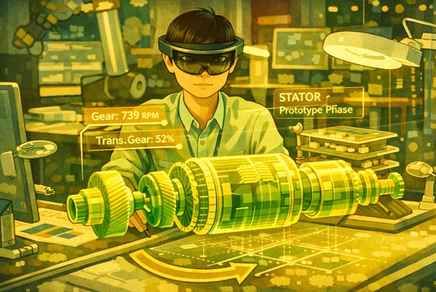
Extended Reality (XR) and haptics are transforming how humans interact with machines, data, and digital environments. In Industry 4.0, these technologies enhance perception, training, collaboration, and control by blending physical and digital worlds and by reintroducing the sense of touch into human–machine interactionThe Internet of Things (IoT) and Digital Twins are foundational technologies of Industry 4.0. Together, they connect physical assets to digital systems, enabling real-time visibility, simulation, prediction, and optimization. In modern manufacturing, IoT provides the data, while Digital Twins transform that data into actionable intelligence. In aerospace manufacturing and operations, IoT and Digital Twins must operate at enterprise scale while meeting stringent requirements for safety, security, certification, and traceability. For organizations such as Boeing, these technologies enable smarter factories, predictive maintenance, and digitally connected operations across the product lifecycle. In digital manufacturing and smart factories, XR and haptics are not entertainment technologies—they are productivity, safety, and quality enablers. Enterprises deploying automation and robotics increasingly rely on immersive visualization and tactile feedback to support workers, reduce errors, and improve system usability at scale.
Learning Objectives
This module covers AR, VR, MR, and XR fundamentals; applications of XR in digital manufacturing and smart factories; pilot implementations of VR in BIM; haptics for robotics and biomedical applications; vibrotactile sensitivity; human touch mechanoreceptors; and human-in-the-loop systems. After completing this module, learners will be able to differentiate AR, VR, MR, and XR; explain XR usage in digital manufacturing and smart factories; understand VR applications in BIM pilot implementations; explain the role of haptics in robotics and biomedical systems; understand vibrotactile sensitivity; and describe human mechanoreceptors relevant to haptic devices
Key Concepts
Augmented Reality (AR) overlays digital information onto the real world. Virtual Reality (VR) immerses users in fully virtual environments. Mixed Reality (MR) enables interaction between physical and digital objects. Extended Reality (XR) is an umbrella term encompassing AR, VR, and MR.
These concepts represent different points on the reality–virtuality continuum.
XR In Digital Manufacturing & Smart Factories
XR enables guided assembly and maintenance by overlaying instructions directly onto physical equipment. It supports remote expert assistance, immersive training for complex tasks, and digital work instructions that adapt in real time. These capabilities improve accuracy, reduce downtime, and shorten learning curves in smart factories.
VR In BIM – Pilot Implementations
Virtual Reality combined with Building Information Modeling (BIM) enables immersive design reviews, early clash detection, layout validation, and collaborative decision-making. Stakeholders can experience facilities at full scale before construction or modification begins.
Value From XR Pilot Implementations
XR pilot programs consistently reveal early design and process issues, improve spatial understanding, reduce late-stage change costs, and increase alignment among engineering, operations, and business stakeholders. These pilots help validate value before large-scale rollout
Introduction To Haptics
Haptics introduces the sense of touch into digital systems. It provides force feedback, tactile feedback, and kinesthetic interaction, allowing users to feel resistance, texture, and motion rather than relying on vision alone.
Haptics In Robotics Applications
In robotics, haptics supports teleoperation, precision manipulation, training and simulation, and safety-critical control. Operators can feel contact forces and adjust actions intuitively, improving accuracy and safety when controlling robots remotely or collaboratively.
Haptics In Biomedical Applications
Biomedical applications of haptics include surgical simulation, rehabilitation devices, prosthetics, and skill training. Haptic feedback enables realistic practice, improved motor learning, and more natural interaction with assistive devices.
Vibrotactile Sensitivity
Vibrotactile feedback uses vibration to convey information such as alerts, boundaries, or guidance. The effectiveness of vibrotactile cues depends on frequency and amplitude and is widely used in wearables, controllers, and handheld devices.
Human Touch Mechanoreceptors
Human touch perception is enabled by specialized mechanoreceptors. Merkel cells detect pressure and texture. Meissner corpuscles respond to light touch. Pacinian corpuscles are sensitive to vibration. Ruffini endings detect skin stretch.
Understanding these receptors is critical for designing effective haptic systems.
XR + Haptics In Human-In-The-Loop Systems
When XR and haptics are combined in human-in-the-loop systems, they improve situational awareness, reduce cognitive load, enable safer human–robot collaboration, and support factory flow simulation. Humans remain active decision-makers, supported by immersive and tactile feedback.
Enterprise Perspective (Example: Boeing)
From an enterprise perspective, organizations such as Boeing must consider worker safety, ergonomics, certification and compliance, and cost–benefit validation when adopting XR and haptics. Governance ensures these technologies enhance performance without introducing new risks.
Key Takeaways
XR enhances perception, training, and collaboration. VR supports early design validation and stakeholder alignment. Haptics reintroduces touch and control into digital systems. Human physiology plays a critical role in system design. Enterprise adoption of XR and haptics must be governed to ensure safety, value, and scalability.