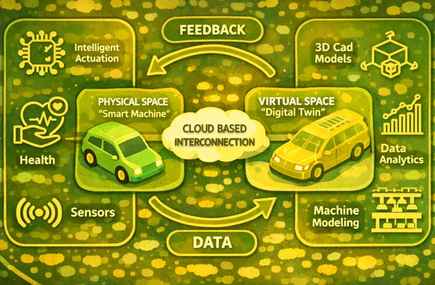
The Internet of Things (IoT) and Digital Twins are foundational technologies of Industry 4.0. Together, they connect physical assets to digital systems, enabling real-time visibility, simulation, prediction, and optimization. In modern manufacturing, IoT provides the data, while Digital Twins transform that data into actionable intelligence. In aerospace manufacturing and operations, IoT and Digital Twins must operate at enterprise scale while meeting stringent requirements for safety, security, certification, and traceability. For organizations such as Boeing, these technologies enable smarter factories, predictive maintenance, and digitally connected operations across the product lifecycle.
Learning Objectives
This module covers IoT fundamentals, RFID and localization technologies, IoT protocols with a focus on MQTT, RFID and MQTT integration patterns, IoT integration architectures, Digital Twin concepts and real-life scenarios, Eclipse Ditto as a Digital Twin implementation platform, and AI-assisted mitigation using Generative AI. After completing this module, learners will be able to explain IoT concepts and enterprise value, understand RFID and localization applications, describe IoT protocols with emphasis on MQTT, explain RFID and MQTT integration patterns, understand IoT integration architectures, explain Digital Twin concepts and real-world use cases, understand Eclipse Ditto as a Digital Twin platform, and relate IoT data to AI-driven mitigation and decision support.
Internet Of Things (IoT) – Fundamentals
The Internet of Things connects physical devices, sensors, and actuators to digital platforms through networks. These connections enable applications and analytics systems to monitor, analyze, and act on real-world events in near real time. IoT forms the data foundation for smart manufacturing and cyber-physical systems.
RFID – Identification & Tracking
RFID (Radio Frequency Identification) enables automatic identification of objects without direct line of sight. In industrial environments, RFID supports asset and part tracking, inventory visibility, and end-to-end traceability. This capability is critical for compliance, quality assurance, and lifecycle management.
Localization & Its Applications
Localization technologies determine the real-time position of assets, tools, and people. Common approaches include RFID-based Real-Time Location Systems (RTLS), Wi-Fi or BLE positioning, and ultra-wideband (UWB) systems. These technologies are used for tool and asset location, worker safety, and optimization of material flow across large factories.
IoT Protocols – Overview
IoT systems rely on lightweight communication protocols optimized for constrained devices and unreliable networks. Common protocols include MQTT, HTTP/REST, CoAP, and AMQP. Each protocol serves different use cases depending on latency, reliability, and scalability requirements.
MQTT – Message Queuing Telemetry Transport
MQTT is a lightweight, publish/subscribe-based messaging protocol designed for low bandwidth and unreliable networks. It uses a broker-based architecture, decoupling data producers from consumers. These characteristics make MQTT well suited for large-scale industrial IoT deployments.
RFID + MQTT Integration
A common Industry 4.0 integration pattern combines RFID and MQTT. RFID readers capture identification or movement events and publish them to an MQTT broker. Subscribed systems consume these events, feeding analytics platforms and Digital Twins. This pattern enables scalable, real-time traceability across the enterprise.
MQTT For Mitigation Using Generative AI
In advanced architectures, IoT events flowing through MQTT are analyzed by AI and ML models to detect anomalies. Generative AI can then explain the situation in natural language and recommend mitigation actions. Final decisions remain human-in-the-loop, ensuring safety, accountability, and trust.
IoT Integration Architecture
A typical IoT integration architecture consists of four layers. The device layer includes sensors, RFID readers, and actuators. The connectivity layer handles protocols and networks. The platform layer manages data ingestion, messaging, and device management. The application and analytics layer provides visualization, insights, and decision support.
Digital Twin – Concept
A Digital Twin is a digital representation of a physical asset, process, or system. It is continuously updated using IoT data and is used for monitoring, simulation, prediction, and optimization. Digital Twins bridge the physical and digital worlds.
Digital Twin – Real-Life Scenarios (Example: Boeing)
Real-life Digital Twin scenarios include aircraft assembly line twins for throughput optimization, tooling and robot cell twins for simulation and validation, predictive maintenance twins for health monitoring, and factory flow simulations for capacity planning and risk reduction.
Eclipse Ditto is an open-source Digital Twin framework that manages digital representations of devices and assets. It integrates with IoT platforms and messaging systems, making it suitable for implementing scalable Digital Twin solutions in industrial environments.
Enterprise Perspective (Example: Boeing)
From an enterprise perspective, IoT and Digital Twin implementations must address cybersecurity, data governance, safety and certification, and scalability and resilience. In aerospace, governance and architecture discipline are as important as the underlying technology.
Key Takeaways
IoT provides real-time data from the physical world. RFID and localization enable traceability and visibility. MQTT supports scalable and reliable messaging. Digital Twins enable simulation and optimization across the lifecycle. Strong governance is essential for safe and effective adoption in aerospace environments.