
Focus Areas
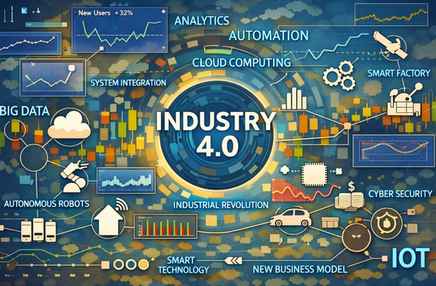
Industry 4.0 represents a fundamental shift in how manufacturing systems are designed, operated, and optimized. This module focuses on the evolution of industrial revolutions and the emergence of Industry 4.0 as a data-driven paradigm. It explores Industry 4.0 frameworks and characteristics, key technologies and design principles, smart manufacturing and product development practices, advanced robotics and additive manufacturing, and the use of maturity models to guide adoption.
Learning Objectives
After completing this module, learners will be able to explain Industry 4.0 and its historical evolution, identify its benefits and challenges, and describe the key technologies that enable it. Learners will also be able to apply Industry 4.0 design principles, understand maturity indices and frameworks, explain smart manufacturing and digital product development, and recognize advanced use cases such as autonomous robots and additive manufacturing.
Evolution Of Industrial Revolutions
Industrial development has progressed through four major revolutions. Gaps exist because each revolution required enabling technologies to mature. Industry 1.0 introduced mechanization through steam and water power. Industry 2.0 enabled mass production using electricity and assembly lines. Industry 3.0 brought automation through electronics, IT systems, and programmable logic controllers (PLCs). Industry 4.0 builds on these foundations by integrating cyber-physical systems and enabling data-driven, intelligent manufacturing.
| Industrial Revolution | Approximate Timeline |
|---|---|
| Industry 1.0 | ~1760–1840 |
| Industry 2.0 | ~1870–1914 |
| Industry 3.0 | ~1970–2000 |
| Industry 4.0 | ~2011–present |
The evolution from Industry 1.0 to Industry 4.0 represents a shift from mechanized manual labor to mass production, then automated manufacturing, and finally to intelligent, connected, and data-driven manufacturing systems. In enterprises such as Boeing, this evolution is reflected in the transition from manual aircraft assembly to digitally integrated smart factories.
| Industrial Stage | Core Focus | Manufacturing Example (Analogy) |
|---|---|---|
| Industry 1.0 | Mechanization | Manual assembly with mechanical tools |
| Industry 2.0 | Mass production | Electrified assembly lines and standardized parts |
| Industry 3.0 | Automation | CNC machines, PLCs, robotic drilling |
| Industry 4.0 | Intelligence & connectivity | Digital twins, IIoT, simulation-driven automation |
Industry 1.0 refers to the first industrial revolution, occurring roughly between 1760 and 1840, characterized by mechanization through steam and water power. Industry 1.0 introduced mechanization through steam and water power. Industry 1.0 is associated with the First Industrial Revolution, which began in Britain and later spread to Europe and North America. Key enabling factors during this time: Steam engines (James Watt’s improvements in the 1760s–1770s), Water-powered machinery, Mechanization of textile and metalworking industries, Transition from cottage industries to early factories. Industry 1.0 marks the shift from manual craftsmanship to mechanized production using steam engines and water power. Machines assisted human labor, but control and skill remained largely manual.
When early aircraft manufacturing emerged in the early 20th century (including Boeing’s early years), production relied on: Hand tools and mechanically assisted equipment. Skilled craftsmen shaping and assembling parts. Limited standardization. Aircraft parts were built one at a time, with heavy dependence on human skill. Industry 1.0 introduced mechanical assistance to human labor but lacked standardization, automation, and scalability. Industry 1.0 predates Boeing (founded in 1916). Boeing did not operate during Industry 1.0. But Industry 1.0 laid the manufacturing foundations: Mechanization, Factory-based production, Standardized mechanical processes. Although Boeing emerged much later, its manufacturing heritage builds on principles first introduced during Industry 1.0.
Industry 2.0 refers to the second industrial revolution, occurring roughly between 1870 and 1914, characterized by electrification, assembly lines, and mass production. Industry 2.0 enabled mass production using electricity and assembly lines. Industry 2.0 introduced electric power, enabling assembly lines and mass production. Products were standardized, and work was broken into repeatable tasks. Key characteristics: Electrification. Assembly-line production. Division of labor. Standardized parts.
Boeing context: Boeing was founded in 1916, right at the end of Industry 2.0. Early Boeing manufacturing strongly reflected Industry 2.0 principles. Examples: Electrically powered tools, Assembly-line-style aircraft production, Standardized aircraft components, Rapid scaling of production during wartime. As Boeing scaled aircraft production (especially during wartime and commercial aviation expansion): Electrically powered tools replaced mechanical ones. Aircraft assembly was organized into stations. Parts and subassemblies were standardized. Production volumes increased significantly. Aircraft moved along assembly lines rather than being built entirely in one place. Industry 2.0 enabled scale and consistency through electrification and assembly-line manufacturing.
| Industry 1.0 | Industry 2.0 |
|---|---|
| Steam & water power | Electricity |
| Mechanization | Mass production |
| Craft-based work | Assembly-line work |
| Small factories | Large industrial plants |
Industry 3.0 (1970–2000) introduced automation through electronics, IT, and PLCs, enabling programmable and repeatable manufacturing processes. Industry 3.0 introduced automation using electronics and computers. Key enablers: Electronics and semiconductors. Computers and IT systems. PLCs (Programmable Logic Controllers). CNC machines. Early industrial robots. Manufacturing systems could now: Execute pre-programmed logic, Reduce human intervention, Improve precision and repeatability. CNC stands for Computer Numerical Control. CNC is a manufacturing method where machines are controlled by computer programs instead of manual operation. The computer tells the machine exactly what to do, how fast, and where to move.
Systems were automated, but mostly standalone and siloed. For Example, at Boeing, Industry 3.0 is seen in: CNC machining of aircraft structural components. PLC-controlled drilling and fastening equipment. Early industrial robots performing repetitive tasks. IT systems supporting production planning and tracking. Automation improved quality and consistency, but data was not yet fully connected across the enterprise.
CNC is how software controls physical manufacturing. A CNC machine: Cuts, drills, mills, or shapes material. Follows precise digital instructions. Repeats the same operation with high accuracy. Common CNC machines: CNC milling machines, CNC lathes, CNC drilling machines, CNC machining centers. How CNC Works (Step by Step): Engineers create a digital design (3D CAD model). The model is converted into machine instructions (G-code). The CNC controller reads the instructions. Motors move the cutting tool along precise paths. The part is produced with micron-level accuracy. Once programmed, the machine can run with minimal human intervention.
Why CNC Was a Big Deal (Industry 3.0): Before CNC: Machines were manually operated. Accuracy depended on operator skill. Repeatability was limited. With CNC: Precision is consistent. Complex geometries are possible. Automation becomes feasible. This is why CNC is a core pillar of Industry 3.0 (automation).
Boeing Example: CNC in Aircraft Manufacturing. At Boeing, CNC machines are used to: Drill thousands of precise holes in aircraft fuselage panels. Machine wing ribs and spars from aluminum or titanium. Mill structural components with extremely tight tolerances. Ensure parts fit perfectly during assembly. Even a tiny deviation can affect aircraft safety — CNC ensures repeatability and precision. CNC and Robots often work together in aerospace factories. In Industry 4.0: CNC machines are connected via IIoT. Machine data is streamed in real time. Performance is monitored digitally. Predictive maintenance is applied. CNC becomes part of a cyber-physical system.
| CNC | Industrial Robot |
|---|---|
| Shapes or cuts parts | Moves tools or parts |
| Fixed machine tool | Flexible motion system |
| Best for precision machining | Best for handling, welding, drilling |
| Industry 3.0 core | Industry 3.0 → 4.0 |
What Is Industry 4.0?
Industry 4.0 (2011–present) integrates physical and digital systems to enable connected, intelligent, and data-driven manufacturing through cyber-physical systems. The term Industry 4.0 was formally introduced in Germany in 2011. Industry 4.0 represents the integration of physical manufacturing systems with digital technologies. It enables intelligent and connected factories where machines, systems, and products communicate and coordinate. Operations become data-driven, adaptive, and increasingly autonomous, allowing organizations to respond rapidly to change.
Industry 4.0 builds on automation and adds connectivity and intelligence. Key enablers: Cyber-physical systems. Industrial IoT (IIoT). Cloud and edge computing. Digital twins. Advanced analytics and AI. Autonomous and collaborative robots. Manufacturing systems now: Communicate with each other. Adapt in real time. Optimize themselves using data. This is the shift from automated to intelligent manufacturing.
Boeing Context (Modern Enterprise Reality): In Industry 4.0, Boeing: Uses Digital Product Definition (DPD) instead of drawings. Applies Model-Based Engineering (MBE). Programs robots using offline programming and simulation. Uses digital twins of aircraft, factories, and processes. Collects real-time data from machines and embedded sensors. Applies analytics for predictive quality and maintenance. Design, manufacturing, and operations are connected by a digital thread.
The evolution from Industry 3.0 to Industry 4.0 marks a transition from automated but isolated systems to intelligent, connected, and data-driven manufacturing. In enterprises such as Boeing, this evolution is reflected in the shift from PLC-based automation to digitally integrated smart factories using digital twins, simulation, and real-time analytics.
Characteristics Of Industry 4.0
Industry 4.0 is characterized by interoperability between systems, information transparency through real-time data, technical assistance to support human decision-making, and decentralized decision-making where systems act autonomously within defined rules.
Industry 4.0 Design Principles
Industry 4.0 is how systems are designed to sense, decide, and adapt together. The core design principles of Industry 4.0 include interoperability, virtualization through digital twins, decentralization of control, real-time capability, service orientation, and modularity. Together, these principles ensure flexible, scalable, and resilient manufacturing systems. Industry 4.0 is not just about new technologies — it is about how systems are designed to work together. These core principles ensure manufacturing systems are flexible, scalable, and resilient.
Interoperability: Interoperability is the ability of machines, systems, software, and people to communicate and work together seamlessly. This includes: Machine ↔ machine, Machine ↔ IT systems, Factory ↔ enterprise systems,. Example (Aerospace context): At Boeing: Robots, CNC machines, and inspection systems exchange data, MES communicates with PLM, Sensor data flows into analytics platforms. Without interoperability, Industry 4.0 collapses into isolated “smart silos”.
Virtualization (Digital Twin): Virtualization is the creation of a digital representation of physical assets — machines, processes, or entire factories — known as digital twins. The digital twin mirrors: Structure, Behavior, Real-time status. Example: Before changing an aircraft assembly process: Engineers simulate the change in a digital twin, Test robot paths and cycle times, Identify collisions or bottlenecks, Decisions are validated virtually before physical execution.
Decentralization of Control: What it means: Instead of one central system controlling everything, local systems make decisions autonomously within defined rules. Machines can: Decide how to execute tasks. Adjust parameters based on conditions. Coordinate with nearby systems. Example: A robotic drilling cell: Detects excessive vibration, Slows down automatically, Alerts MES only if thresholds are exceeded, Control moves closer to the machine, improving speed and robustness.
Real-Time Capability: What it means. Industry 4.0 systems must: Collect data continuously, Process it immediately, Respond without delay, This is essential for: Quality control, Safety, Optimization, Example: During aircraft assembly: Sensors detect torque deviation, System reacts instantly, Prevents defective installation, Decisions are made while production is happening, not afterward.
Service Orientation: Functions are exposed as services that can be reused and recombined. Instead of monolithic systems: Capabilities are modular services. Systems consume what they need. Example: A quality-inspection service: Can be used by multiple assembly lines. Can be updated independently. Integrates with different machines. This supports scalability and reuse.
Modularity: What it means: Manufacturing systems are designed in independent modules that can be: Added, Removed, Reconfigured. Without redesigning the entire factory. Example: If Boeing introduces a new aircraft variant: A new inspection module is added. Existing modules remain unchanged. Production adapts quickly. Modularity enables rapid response to change.
Key Industry 4.0 Technologies
Industry 4.0 is enabled by a combination of advanced technologies, including Industrial IoT (IIoT), robotics and automation, artificial intelligence and analytics, cloud and edge computing, simulation and digital twin technologies, and additive manufacturing. Industry 4.0 principles are not abstract ideas. Each one is implemented using specific technologies. The table and explanations below show how principles translate into real systems on the factory floor. Industry 4.0 principles define how systems should behave; Industry 4.0 technologies define how those behaviors are implemented. Principles guide architecture, technologies implement it.
| Design Principle | Enabled By Technologies | What It Achieves |
|---|---|---|
| Interoperability | IIoT, OPC UA, APIs | System integration |
| Virtualization | Digital twins, simulation | Risk-free optimization |
| Decentralization | Edge computing, SoCs | Faster local decisions |
| Real-time capability | Sensors, streaming analytics | Instant response |
| Service orientation | Microservices, APIs | Reuse and scalability |
| Modularity | Modular cells, robots | Flexible manufacturing |
Smart Manufacturing
Smart manufacturing enables connected shop floors where machines, systems, and operators are digitally integrated. Real-time monitoring allows rapid response to issues, adaptive production adjusts to demand and conditions, and predictive quality and maintenance reduce downtime and defects. A Smart Factory is not a single system or tool. It is an architected ecosystem where machines, software, data, and people work together intelligently. Industry 4.0 design principles act as the architectural rules that shape this ecosystem.
| Design Principle | Smart Factory Architecture | Example: Aerospace / Boeing |
|---|---|---|
| Interoperability | Across all layers (machines ↔ edge ↔ MES ↔ PLM) | Robots, CNC machines, MES, and PLM exchange configuration and production data |
| Virtualization (Digital Twin) | Digital Twin & Analytics Layer | Aircraft assembly lines simulated before physical changes are made |
| Decentralization of Control | Edge Layer / Control Layer | A drilling robot adjusts speed locally based on vibration |
| Real-Time Capability | Edge, Control, and Execution Layers | Torque deviations detected and corrected during fastening |
| Service Orientation | Enterprise & Platform Layer | Vision inspection service reused across multiple aircraft programs |
| Modularity | Physical factory layout & software architecture | New inspection modules added for a new aircraft variant without redesign |
Industry 4.0 In Product Development
From an Enterprise Architecture viewpoint, digital manufacturing impacts all architecture domains: Business Architecture: Faster delivery, higher quality, and improved customer outcomes. Data Architecture: Real-time production and performance data. Application Architecture: MES, PLM, simulation, and analytics platforms. Technology Architecture: Robotics, IoT, cloud, and edge computing. This alignment ensures digital manufacturing initiatives support strategic business goals. Industry 4.0 transforms product development through Model-Based Engineering and Digital Product Definition. A continuous digital thread connects design, manufacturing, and operations, significantly reducing the time from design to production while improving consistency and traceability.
Additive Manufacturing – Direct Energy Deposition (DED)
Additive Manufacturing (AM) is a manufacturing process where: Parts are built by adding material layer by layer from a digital model, rather than removing material as in machining. This is why it is often called 3D printing.
Direct Energy Deposition (DED) is a metal additive manufacturing process in which: A focused energy source (laser or electron beam). Melts metal powder or wire. As material is deposited layer by layer. Directly onto a substrate or existing part. The process is digitally controlled and driven by a 3D model. Direct Energy Deposition (DED) is an additive manufacturing process that uses focused energy, such as a laser or electron beam, to deposit metal material layer by layer. It enables the creation of complex geometries and is particularly valuable for repairing high-value components. How DED Works (Step-by-Step): A 3D digital model defines the geometry -> A laser or electron beam creates a molten pool -> Metal wire or powder is fed into the pool -> Material solidifies as the head moves -> Layers build up to form or repair a part -> The result is a fully dense metal structure.
At Boeing, aircraft parts are: Large, Expensive, Made from titanium, aluminum, or superalloys, Critical to safety. DED enables Boeing to repair, modify, and optimize such parts digitally.
| Aspect | CNC Machining | DED |
|---|---|---|
| Material flow | Subtractive | Additive |
| Waste | High | Low |
| Geometry | Limited | Highly complex |
| Repair capability | Difficult | Excellent |
Direct Energy Deposition is a metal additive manufacturing process that uses a focused energy source to melt and deposit material layer by layer, enabling the production and repair of complex, high-value aerospace components. At Boeing, Direct Energy Deposition supports the repair and manufacture of large, high-value metal aircraft components, reducing waste, cost, and production lead time. DED is digitally controlled metal build and repair for critical aerospace parts.
Autonomous Robot Applications
Autonomous robots in Industry 4.0 environments are capable of self-navigation, adaptive task execution, collaborative operations with humans, and performing inspection and material handling tasks. These capabilities reduce manual effort while increasing flexibility and safety.
Industry 4.0 Maturity Index
The Industry 4.0 Maturity Index is: A structured framework used to assess how advanced an organization is in adopting Industry 4.0 capabilities, and to guide its step-by-step transformation. In simple words: It tells you where you are today, where you want to go, and what to do next. Industry 4.0 adoption is often guided by maturity models. Typical levels include computerization, connectivity, visibility, transparency, predictive capability, and adaptability. Organizations progress through these stages to reduce risk and maximize value.
Why a Maturity Index Is Needed: Industry 4.0 cannot be adopted all at once. Organizations face: Legacy systems. High investment costs. Skills gaps. Safety and regulatory constraints. A maturity index: Prevents “big-bang” failures. Enables phased, low-risk adoption. Aligns technology with business readiness
Industry 4.0 is not something organizations can adopt overnight. It represents a progressive transformation from basic digitization to intelligent, autonomous manufacturing. The Industry 4.0 Maturity Index provides a structured way to understand this journey by defining clear stages of capability growth. Most maturity models—especially those used in aerospace and complex manufacturing—follow six progressive levels, each building on the previous one.
1. Computerization: Computerization represents the first step toward digital manufacturing. At this stage, machines and processes are digitized, but they largely operate in isolation. Capabilities: Organizations at this level typically rely on CNC machines, PLC-controlled equipment, and standalone IT systems. Automation exists, but connectivity is minimal. Boeing Context: At Boeing, this stage is reflected in CNC machines drilling aircraft components with local control systems and limited integration across the factory. This level broadly aligns with late Industry 3.0, where automation is present but not yet connected.
2. Connectivity: Connectivity is achieved when machines, systems, and equipment can communicate and exchange data. Capabilities: This stage introduces Industrial IoT (IIoT), machine-to-system communication, and centralized data collection across the shop floor. Boeing Context: Robots, CNC machines, and inspection tools transmit production and quality data to central manufacturing systems. While data is available, it is not yet fully exploited for insights. At this level, data exists, but intelligence is still limited.
3. Visibility: Visibility provides real-time transparency into manufacturing operations. Capabilities: Dashboards, live production monitoring, and performance tracking allow teams to see what is happening on the shop floor as it happens. Boeing Context: Manufacturing teams can monitor aircraft assembly lines in real time, identify bottlenecks, and track production status across stations. This stage answers the question: “What is happening right now?”
4. Transparency: Transparency goes beyond seeing data to understanding why things happen. Capabilities: Organizations use root-cause analysis, data correlation across systems, and context-aware analytics to explain deviations and issues. Boeing Context: Engineers correlate defects with specific aircraft configurations, tools, operators, or process steps, enabling informed corrective actions. At this level, organizations understand cause and effect.
5. Predictive Capability: Predictive capability enables organizations to anticipate future outcomes rather than react to past events. Capabilities: Predictive maintenance, quality forecasting, and failure prediction models are introduced using historical and real-time data. Boeing Context: Tool wear, structural fatigue, or quality deviations can be predicted before they occur, allowing proactive intervention. This stage answers: “What is likely to happen next?”
6. Adaptability: Adaptability represents the highest level of Industry 4.0 maturity, where systems can optimize themselves autonomously. Capabilities: Production systems dynamically adjust schedules, robot parameters, and workflows using closed-loop control and real-time data. Boeing Context: Manufacturing schedules and automation parameters adjust automatically in response to changing conditions, reducing the need for manual intervention. At this level, the system responds and optimizes itself.
The Industry 4.0 Maturity Index transforms digital manufacturing from an abstract vision into a structured, manageable journey. By progressing step by step—from computerization to adaptability—enterprises can reduce risk, maximize value, and build truly intelligent manufacturing systems. For a large, global enterprise like Boeing, the Industry 4.0 Maturity Index serves as a strategic management tool rather than just a technical assessment. It helps to assess factories across different regions, prioritize digital investments, align safety-critical processes with organizational readiness, and ensure consistent adoption of Industry 4.0 practices. Importantly, not all plants operate at the same maturity level. Different facilities may progress at different speeds based on product complexity, regulatory constraints, and business priorities.
Benefits Of Industry 4.0
Industry 4.0 delivers improved quality and precision, increased productivity, reduced downtime, enhanced traceability, and better decision-making through real-time and predictive insights.
Challenges Of Industry 4.0
Despite its benefits, Industry 4.0 presents challenges such as high initial investment, integration with legacy systems, cybersecurity risks, skills gaps and change management issues, and regulatory constraints.
While Industry 4.0 promises intelligent, connected, and data-driven manufacturing, its adoption is not without significant challenges. These challenges span technology, people, cost, and governance, and are especially critical in safety- and compliance-driven industries such as aerospace. Industry 4.0 requires substantial upfront investment in digital infrastructure, advanced equipment, and software platforms. Typical costs include: Smart machines, robots, and sensors. Industrial IoT infrastructure. Cloud, edge, and analytics platforms. Digital twins, simulation, and cybersecurity solutions. The return on investment (ROI) is often long-term, making it difficult to justify immediate expenditure. For a company like Boeing, upgrading large, global factories involves billions of dollars and long payback periods. This makes phased, maturity-based adoption essential. High capital cost slows adoption and increases financial risk.
Most manufacturers do not start from a clean slate. Industry 4.0 must coexist with: Old machines lacking connectivity. Proprietary control systems. Siloed IT applications. Integrating these legacy systems with modern digital platforms is complex, time-consuming, and costly. In aerospace manufacturing, legacy CNC machines and PLC systems may still be operationally critical. Retiring them is risky, but integrating them into an Industry 4.0 environment requires custom interfaces and middleware. Legacy systems limit interoperability and slow digital transformation.
Industry 4.0 dramatically increases the attack surface by connecting machines, systems, and products to networks. Risks include: Unauthorized access to machines. Data breaches of sensitive design information. Sabotage of production systems. Safety risks due to manipulated control systems. For aerospace manufacturers, cybersecurity is also a national security concern. A breach could compromise intellectual property, safety, or regulatory compliance. Increased connectivity introduces significant security and safety risks.
Industry 4.0 is not just a technology shift — it is a people and culture transformation. Challenges include: Shortage of digital skills (data, automation, AI). Resistance to change from traditional roles. Need for cross-disciplinary collaboration. Continuous upskilling of the workforce. At Boeing-scale operations, transitioning from drawing-based work to model-based, data-driven processes requires extensive training and organizational change management. Technology advances faster than workforce readiness.
Highly regulated industries must ensure that Industry 4.0 solutions: Meet safety and certification requirements. Are auditable and traceable. Comply with national and international standards. Digital changes cannot be deployed freely without regulatory approval. In aerospace, any change to manufacturing processes, automation logic, or digital product definitions may require regulatory validation, slowing innovation and deployment. Compliance requirements limit speed and flexibility of adoption.
These challenges rarely occur in isolation: High investment increases risk when ROI is uncertain. Legacy systems complicate cybersecurity and integration. Skills gaps slow adoption of new technologies. Regulatory constraints limit experimentation. This is why Industry 4.0 adoption is best approached through maturity models and phased roadmaps. Industry 4.0 adoption is challenged by high initial investment, complex legacy system integration, increased cybersecurity risks, workforce skill gaps, and stringent regulatory constraints, particularly in safety-critical industries. Industry 4.0 is as much a governance and transformation challenge as it is a technological one. Organizations that recognize and manage these challenges systematically are far more likely to succeed in building sustainable smart manufacturing capabilities.
Industry 4.0 Framework (Enterprise View)
From an enterprise perspective, Industry 4.0 spans multiple layers. It aligns business strategy with processes and operations, is enabled by data and applications, and is executed through technology and infrastructure. Successful adoption requires coherence across all these layers.
Key Takeaways
Industry 4.0 is fundamentally data-driven and connected. Robotics and automation act as core enablers, while smart manufacturing improves agility and quality. Adopting Industry 4.0 through maturity-based approaches reduces risk. In an enterprise context, organizations such as Boeing exemplify large-scale Industry 4.0 adoption across design, manufacturing, and operations.

References
– https://www.weforum.org/stories/2016/01/the-fourth-industrial-revolution-what-it-means-and-how-to-respond/
– https://www.amazon.com/Product-Lifecycle-Management-Generation-Thinking/dp/0071452303