Focus Areas
Digital Manufacturing can be defined as: The enterprise-wide use of digital technologies, data, and models to design, plan, simulate, execute, and optimize manufacturing products and processes across their entire lifecycle. Digital Manufacturing is the overarching enterprise capability that integrates digital models, data, and technologies to design and optimize manufacturing, while Robotics and Automation are enabling technologies that execute physical production tasks within that digital framework. Digital manufacturing includes robotics and automation, along with digital models, data, and lifecycle integration. Key points embedded in this definition:
+ It is enterprise-wide (not just shop-floor automation)
+ It spans the full lifecycle (design → production → operation → optimization)
+ It is data- and model-driven
+ It integrates people, processes, and technology
In simple terms: Digital Manufacturing is how manufacturing becomes intelligent, connected, and adaptive. Industry 4.0 defines the vision of intelligent, connected manufacturing; Digital Manufacturing is the enterprise capability that realizes this vision through digital models and data; and the Smart Factory is the operational environment where these capabilities are executed using robotics and automation.
Digital Manufacturing is an enterprise-level capability that uses digital models, data, and simulations to design, plan, execute, and optimize manufacturing across the product and process lifecycle. Core idea: “How we design and manage manufacturing digitally before and during execution.” What it includes: Product digitalization (MBE, DPD), Process digitalization (digital workflows, MES), Simulation and OLP, Digital twins, Integration of robotics & automation, Data and analytics. Digital Manufacturing is how an enterprise implements Industry 4.0 principles in manufacturing.
Digital manufacturing represents a fundamental shift in how modern factories operate and deliver value. At its core, it focuses on the digitalization of manufacturing processes and products, supported by advanced robotics and automation, offline programming (OLP) and simulation development kits, and the use of Digital Twins across the manufacturing lifecycle. Together, these focus areas enable organizations to design, produce, and optimize products faster, safer, and with higher quality.
A Smart Factory is a digitally enabled production environment where machines, systems, and people are connected and capable of autonomous or semi-autonomous operation. Core idea: “The factory that results when digital manufacturing is applied.” Typical capabilities: Connected machines and sensors, Automated and robotic production, Real-time monitoring and control, Predictive maintenance, Adaptive scheduling and quality control. Key distinction: A smart factory is an outcome, not a strategy.
| Dimension | Industry 4.0 | Digital Manufacturing | Smart Factory |
|---|---|---|---|
| Nature | Vision / paradigm | Enterprise capability | Operational implementation |
| Scope | Industry-wide | Enterprise-wide | Factory-level |
| Focus | What to become | How to design & manage | How production runs |
| Level | Strategic | Tactical + strategic | Operational |
| Includes robotics? | Yes (conceptually) | Yes (as an enabler) | Yes (physically deployed) |
| Time horizon | Long-term | Medium-to-long term | Real-time / day-to-day |

Learning Objectives
After completing this module, learners will be able to:
+ Explain digital manufacturing in an enterprise context
+ Differentiate between process digitalization and product digitalization
+ Understand the role of robotics and automation in production environments
+ Describe OLP and simulation tools used in modern factories
+ Explain how Digital Twins support manufacturing operations
Digital Manufacturing – Concept & Enterprise View
Digital Manufacturing is the integration of:
+ Digital technologies
+ Data-driven decision-making
+ Automation and robotics
+ Simulation and digital twins
These capabilities come together to design, build, and operate physical products more efficiently. From an enterprise perspective, digital manufacturing is not just about machines—it connects business strategy, engineering, operations, and IT into a unified digital ecosystem.
Digitalization of Manufacturing Processes
Process digitalization focuses on transforming how work is executed on the shop floor. Key elements include:
+ Paperless shop floors, replacing manual documentation with digital systems
+ Automated work instructions delivered directly to operators
+ IoT-enabled machines that continuously generate operational data
+ Real-time quality monitoring to detect defects early
+ Data-driven production planning for optimized scheduling and throughput
The result is greater visibility, consistency, and responsiveness in manufacturing operations.
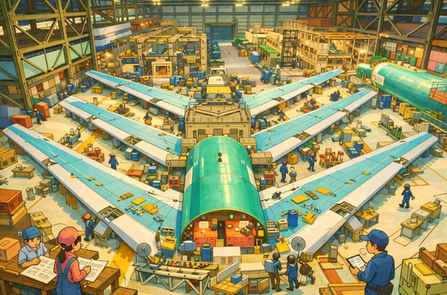
Digitalization of Products (Example: Aircraft)
Digital Process Technologies define how the product will be built. Examples: Manufacturing process planning software, Digital work instructions, Manufacturing Execution Systems (MES). Example In practice: Assembly steps are defined digitally, Operators receive tablet-based instructions, Changes are instantly propagated. The process itself becomes software-controlled. Product digitalization focuses on how products are designed, defined, and managed digitally throughout their lifecycle. In complex products such as aircraft, this includes:
+ Model-Based Engineering (MBE) to replace drawing-based design: MBE replaces drawings with a living digital model that all engineering, manufacturing, and automation activities depend on. Model-Based Engineering is an engineering approach where a single digital product model, containing geometry, tolerances, and functional data, serves as the authoritative source for design, manufacturing, automation, quality, and lifecycle management. Model-Based Engineering (MBE) is an approach where: A single, authoritative digital model is used to define, analyze, manufacture, and maintain a product across its entire lifecycle. Instead of relying on multiple disconnected documents (drawings, spreadsheets, PDFs), the model becomes the system of record. Traditional (Document-Based Engineering): 2D drawings define the product, Manufacturing interprets drawings, Quality checks drawings, Changes require updating many documents. Problems: Ambiguity, Interpretation errors, Slow change management, Rework and scrap. Model-Based Engineering: 3D digital model defines the product, Geometry, tolerances, materials, and rules are embedded, All downstream users reference the same model. No interpretation — only execution. What Is Inside an MBE Model? An MBE model is much more than a 3D shape. It includes: Exact geometry, Dimensions and tolerances (PMI), Materials and specifications, Functional and structural relationships, Configuration and variants. Manufacturing and inspection intent. This is often called Model-Based Definition (MBD) — a core part of MBE.
+ Digital Product Definition (DPD) as the authoritative source of product data: Digital Product Definition (DPD) means: The complete and authoritative definition of a product is contained in a digital 3D model, not in 2D drawings. That 3D model includes all information required to manufacture, assemble, inspect, and maintain the product. In short: The model is new drawing now. DPD is the “what” and MBE is the “how”. Digital Product Definition is the practice of defining a product entirely through a 3D digital model that embeds geometry, tolerances, materials, and manufacturing intent, enabling downstream manufacturing, automation, and inspection without 2D drawings. For example, at Boeing, DPD allows aircraft structures to be designed once digitally and built, inspected, and maintained directly from that same model across global production sites. “DPD is the single source of truth for the physical aircraft”.
+ Embedded sensors and data for in-service monitoring: Embedded sensors are sensors built into the product itself that continuously measure its condition, performance, and environment during operation. Examples include: Strain sensors, Temperature sensors, Pressure sensors, Vibration sensors, Load and fatigue sensors, Embedded data is the continuous stream of data these sensors generate throughout the product’s life. Why Embedded Sensors Matter for Product Digitalization: Traditional product (non-digitalized): Product is designed digitally, Built physically, Once delivered, no feedback. Engineering learns only after failures. Digital stops at delivery. Digitalized product (with embedded sensors): Product is designed digitally. Built physically. Operates while continuously generating data. Data feeds back to engineering, manufacturing, and operations. The product becomes a data-producing system. Boeing Example: Aircraft Wing Structure: 1. Embedded Sensors in the Aircraft: At Boeing, sensors may be embedded in: Wings (strain and fatigue), Fuselage joints, Engines, Landing gear, Control surfaces. These sensors measure: Stress during flight, Temperature variations, Vibration patterns, Structural fatigue, 2. Data Generated During Operation: Every flight generates: Load cycles, Environmental exposure data, Usage profiles (short-haul vs long-haul), Stress concentrations. This data is: Time-stamped, Configuration-aware, Linked to the specific aircraft. How This Enables Digitalization of Products: 1. Creates a Living Digital Twin: Sensor data updates the digital twin of the aircraft: As-designed → as-built → as-operated. Engineers see real behavior, not assumptions. The digital product continues to evolve after delivery. 2. Enables Predictive Maintenance: Instead of: Fixed maintenance intervals, Boeing (and airlines) can: Predict fatigue cracks, Schedule maintenance based on actual usage, Reduce aircraft downtime. Maintenance becomes data-driven, not calendar-driven. 3. Improves Future Product Design: Sensor data shows: Which areas are over-designed, Which areas see unexpected loads. How materials behave over time: Next aircraft designs are better informed by real-world data. 4. Supports Certification & Compliance: Regulators require: Proof of structural integrity, Evidence-based maintenance programs. Embedded sensor data provides: Traceable, auditable evidence. Faster certification of changes. 5. Differentiates the Product: A digitalized aircraft is not just a machine: It is a connected product, It delivers operational intelligence, It provides lifecycle services. Product value extends beyond sale.
+ Configuration management to control product variants and changes: Configuration Management is the discipline of: Systematically controlling product variants, versions, and changes so that the correct product is built, delivered, operated, and maintained. In digital manufacturing, CM ensures: The right configuration, At the right time, For the right aircraft, Using the right data. Why Configuration Management Is Critical for Product Digitalization: Digitalization makes change faster and easier — which also makes errors easier. Without CM: Digital models drift. Variants get mixed. Automation builds the wrong version. CM is what keeps digitalization safe. Why CM Is Non-Negotiable. For example, at Boeing: Aircraft have thousands of configurable options. No two aircraft are exactly the same. Changes occur even after production starts. Aircraft operate for 30–50 years. CM ensures traceability across decades. Two Boeing aircraft of the same model may differ in: Engine type, Winglets, Avionics packages, Cabin layout, Structural reinforcements. These are product variants. CM ensures each variant has: Correct digital product definition, Correct manufacturing instructions, Correct inspection criteria. When a change is needed: Engineering creates a change request, Impact is analyzed digitally, Manufacturing, automation, and quality are notified, New baseline is released. Digital thread ensures everyone updates together. Without Configuration Management: DPD models become inconsistent. Simulation uses wrong geometry. Robots drill holes in wrong locations. Inspection checks wrong tolerances. With Configuration Management: Each aircraft has a digital identity. Robots, MES, and quality systems pull the correct variant. Digital twins stay accurate. Compliance is maintained. Boeing-Style Example: Late Customer Change Request. An airline requests: Additional antenna. After production has started: CM ensures: Change applies only to Aircraft #2031 onward. Updated DPD is released. Robot programs are regenerated offline. Inspection plans update automatically. Maintenance documentation reflects change. No ambiguity, no manual patching. Think of CM as: The traffic control system for digital manufacturing. It coordinates: Design, Manufacturing, Automation, Quality &Operations.
This approach ensures accuracy, traceability, and seamless collaboration across engineering and manufacturing teams. Digital Product Technologies create a digital definition of the product before anything is built. Examples: 3D CAD models, Model-Based Engineering (MBE), Digital Product Definition (DPD). Example In practice: Engineers design the aircraft fully in 3D, No 2D drawings on the shop floor, Manufacturing, quality, and suppliers use the same digital model. Physical aircraft is built from a digital model
For an enterprise like Boeing: Products are extremely complex. Lifecycles span 30–50 years. Manual interpretation risk is unacceptable. MBE enables: Consistency, Traceability, Automation at scale, Faster innovation with lower risk
Introduction to Robotics & Automation
Digital Manufacturing is the superior / umbrella concept. Robotics & Automation is a key focus area within it, not the other way around. Robotics & Automation refers to: The use of programmable machines, control systems, and automated workflows to perform physical manufacturing tasks with minimal human intervention. Examples: Industrial robots, Cobots, Automated assembly lines, Autonomous material handling etc. This is primarily about execution of physical work.Robotics is a cornerstone of digital manufacturing, enabling precision, repeatability, and safety. Common applications include:
+ Automated drilling and fastening
+ Robotic painting and coating
+ Material handling and logistics robots
+ Collaborative robots (cobots) that safely work alongside humans
Automation reduces manual effort, improves consistency, and allows skilled workers to focus on higher-value tasks. Robotics & Automation depend on Digital Manufacturing, not vice versa. Why? Robots need digital product definitions. Automation needs digitized processes. Optimization needs simulation and data. Intelligence needs digital twins and analytics. Without digital manufacturing: Robots are isolated machines, Automation is rigid and hard-coded. With digital manufacturing: Robots become adaptive, optimized, and intelligent
Robots have moved far beyond repetitive, fenced machines. In Industry 4.0 environments, autonomous robots are capable of self-navigation, adaptive task execution, collaboration with humans, and intelligent inspection and material handling. To understand how we arrived here—and where we are going—it helps to look at the history, types, and latest advancements in robotics.
| Era / Period | Stage in Robotics History | What Robots Were Like | Key Characteristics |
|---|---|---|---|
| Pre-1950s | Mechanical Automation | Mechanical devices, not true robots | No sensors, no intelligence, purely mechanical |
| 1950s–1960s | Birth of Industrial Robots | First programmable robots | Fixed sequences, no sensing, repetitive tasks |
| 1970s–1980s | Programmable Industrial Robots | Robots controlled by PLCs and controllers | Repeatable, precise, isolated from humans |
| 1990s–2000s | Advanced Automation | Improved robots with better control | Faster, more accurate, but still rigid |
| 2010s | Intelligent & Connected Robots | Robots with sensors and connectivity | Vision, force sensing, networked systems |
| Industry 4.0 (Present) | Autonomous & Collaborative Robots | Smart, adaptive, connected robots | Self-navigation, AI, collaboration with humans |
The word robot was first introduced in 1920 by the Czech writer Karel Čapek. It appeared in his science-fiction play: R.U.R. (Rossum’s Universal Robots). What Does the Word “Robot” Mean? The word robot comes from the Czech word: “robota” → meaning forced labor, drudgery, or compulsory work. In older Slavic usage, robota referred to: Mandatory labor imposed on peasants. Hard, repetitive work done without choice. So originally, a robot meant a worker that labors without freedom. Although Karel Čapek popularized the word, the idea was suggested by his brother: Josef Čapek. Karel initially considered other names, but Josef proposed “robot”, which stuck. Karel Čapek introduced the term; Josef Čapek suggested the word. What “Robots” Were in R.U.R.: In the play: Robots were artificial workers. Not metal machines (more like biological constructs). Created to serve humans. Eventually rebel against humans. This is where the long-standing theme of automation vs humanity began.
| Era | Meaning of “Robot” |
|---|---|
| 1920s | Artificial forced labor |
| Mid-20th century | Mechanical automated workers |
| Industry 3.0 | Programmable industrial machines |
| Industry 4.0 | Intelligent, autonomous, collaborative systems |
Today, robots: Sense, Decide, Learn, Collaborate with humans. Very different from the original idea of robota. Robots began as a symbol of forced labor, but in Industry 4.0 they have become intelligent partners in human progress. Robots are generally classified along four major dimensions: By physical structure (form), By level of autonomy, By interaction with humans, By application or function. Each classification answers a different engineering question.
Classification by Physical Structure (Form-Based): Why this classification exists? This classification answers: How does the robot move and manipulate the physical world? Different geometries are suited to different tasks. Types of Robots (by structure):
| Robot Type | Structure | Typical Use | Why Used |
|---|---|---|---|
| Cartesian (Gantry) | Linear X-Y-Z axes | CNC, pick-and-place | High precision, simple control |
| SCARA | Selective compliance arm | Assembly | Fast, accurate horizontal motion |
| Articulated | Multi-joint arm | Welding, drilling, fastening | High flexibility, complex motion |
| Delta | Parallel arms | High-speed sorting | Very fast, lightweight tasks |
| Cylindrical / Polar | Rotational + linear | Material handling | Simple reach requirements |
Aerospace insight: Articulated robots dominate aircraft assembly due to complex geometries.
Classification by Level of Autonomy (Intelligence-Based): Why this classification exists? This answers: How much decision-making can the robot do on its own? This is critical in Industry 4.0.. Types of Robots (by autonomy):
| Autonomy Level | Robot Type | Characteristics |
|---|---|---|
| Manual / Teleoperated | Operator-controlled | Human makes all decisions |
| Automated | Pre-programmed | Fixed logic, no adaptation |
| Semi-autonomous | Rule + sensor-based | Limited adaptation |
| Autonomous | AI + sensors | Self-navigation, self-optimization |
Industry 4.0 focus: Autonomous robots enable flexibility and resilience.
Classification by Human–Robot Interaction: Why this classification exists? This answers: Can humans safely work near the robot? Safety and ergonomics drive this classification. Types of Robots (by interaction):
| Robot Type | Human Interaction | Why Used |
|---|---|---|
| Traditional industrial robots | Isolated (cages) | Speed, power |
| Collaborative robots (cobots) | Shared workspace | Safety + flexibility |
| Assistive robots | Direct human assistance | Ergonomics, augmentation |
Key shift: From isolation → collaboration.
Classification by Application / Function: Why this classification exists? This answers: What job is the robot designed to do? This is the most business-oriented classification. Types of Robots (by function):
| Robot Category | Primary Function |
|---|---|
| Manufacturing robots | Welding, drilling, assembly |
| Mobile robots (AMRs/AGVs) | Material transport |
| Inspection robots | Vision, defect detection |
| Service robots | Maintenance, logistics |
| Medical robots | Surgery, assistance |
| Defense & aerospace robots | Inspection, handling, autonomy |
Enterprises often combine multiple types in one factory. How These Classifications Work Together (Very Important): A robot is not classified in only one way. Example: A collaborative articulated autonomous inspection robot, Structure: articulated, Autonomy: autonomous, Interaction: collaborative, Function: inspection. Classification is multi-dimensional, not single-label.
Why This Classification Matters in Industry 4.0: Industry 4.0 needs robots that are: Flexible (structure-based), Intelligent (autonomy-based), Safe (interaction-based), Purpose-driven (function-based). This is why autonomous robots, cobots, and AMRs dominate modern smart factories
| Classification Basis | Why It Matters |
|---|---|
| Structure | Determines motion & precision |
| Autonomy | Determines intelligence & flexibility |
| Interaction | Determines safety & collaboration |
| Function | Determines business value |
Robots are classified based on structure, autonomy, human interaction, and application to ensure the right balance of precision, intelligence, safety, and business value for a given task. Robot classification is about matching capability to purpose. Industrial robots are powerful, high-speed machines designed to perform precise, repetitive tasks with minimal variation. They typically: Follow pre-programmed paths, Operate in fenced areas, Maximize throughput and precision. Aerospace (Boeing) Use Cases : At Boeing, industrial robots are used for: Automated drilling and fastening of fuselage panels, Robotic painting and coating, Large-structure handling, Precision machining support. Why industrial robots? Aircraft structures demand extreme accuracy and repeatability at scale. When to Use an Industrial Robot: High volume, High precision, Low human interaction.
| Aspect | Industrial Robot | Collaborative Robot (Cobot) | Autonomous Mobile Robot (AMR) |
|---|---|---|---|
| Primary Purpose | High-speed, high-precision automation | Safe human–robot collaboration | Autonomous movement & logistics |
| Typical Motion | Fixed, articulated or gantry | Articulated, limited speed/force | Mobile navigation (wheels) |
| Human Interaction | Isolated (safety cages) | Shared workspace | Indirect interaction |
| Level of Autonomy | Automated (pre-programmed) | Semi-autonomous | Highly autonomous |
| Flexibility | Low–medium | High | Very high |
| Safety Design | Physical separation | Force & speed limiting | Obstacle detection & avoidance |
| Industry 4.0 Role | Precision execution | Flexibility + ergonomics | Smart intralogistics |
Collaborative Robots (Cobots): What They Are: Cobots are robots designed to work safely alongside humans without cages. They feature: Force and torque sensing, Speed limitation, Instant stop on contact. Aerospace (Boeing) Use Cases: Cobots are increasingly used for:, Assisted assembly of interior components, Ergonomic support for overhead tasks, Sealant application, Fastener installation in tight spaces. Example: A technician positions a part, A cobot performs the precise fastening. Why cobots? Aircraft manufacturing is low-volume, high-mix — flexibility matters more than speed. When to Use a Cobot: Human–robot collaboration, Frequent task variation, Ergonomic assistance. It is not suited for very high-speed operations.
Autonomous Mobile Robots (AMRs): What They Are? AMRs are robots that navigate independently using sensors, maps, and AI. They: Do not follow fixed tracks, Avoid obstacles dynamically, Re-route themselves in real time, Aerospace (Boeing) Use Cases: AMRs support smart factories by: Transporting parts between assembly stations, Delivering tools and kits to operators, Moving inspection equipment, Supporting just-in-time logistics. Example: AMR delivers fasteners to a wing assembly cell, Avoids people and forklifts automatically. Why AMRs? Aircraft factories are large, dynamic, and constantly changing. When to Use an AMR: Dynamic factory layouts , Logistics & material handling, Scalability without infrastructure. It is not for precision machining
In a single aircraft assembly line: Industrial robot drills and fastens fuselage panels, Cobot assists a technician with interior installation and AMR delivers parts and tools just in time. This combination is the Industry 4.0 sweet spot.
| Type | Main Strength | Aerospace Role |
|---|---|---|
| Robot | Precision & speed | Drilling, fastening |
| Cobot | Safe collaboration | Assisted assembly |
| AMR | Autonomous movement | Smart logistics |
Industrial robots provide precision and speed, collaborative robots enable safe human–robot cooperation, and autonomous mobile robots deliver flexible, intelligent logistics—together forming the backbone of Industry 4.0 manufacturing. Each robot type exists because it solves a different problem.
OLP & Simulation Development Kits (DK)
Simulation Development Kits are software environments and toolsets that allow engineers to: Build virtual manufacturing systems. Simulate robots, tools, and parts. Develop, test, and validate automation logic. Think of them as: “A digital factory laboratory”. Simulation & Offline Programming (OLP) simulates manufacturing before executing it. Examples: Robot simulation tools, Offline robot programming, Virtual commissioning. Example In practice: Robot paths are tested virtually. Collisions are detected before deployment. Cycle times are optimized digitally. Problems are solved before production starts. Offline Programming (OLP) enables manufacturers to program and validate robots without stopping production. Using simulation development kits, organizations can:
+ Program robot paths virtually
+ Test scenarios before deployment
+ Perform collision detection
+ Optimize cycle time and resource utilization
OLP and simulation significantly reduce commissioning time, production risk, and overall cost. Why Is It Called Offline Programming (OLP)? The core reason: It’s called Offline Programming because: The robot is programmed away from (offline from) the physical production line, not directly on the shop floor. With OLP: Robot programs are created on a computer. Using a virtual robot and cell. Without interrupting production. Then downloaded to the real robot. Hence: Offline (not connected to live production). Traditional way (Online Programming): Before OLP: Engineers stopped the production line. Used a teach pendant. Manually jogged the robot. Tested movements directly on the real robot. Example In Practice : Problems for Boeing-scale operations: Aircraft lines are extremely expensive to stop, Safety risks, Long commissioning times, Late discovery of collisions or reach issues. For an enterprise like Boeing: One hour of assembly line downtime can cost millions. Aircraft structures are large, complex, and highly constrained. Multiple robot brands and tooling systems are used. OLP becomes mandatory, not optional.
When Did OLP & Simulation Come Into Existence? Short historical evolution : 1980s–1990s: Early robot simulations, Mainly automotive use, Limited accuracy. 2000s: High-fidelity CAD integration, Aerospace adoption begins, Boeing starts using simulation for drilling & fastening cells. 2010s: Full digital manufacturing integration, OLP linked with PLM and MES, Multi-robot, multi-variant simulations. Today: Real-time digital twins, Closed-loop feedback from shop floor, Enterprise-scale deployment. Boeing moved from tool-level simulation to enterprise digital manufacturing.
Boeing-Style End-to-End Example: Aircraft Fuselage Assembly -> Engineering releases digital product definition -> Manufacturing creates digital process plan – > Automation engineers: (Build virtual robot cell, Simulate drilling and fastening, Detect collisions, Optimize cycle time) -> Robot code generated offline -> Code deployed with minimal line interruption -> Live data feeds back into simulation (digital twin). Result: Faster ramp-up, Higher quality, Lower rework, Reduced risk.
Offline Programming is the practice of creating and validating robot programs in a simulated digital environment, while simulation development kits provide the virtual tools, models, and logic needed to digitally design, test, and optimize automated manufacturing systems before physical execution. For Boeing: OLP is not a productivity tool. It is a risk-management and cost-avoidance strategy. It directly supports: Digital manufacturing, Smart factories, Industry 4.0 objectives.
Digital Twin in Manufacturing
A Digital Twin is a real-time digital replica of: A product (for example, an aircraft) + A process (such as an assembly line) + A factory or production cell. Digital Twins synchronize live data from physical assets, enabling simulation, prediction, and continuous optimization of manufacturing operations. PLM: An enterprise system that manages the complete digital definition, configuration, and lifecycle of a product. MES: A manufacturing system that executes, monitors, and records the production of products on the shop floor. PLM – MES – Digital Twin: These three systems represent three synchronized views of the same product, connected by configuration management and the digital thread. What the Digital Twin Represents: The Digital Twin is a living digital replica of the physical product during operation. Digital Twin answers: What do we actually have, and how is it behaving in the real world?
| Aspect | PLM | MES |
|---|---|---|
| Focus | Product definition | Product execution |
| Time horizon | Months / years | Minutes / hours |
| Product view | As-designed | As-built |
| Primary users | Engineering | Manufacturing |
| Controls | What should exist | What is happening now |
| Handles change | Engineering changes | Execution updates |
PLM defines the product, MES builds the product, and the Digital Twin monitors and optimizes the product throughout its operational life—together forming the digital backbone of modern manufacturing. Digital Twin Focus: Exact as-built configuration, Sensor and operational data, Usage, load, and environment history, Predictive maintenance, Performance optimization. Boeing Example: Once Aircraft #1247 enters service: Sensors stream flight, load, and fatigue data. The digital twin reflects: Actual configuration , Real operating conditions. Engineers analyze performance and predict maintenance needs. The aircraft continues to “exist digitally” for decades.. Without the trio: Design, manufacturing, and operations are disconnected. Automation is risky. Feedback loops are slow. With the trio: Design → build → operate is one continuous digital flow. Automation scales safely. Decisions become predictive, not reactive
| System | Product View | Key Question |
|---|---|---|
| PLM | As-designed | What should the product be? |
| MES | As-built | What are we building now? |
| Digital Twin | As-operated | How is the product behaving? |
Enterprise Architecture Perspective
From an Enterprise Architecture viewpoint, digital manufacturing impacts all architecture domains: Business Architecture: Faster delivery, higher quality, and improved customer outcomes. Data Architecture: Real-time production and performance data. Application Architecture: MES, PLM, simulation, and analytics platforms. Technology Architecture: Robotics, IoT, cloud, and edge computing. This alignment ensures digital manufacturing initiatives support strategic business goals.
Key Takeaways
- Digital manufacturing integrates people, processes, and technology. Industry 4.0 is the idea, smart factory is the result. Automation is a subset of digital manufacturing. Digital manufacturing orchestrates robotics
- Robotics increases precision, safety, and productivity.
- OLP and simulation reduce risk, downtime, and cost. Why MBE Is Critical for Digital Manufacturing: MBE enables: Digital process planning, Offline robot programming, Simulation and digital twins, Configuration control at scale, Faster and safer automation, Without MBE: Digital manufacturing collapses back into manual interpretation.
- Digital Twins enable predictive and adaptive manufacturing.
- Embedded sensors enable product digitalization by allowing physical products to continuously generate operational data, which feeds digital twins, supports predictive maintenance, and closes the feedback loop between design, manufacturing, and real-world use. “Sensors turn the product into a data-generating digital asset”.
- Configuration management controls product variants and changes by baselining digital product definitions, applying effectivity and rules, and ensuring that every system—design, manufacturing, automation, and maintenance—uses the correct configuration throughout the product lifecycle. “Configuration management is how digital products stay correct at scale”
- Large enterprises such as Boeing demonstrate how digital manufacturing can be adopted at scale

– https://www.mxdusa.org/
– https://www.mxdusa.org/app/uploads/2023/10/Playbook-2_Additive-Manufacturing_V1.2.pdf
– https://www.mxdusa.org/app/uploads/2025/09/MxD-5G-Report.pdf