Focus Areas
Artificial Intelligence (AI), Machine Learning (ML), and Analytics are core enablers of modern robotics and automation. In Industry 4.0 environments, they transform machines from rule-following systems into intelligent, adaptive, and autonomous entities capable of learning, predicting, and supporting complex decisions. In aerospace manufacturing and operations, AI and ML must operate under strict constraints of safety, reliability, explainability, and certification. For enterprises such as Boeing, AI is not just about optimization—it is about trustworthy intelligence embedded across design, manufacturing, and operational lifecycles.
Learning Objectives
This module explores Machine Learning fundamentals and types of ML, analytics for monitoring and reporting, differences between RPA and AI, Generative AI, Agentic AI and intelligent agents, agent-based modeling, and the role of AI-enabled autonomy in Industry 4.0. After completing this module, learners will be able to explain the roles of AI, ML, and analytics in automation, understand ML basics and learning types, differentiate RPA, AI, and Agentic AI, explain Generative AI and intelligent agents, understand agent-based modeling, and apply AI/ML for monitoring and reporting.
AI, ML & Analytics – Big Picture
Analytics, Machine Learning, and Artificial Intelligence form a layered intelligence stack. Analytics extracts insights from data. Machine Learning identifies patterns and learns from data. Artificial Intelligence uses those insights to support reasoning, decision-making, and action. Together, they enable intelligent automation.
Analytics For Monitoring & Reporting
Analytics provides structured understanding of operational data. Descriptive analytics explains what happened. Diagnostic analytics explains why it happened. Predictive analytics estimates what may happen next. Prescriptive analytics recommends what actions should be taken. In Industry 4.0, these analytics power dashboards, alerts, and decision support systems.
Machine Learning Basics
Machine Learning systems learn patterns from historical data rather than relying on explicitly coded rules. Over time, ML models improve their predictions as more data becomes available. This makes ML especially valuable in complex, variable manufacturing environments. Machine learning is not rule-based programming and not memorization of data. The core idea of ML is learning from data and generalizing to unseen data. ML relies heavily on mathematical concepts and data-driven algorithms. Typical ML problems include spam detection, weather forecasting, recommendation systems, face grouping, robotics navigation, and stock market prediction. Machine learning is applied in areas that replicate human capabilities such as vision, speech, language understanding, and decision-making, as well as in fields like finance, science, sports analytics, and e-commerce. Machine learning is neither procedural programming nor memorization, but a data-driven approach that learns patterns and generalizes to unseen data. The key components of machine learning are data, algorithms, generalization, and mathematics.
Types Of Machine Learning
Supervised learning uses labeled data to learn known outcomes, such as defect classification. Machine learning algorithms learn from labeled examples of spam and non-spam messages to automatically classify new emails or messages as spam or legitimate. Using historical weather data such as rainfall, humidity, pressure, and temperature, machine learning models predict whether it will rain on a future day. Based on a user’s viewing history and preferences, machine learning models recommend movies that the user is likely to enjoy, resulting in personalized suggestions. Machine learning analyzes user behavior, connections, and similarities to suggest new people a user may know or want to connect with on social or professional platforms. Machine learning models learn patterns in audio signals to separate vocals and instrumental sounds from a mixed music track. Machine learning models analyze past stock data and trends to predict future price movements, learning and adapting based on feedback over time.
Unsupervised learning discovers hidden patterns or anomalies without labeled data. By analyzing facial features, machine learning groups photos containing the same person, even across different poses, lighting conditions, and backgrounds. Reinforcement learning enables systems to learn through reward and feedback, making it suitable for adaptive control and robotics. A robot learns how to move in an environment by taking actions and receiving feedback, improving its navigation through trial and error rather than fixed rules. Reinforcement learning enables robots to learn optimal motion strategies through interaction and feedback, extending traditional control into adaptive, autonomous decision-making. Labels present → Supervised. Only grouping / similarity → Unsupervised. Actions + rewards + feedback → Reinforcement Learning
A robot learns how to navigate by making movement decisions and receiving feedback from the environment. An action such as moving forward may be correct in one situation but incorrect in another, so the robot cannot rely on fixed rules. Instead, it learns through trial and error, improving its decisions based on experience. This illustrates a more complex form of machine learning where learning occurs through interaction with the environment rather than from predefined examples. A robot navigation problem where learning occurs through trial-and-error feedback, makes it a more complex form of machine learning based on experience.
Reinforcement learning is revolutionizing motion planning by shifting control systems from static, rule-based logic to adaptive, experience-driven intelligence. By learning through state–action–reward interactions, robots can optimize movement, adapt to dynamic environments, and extend autonomy into complex nonlinear domains. Simulation, careful reward design, and safety constraints are essential to real-world deployment. As reinforcement learning integrates with classical control, sensor fusion, and multi-agent coordination, it is becoming the foundation of intelligent, self-optimizing autonomous systems across robotics, transportation, manufacturing, and beyond. Reinforcement learning enables robots to learn optimal motion strategies through interaction and feedback, extending traditional control into adaptive, autonomous decision-making. Reinforcement Learning represents a fundamental shift from predefined control logic to experience-driven intelligence. Traditional control relies on fixed rules and manual tuning. RL enables systems to learn optimal behavior through interaction. Robots are no longer just controlled — they improve themselves. This mirrors human learning: act → observe → learn → adapt.
| Example | What the model does | ML Paradigm |
|---|---|---|
| Spam Email / SMS Detection | Classifies messages as spam or non-spam using labeled data | Supervised Learning |
| Rainfall Forecasting | Predicts future rainfall using historical weather data | Supervised Learning |
| Movie Recommendation Systems | Predicts user preferences based on past behavior | Supervised Learning (often combined with Unsupervised) |
| Friend Suggestions (Social Networks) | Suggests potential connections based on similarity patterns | Supervised / Unsupervised Learning |
| Voice–Instrument Separation | Learns to separate mixed audio signals | Supervised Learning |
| Face Grouping in Photo Galleries | Groups images of the same person without knowing identities | Unsupervised Learning |
| Robot Navigation | Learns actions through trial-and-error feedback from environment | Reinforcement Learning |
| Stock Market Prediction | Predicts stock movement using past market data | Supervised Learning |
Traditional motion planning: Assumes predictable environments. Breaks down in dynamic or nonlinear conditions. RL-based motion planning: Adapts continuously, Handles uncertainty and change, Improves efficiency over time. Insight: RL turns motion planning into a living process, not a one-time computation. At its core, RL is built on three elements: State – what the environment looks like, Action – what the agent can do, Reward – how good the outcome was . Learning happens by: Observing the state, Taking an action, Receiving a reward, Updating the policy. Insight: Intelligence is not programmed — it emerges from feedback. Reinforcement Learning (RL) Extends Control Beyond PID Control (Proportional, Integral, Derivative) and Model Predictive Control (MPC). Traditional control (PID, MPC): Highly reliable, Deterministic, Requires expert tuning, Limited adaptability. Reinforcement learning: Data-driven, Learns nonlinear dynamics, Generalizes across conditions, Enables autonomous decision-making. RL does not replace classical control — it extends control into autonomy.
Different RL algorithms serve different motion-planning needs: Q-learning → simple, discrete navigation, Deep Q Networks (DQN) → perception-driven discrete control, Policy Gradient methods → continuous control (drones, arms), PPO → stable learning for autonomous driving, Actor–Critic → coordination, multi-agent systems, Insight: There is no “one RL algorithm” — architecture must match the task.
When multiple agents learn together: Coordination emerges. Decentralized decisions scale. Collective behavior becomes intelligent. Applications: Swarm robotics, Traffic flow optimization, Multi-robot task allocation. Insight: Intelligence scales when learning is shared. RL-powered motion planning is transforming: Self-driving vehicles (lane changes, merging), Drones (dynamic airspace navigation), Humanoid robots (balance, gait learning), Warehouses (multi-robot coordination), Space robotics (autonomous docking, traversal). Insight: RL is the common intelligence layer behind diverse autonomous systems. RL systems can behave unpredictably if unconstrained. Key safeguards: Safety-aware reward functions, Constraint-based learning, Supervisory control layers, Human-in-the-loop validation. Insight: Autonomy without safety is unacceptable — trust is engineered, not assumed. Reinforcement Learning enables: Data-driven motion, Context-aware planning, Self-optimizing behavior, Long-term adaptation. Future direction: Explainable RL, Verifiable policies, Hybrid RL + control architectures, Regulatory-aligned autonomy. Big picture: Machines are learning not just how to move, but how to decide.
| Aspect | PID Control | Model Predictive Control | Reinforcement Learning |
|---|---|---|---|
| Control philosophy | Reactive correction | Predictive optimization | Learning through experience |
| Decision basis | Current & past error | Future state prediction | Trial-and-error interaction |
| System model required |  No No |  Yes (explicit model) Yes (explicit model) | Not required (can be model-free) |
| Adaptability | Low | Medium | Very high |
| Learning capability | None | None (fixed model) | Yes |
| Handling nonlinearity | Limited | Good (if model exists) | Excellent |
| Manual tuning required | High | Medium | Low (reward-driven) |
| Real-time guarantees | Strong | Strong (with constraints) | Weak–Medium (needs safety layers) |
| Computational demand | Low | Medium–High | High |
| Safety & certification | Easy | Manageable | Challenging |
| Typical role | Low-level control | Mid-/high-level optimization | High-level autonomy |
PID: “Fix the error now.” Looks at what just happened. Reacts immediately. No understanding of the future. No learning. Reliable, simple, everywhere. MPC: “Predict the future and choose the best action.” Uses a mathematical model, Simulates future behavior, Optimizes actions under constraints, Smarter than PID, but only as good as the model. Reinforcement Learning: “Try, learn, and improve over time.” No fixed rules, Learns from outcomes. Improves with experience. Adapts to unknown dynamics. Intelligent, but must be constrained for safety. Modern autonomous systems do NOT choose one — they combine all three. RL decides what to do. MPC decides how best to do it. PID ensures it is done safely. PID provides simple, reactive control based on present and past error but lacks adaptability. MPC optimizes control actions by predicting future system behavior using explicit models. Reinforcement learning enables adaptive control by learning optimal policies through interaction and feedback. Need safety & predictability? → PID. Need constraint-aware optimization? → MPC. Need learning & autonomy? → RL. PID stabilizes, MPC optimizes, RL learns. Together, they power modern autonomous systems.
| Application | PID | MPC | RL |
|---|---|---|---|
| Motor speed control | ✅ | ❌ | ❌ |
| Robot joint control | ✅ | ✅ | ❌ |
| Trajectory optimization | ❌ | ✅ | ✅ |
| Drone flight | ✅ | ✅ | ✅ |
| Autonomous driving decisions | ❌ | ✅ | ✅ |
| Multi-robot coordination | ❌ | ❌ | ✅ |
| Learning new behaviors | ❌ | ❌ | ✅ |
AI/ML For Monitoring & Reporting
AI and ML enhance monitoring by detecting anomalies in real time, predicting failures before they occur, automating alerts, and supporting root-cause analysis. This shifts organizations from reactive monitoring to predictive and proactive operations. Real-world trial-and-error is unsafe and expensive. Simulation solves this. Key practices: Physics-based simulators, Large-scale experimentation, Failure without consequences. Enhancements: Domain randomization for robustness, Sim-to-real transfer to minimize real-world data needs. Insight: No serious RL system is trained directly in the real world first.
Computer Vision & Sensor Fusion is the Foundation of Autonomy. 1. Vision + Fusion = The Perceptual Brain of Autonomous Systems. Key insight: Computer vision gives machines the ability to see, while sensor fusion gives them the ability to trust what they see. Vision alone is powerful but fragile. Fusion adds redundancy, robustness, and context. Autonomy begins with perception, not control or planning. 2. Computer Vision Turns Pixels into Meaning: Computer vision is not about images — it’s about semantic understanding. Core capabilities: Image classification → What is this? Object detection → Where is it? Segmentation → Which pixels belong to what? Tracking → How is it moving? 3D reconstruction → What does the world look like spatially? These form the sensory cortex of intelligent machines. 3. Deep Learning Architectures Define What Vision Can Do: Different models specialize in different perception tasks: CNNs → spatial feature extraction, YOLO / SSD / R-CNN → real-time object detection, Transformers (ViT, DETR) → global context & attention, Optical flow → motion estimation, GANs → synthetic data generation, Insight: Architecture choice determines latency, accuracy, and real-time feasibility. No single sensor is reliable in all conditions:
| Sensor | Strength | Weakness |
|---|---|---|
| Camera | Rich detail | Sensitive to light/weather |
| LiDAR | Accurate 3D | Expensive, weather issues |
| Radar | Speed & range | Low resolution |
| IMU | Motion tracking | Drift over time |
| GPS | Global position | Signal loss |
Fusion Happens at Multiple Levels (This Is Critical): Sensor fusion is not one thing — it happens at three levels: Data-level fusion: Raw sensor data combined, High accuracy, high compute. Feature-level fusion: Learned features combined, Balanced performance. Decision-level fusion: Independent decisions merged, Robust, modular. Autonomous vehicles and robots often use all three simultaneously. Reliable Perception Is the Bottleneck of Autonomy. Why perception is hard ?: Lighting changes, Weather variability, Sensor noise & miscalibration, Synchronization across sensors, Computational cost. New risks: Visual spoofing, Adversarial attacks, Sensor deception. Insight: Most autonomy failures originate in perception, not planning.
Vision + Fusion Power Every Autonomous Domain: Autonomous vehicles → object detection, lane tracking, Robotics → navigation, obstacle avoidance, SLAM, Healthcare → imaging, diagnostics, surgical guidance, Aerospace → flight stabilization, obstacle detection, Manufacturing → quality inspection, predictive maintenance. Accurate, synchronized perception is a cross-industry requirement. There is no single “correct” perception stack — context matters. The field is moving fast: Multimodal transformers → vision + text + audio, Neural Radiance Fields (NeRFs) → 3D scene reconstruction, Self-supervised learning → less labeled data, Edge AI → real-time perception, Quantum sensor fusion → ultra-precise detection. Perception is becoming context-aware, multimodal, and real-time.
Future-ready systems must: Invest in robust sensor integration. Optimize models for edge deployment. Design adaptive, redundant perception pipelines. Embrace multimodal AI architectures. Perception intelligence is now a core enterprise capability, not a research add-on. Computer vision enables machines to extract meaning from visual data, while sensor fusion enhances reliability by combining multiple sensing modalities. Together, they form the perceptual foundation of autonomous systems across vehicles, robotics, aerospace, healthcare, and manufacturing. By integrating deep learning architectures, multi-level fusion strategies, and edge AI, modern systems achieve robust, real-time environmental understanding. As autonomy scales, enterprises must focus on resilient, multimodal perception frameworks that can adapt to uncertainty and operate safely in dynamic real-world environments. Computer vision provides visual understanding, while sensor fusion ensures reliable perception by combining complementary sensor data—together enabling safe and scalable autonomy. “Vision + fusion = trustable perception”. Autonomy begins with seeing, but succeeds with fusion.
Robotic Process Automation (RPA)
RPA automates repetitive, rule-based digital tasks using structured data. It mimics human interactions with software systems but does not learn or reason. RPA is best suited for administrative and transactional processes, not intelligent decision-making
Generative AI (GenAI)
Generative AI can create new content such as text, code, images, and summaries. In engineering and manufacturing contexts, GenAI assists with documentation, analysis, simulation interpretation, and knowledge retrieval, significantly improving productivity.
Intelligent Agents & Agentic AI
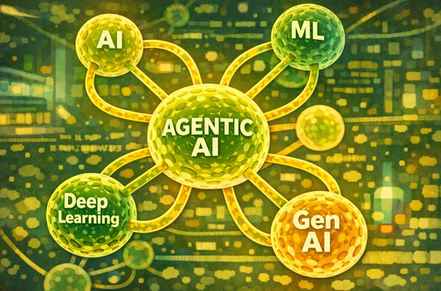
Intelligent agents perceive their environment, decide on actions, and act toward defined goals. Agentic AI goes further by coordinating multiple agents that can plan, collaborate, and execute tasks collectively. This is especially relevant for autonomous systems and complex decision environments.
Types Of Intelligent Agents
Simple reflex agents respond directly to inputs. Model-based agents maintain internal representations of the environment. Goal-based agents act to achieve specific objectives. Utility-based agents optimize outcomes based on defined utility functions. Learning agents continuously improve performance through experience.
Agent-Based Modeling (ABM)
Agent-Based Modeling represents systems as collections of interacting agents. By simulating their interactions, ABM reveals emergent behavior and enables “what-if” analysis. It is widely used to study complex systems such as production flows, logistics, and operational resilience.
From an enterprise perspective, Industry 4.0 spans multiple layers. It aligns business strategy with processes and operations, is enabled by data and applications, and is executed through technology and infrastructure. Successful adoption requires coherence across all these layers.
Enterprise Perspective (Example: Boeing)
From an enterprise perspective, aerospace organizations must ensure safety and certification, explainability of AI decisions, human-in-the-loop control, and strong data governance and security. AI systems must be auditable, transparent, and aligned with regulatory requirements.
Key Takeaways
Analytics provides the foundation for insight. Machine Learning enables prediction. Artificial Intelligence enables decision support and autonomy. RPA automates rules but not intelligence. Agentic AI offers powerful capabilities but requires strong governance, especially in safety-critical industries.