

1: SEGMENTATION (Assemble-Disassemble, Fragmentation, Decentralization) : (A) Divide an object (or system) into independent parts (to work in tandem or counterbalance each other), (B) Make an object (or system) be sectional (or modular), (C) Make an object (or system) easy to assemble (putting together) or disassemble (separating or taking apart), (D) Increase the degree of an object’s (or system’s) fragmentation or segmentation, (E) Use repetitive or multiple units of action if there are strict limits on increasing per unit function (or characteristics like size or weight etc) connected with an action, transit to micro-level.
EXAMPLES: Modular Furniture, Centralization (e.g., Mainframe) versus Decentralization (e.g., Personal Computers), Multi-wire Cables, Multi-Pin Connector, Goal-oriented Team, Multi-Plane Window, Measurement Scale (with increased precision), Serrated Knives (to improve cutting performance), Multi-I/O operations in case of limited memory size, Molecular Beam Epitaxy, Transitioning from Mainframe to Client-Server to Multi-Tier Web Based Application Architecture, Multiple Garden Hoses (That Can Joined Using Connectors To Get Desired Length), Multi-Container Driven Cargo Train or Ships, Smaller or Standardized Plumbing Pipes (Extendable With Connectors or Joints), Venetian Blades (Varying Degree of Segmentation), Customer or Product or Market or Geographic or Demographic Segmentation or Micro-Segmentation, Cement Blocks (With Interlocaking Mechanism) etc.
SYNONYMS: Assemble-Disassemble, Fragmentation, Decentralization, Division, Segregation, Separation, Compartmentalization, Encapsulation, Categorization, Partitioning, Clustering, Classification
ACB:
It could be interpreted as an act or process of dividing something into parts or segments, dividing or separating something into distinct parts or sections, division of something into smaller and more specific parts, organizing or classifying into categories or segments, compartmentalizing i.e the act of dividing something into distinct compartments or sections, subdivision i.e. the act or result of subdividing or creating smaller divisions within a larger whole, separation i.e. the action or state of moving or being moved apart, creating segments, fragmentation i.e. breaking or dividing something into fragments or smaller parts, dissection i.e. the process of analyzing or examining something by separating it into its components, partitioning i.e. the act of dividing or separating into parts or segments.
The overall theme is the implementation of strategies that enhance flexibility, efficiency, and adaptability by breaking down objects into modular or segmented components. Divide an object (or system) into independent parts (to work in tandem or counterbalance each other). Example: Replace a mainframe computer with personal computers. [IP 1.1] Also Ref: [Trend Line: Increasing Interfaces: from one interface to two to three to four etc]. Make an object (or system) be sectional. Example: Replace solid shades with Venetian blinds for a more segmented and adjustable window covering. [IP 1.2]. Make an object (or system) easy to assemble (putting together) or disassemble (separating or taking apart) Example: Design modular furniture with components that can be easily taken apart. [IP 1.3]. Increase the degree of an object’s (or system’s) fragmentation or segmentation [IP 1.4]. Use repetitive or multiple units of action if there are strict limits on increasing per unit function (or characteristics like size or weight etc) connected with an action [IP 1.5]. Transit to micro-level [IP 1.6] Also Ref: [Trend Line : Macro to Micro]. Divide an object (or system) into independent parts (to work in tandem or counterbalance each other) [IP 1.1] Also Ref: [Trend Line: Increasing Interfaces: from one interface to two to three to four etc].
At an abstract level, segmentation is a process or concept that involves dividing a larger entity, system, or market into distinct and more manageable parts or segments. The Segmentation Principle refers to this division or segmentation of an object or system into independent parts. This principle is based on the idea that breaking down a complex system into more manageable and independent components can lead to innovative solutions and improvements. The purpose of segmentation is to simplify complexity, facilitate understanding, and enable more effective management or analysis. Segmentation is widely applicable across various domains, including engineering, business, marketing, and more. It involves the identification of meaningful criteria or characteristics to categorize the whole into smaller, more homogeneous or manageable units. The abstract principle of segmentation is rooted in the idea that breaking down a complex whole into smaller parts can lead to better comprehension, targeted interventions, and improved outcomes. The application of the Segmentation Principle encourages thinking about a problem or system in terms of modular components, each serving a specific function. This modular approach can facilitate the development of solutions that are more targeted, efficient, and easier to implement. The Segmentation Principle is often employed to overcome contradictions within a system. Contradictions in TRIZ are situations where improving one aspect of a system leads to the deterioration of another. By segmenting a system, engineers or problem solvers aim to find ways to address each segment independently, thus resolving or mitigating contradictions more effectively.
The Storyboarding Method, often associated with Walt Disney, is a creative and visual technique used in the pre-production phase of filmmaking, animation, and storytelling. Storyboarding involves creating a sequence of images or illustrations to outline the key scenes and narrative flow of a story. Begin with a clear outline of the story or narrative. Identify key plot points, characters, and important scenes. Divide the overall story into individual scenes. Each scene should represent a significant moment or development in the narrative. For each scene, create a series of visual representations or sketches. These are usually drawn or illustrated images that depict the key actions, emotions, and elements of each scene. Include dialogue, captions, or annotations alongside the images to provide additional context, convey character expressions, or describe the action taking place. Organize the storyboard in a sequential order, reflecting the chronological flow of the story. This allows creators to see how scenes connect and build upon each other.
Share the storyboard with relevant stakeholders, such as directors, writers, or animators, for feedback. Use this feedback to refine and improve the storyboard. Storyboarding allows creators to visualize the story in a series of images, helping to identify pacing, composition, and overall visual aesthetics. It serves as a powerful communication tool among team members, ensuring a shared understanding of the narrative and visual style. By creating a visual representation of the story, creators can identify potential issues with pacing, continuity, or plot coherence early in the process. It helps in planning the sequence of shots and scenes before the actual production, enabling a more efficient use of resources and time. Storyboarding allows creators to experiment with different visual elements, helping set the tone, mood, and atmosphere of the story. Collaborators, including directors, animators, and writers, can easily contribute to the creative process by reviewing and providing feedback on the visual representation of the story. Once finalized, storyboards become a guide for the actual production, serving as a reference for cinematography, animation, and other aspects of filmmaking.
While Walt Disney may not have been the sole developer of the storyboarding method, the Disney studio played a pivotal role in refining and popularizing this visual storytelling technique. Today, storyboarding is a widely adopted practice in various creative industries, including film, animation, advertising, and multimedia production.
In both engineering and business management, segmentation is a strategic approach to handle complexity, enhance efficiency, and tailor solutions to specific needs. Whether applied to technical projects or market strategies, segmentation is a valuable tool for optimizing resource allocation, problem-solving, and decision-making. The development of the internet itself is a complex problem-solving example. The internet can be segmented into layers, such as the application layer, transport layer, and network layer. The layered segmentation model facilitates the design, implementation, and troubleshooting of complex networking systems. It demonstrates that breaking down a complex system into manageable layers enhances modularity and ease of maintenance.
Segmentation, whether in engineering or business management, involves dividing a larger entity into distinct and more manageable parts or segments. The specific application and purpose of segmentation can vary between engineering and business management. In engineering, segmentation is often employed to break down complex systems or projects into smaller, more manageable components. This can offer several benefits. For large engineering projects, segmentation allows engineers to focus on specific elements or subsystems, simplifying the overall problem-solving process. Different segments can be worked on simultaneously by different teams, speeding up the development process. Segmentation enables efficient allocation of resources, as teams can be assigned to specific segments based on their expertise. Breaking down a system into segments promotes modularity, making it easier to modify or upgrade individual components without affecting the entire system. In engineering, the development of the assembly line by Henry Ford in the early 20th century is a noteworthy example. Ford segmented the automobile manufacturing process into distinct tasks performed by specialized workers. The assembly line significantly increased efficiency, reduced production time, and lowered costs. This engineering segmentation approach revolutionized manufacturing and became a hallmark of industrial progress.
Businesses have historically applied market segmentation strategies. For instance, the introduction of the Ford Model T in the early 20th century targeted a specific segment of the population seeking affordable automobiles. Market segmentation allows businesses to tailor products and marketing strategies to specific consumer groups, enhancing customer satisfaction and overall market performance. This approach has been widely adopted and refined in contemporary business practices. Historically and scientifically, the benefits of segmentation have been demonstrated through various inventions, problem-solving methodologies, and applications across different fields. The scientific classification of living organisms by Carl Linnaeus in the 18th century is a classic example. Linnaeus segmented the biological world into hierarchical categories based on shared characteristics. This system, known as taxonomy, simplified the understanding of biodiversity. The Linnaean system laid the foundation for modern biology and facilitated the organization of vast amounts of biological information. It demonstrated that segmentation based on observable characteristics improves the clarity and accessibility of knowledge.
In business management, segmentation involves dividing a market or organizational structure into distinct and homogeneous groups : Market Segmentation: Dividing a larger market into smaller, homogeneous segments based on demographics, psychographics, behavior, or other criteria. This helps in tailoring marketing strategies to specific customer groups. Customer Segmentation: Similar to market segmentation, businesses may segment their customer base to better understand and address the diverse needs of different customer groups. Product Segmentation: Businesses may segment their product or service offerings to target different market segments. This can involve creating variations of a product to meet specific customer needs. Geographic Segmentation: Dividing markets based on geographic criteria such as region, city, or climate to better address the unique needs of those areas. Organizational Segmentation: In larger organizations, segmentation may involve dividing the company into departments or divisions based on functions, products, or geographic locations.
The “tear down” method, also known as a “reverse engineering” or “product dissection,” involves the systematic and careful disassembly of a product or system to understand its components, functionality, and design. This process is often used to gain insights into the engineering, technology, and manufacturing methods employed in the creation of the product. Here’s how the tear down method generally works: (1) Choose a product or system of interest that you want to analyze. This could be a competitor’s product, a market-leading device, or any item you want to understand in detail. (2) Carefully disassemble the chosen product, documenting each step of the process. Take note of the arrangement and connections between different components. (3) Examine and analyze each component individually. Identify materials used, manufacturing methods, and any special features or technologies integrated into each part. (4) Document your findings comprehensively. This documentation may include photographs, written descriptions, sketches, and notes about each component’s function and purpose. (5) Gain insights into the technology and design choices made by the product’s creators. Understand how different parts work together to achieve the overall functionality. (6) Use the information gathered for benchmarking purposes or competitive analysis. Compare the analyzed product with others in the market, looking for strengths and weaknesses. (7) Identify opportunities for innovation or improvement. Understanding the inner workings of a product can inspire new ideas or modifications to enhance performance, reduce costs, or add features.
The tear down method is commonly employed in industries such as consumer electronics, automotive, and manufacturing. It can be utilized for various purposes, including product development, market research, and reverse engineering. In some cases, tear downs are conducted by companies to analyze competitors’ products, learn about emerging technologies, or evaluate market trends. However, it’s important to note that disassembling products might be subject to legal and ethical considerations, especially if it involves reverse engineering for competitive purposes. Care should be taken to adhere to intellectual property laws and ethical standard
The list length effect is a cognitive phenomenon where the time required to read or process a list of items increases as the number of items in the list grows. This effect is often observed in memory studies and experiments involving serial recall tasks, where participants are asked to remember and recite a list of items in the order presented. Overall, the list length effect bias highlights the limitations of working memory capacity and the challenges individuals face when processing and remembering longer lists of information. Understanding this bias can inform instructional strategies, memory enhancement techniques, and experimental design in cognitive psychology research. And this effect can be reduced or eliminated by reducing the length or segmenting for an easier and faser recall rathen just segmenting on the basis of the length or elements in a segement.
Key points about the list length effect bias include: Increase in Processing Time: As the length of the list increases, individuals typically require more time to read or process each item in the list. This phenomenon reflects the limitations of working memory capacity and the cognitive resources needed to encode, store, and retrieve information. Serial Position Curve: The list length effect is often illustrated by the serial position curve, which shows the probability of recalling items from different positions in the list. Typically, items presented at the beginning (primacy effect) and end (recency effect) of the list are more likely to be recalled accurately than items in the middle. Interference and Competition: Longer lists may lead to greater interference and competition among items for storage in working memory. This interference can make it more challenging for individuals to maintain and recall the entire list accurately. Attentional Demands: Longer lists may require increased attentional resources to process and remember each item. Individuals may need to engage in more effortful encoding strategies, such as rehearsal or chunking, to improve memory performance for longer lists. Practical Implications: The list length effect has implications for various domains, including education, information presentation, and cognitive psychology research. Educators and presenters may consider breaking down lengthy information into smaller, more manageable chunks to facilitate comprehension and retention. Experimental Design: Researchers often manipulate list length in memory experiments to investigate the effects of cognitive load, encoding strategies, and memory performance. By varying list length, researchers can explore how factors such as distraction, fatigue, and cognitive processing impact memory processes.
The part-set cuing effect refers to a phenomenon where providing partial cues or hints about something makes it harder to recall the rest of the information. It’s like trying to remember a list of items, but if you’re given a few of the items as hints, you might actually have a harder time remembering the ones you weren’t given. For example, if you’re trying to remember a list of words like “apple, banana, orange, grape,” and someone gives you a hint with just “apple” and “banana,” you might find it more difficult to remember “orange” and “grape” compared to if you weren’t given any hints at all. In technical systems, this effect can occur when providing partial cues or suggestions that inadvertently interfere with the user’s ability to recall the complete set of information or options. Thats why segmentation in parts that increases the recall time or complexity may not be checked the one that helps improve an easy or faster recall to be conisdered to consture a solution. Overall, the part-set cuing effect demonstrates the intricate nature of memory retrieval and the potential for certain cues to either aid or impair the recall of related information. Understanding this phenomenon can contribute to our knowledge of memory processes and inform strategies for effective learning and information retrieval.
This effect suggests that providing cues for a portion of the information can interfere with the retrieval of the non-cued items. Here are some key points about the part-set cuing effect: Memory Retrieval Impairment: When individuals are presented with a subset of items from a larger set (part-set), their ability to recall the remaining items not included in the cue is often impaired compared to conditions where no cues are provided. This phenomenon is contrary to what one might expect, as cues are typically thought to aid memory retrieval. Interference Theory: The part-set cuing effect is often explained within the framework of interference theory, which posits that the presence of certain cues can interfere with the retrieval of related but non-cued information. In this case, the cues provided for the part-set items may lead to interference with the retrieval of the uncued items. Experimental Paradigms: Researchers studying the part-set cuing effect typically use experimental paradigms where participants are asked to study a list of items and then recall them either with or without the presence of cues related to a subset of the items. The impairment in recall for the non-cued items is measured and compared across different conditions.
The part-set cuing effect has implications for learning and memory strategies. For example, educators and instructors may need to consider how providing partial cues during studying or testing may impact students’ ability to recall information. It also highlights the complexity of memory processes and the potential for unexpected effects of retrieval cues. The exact mechanisms underlying the part-set cuing effect are still a topic of investigation in memory research. Some theories suggest that the presentation of partial cues may lead to context-dependent retrieval processes that interfere with accessing the non-cued information.
(A) Divide an object (or system) into independent parts (to work in tandem or counterbalance each other),” aligns closely with the concept of encapsulation in object-oriented programming (OOP). In object-oriented programming, encapsulation involves bundling the data (attributes) and methods (functions or procedures) that operate on the data into a single unit, known as an object. This bundling of data and methods helps in achieving data abstraction, where the internal workings of an object are hidden from the outside world, and only the necessary interfaces or methods are exposed for interaction.
The segmentation principle suggests breaking down a system or object into independent parts that can either work together in tandem or counterbalance each other. This mirrors the idea of encapsulation, where an object is composed of independent parts (attributes and methods) that collaborate to fulfill a specific functionality or represent a concept in the system. Independence comes from the fact that both data and method or operations are kept next to each other in the same entity or class and class is designed as an independent building block to be able to independently create its objects and also be able to act or work or make these object behave based on the methods defined in the same class itself. This is called encapsulation as both data and operations on it or methods are encapsulated into a single logical unit called class (basic or fundamental building block). By dividing an object into independent parts, encapsulation enables better organization, modularization, and abstraction of the system’s components. Each part can perform its designated task independently, and interactions between different parts are facilitated through well-defined interfaces or methods, promoting better code maintainability, reusability, and flexibility.
This principle hence comes close to use of the concept of encapsulation as in Java or object-oriented programming is “Segregation” or “Separation” principle. In segmentation which also act as a segregation principle, the emphasisis is on separating parts or elements of a system to make it easier to manage, maintain, and improve. This principle aligns quite well with the idea of encapsulation in object-oriented programming, where the internal state of an object is hidden from the outside world, and interactions occur through well-defined interfaces or methods. Encapsulation allows for better control over access to an object’s data and behavior, enhancing modularity, reusability, and maintainability of code. Similarly, this segregation principle aims to break down complex systems into more manageable and independent components, facilitating problem-solving and innovation.
The curse of knowledge bias can be associated with several principles, primarily those related to improving communication, simplifying systems, and considering the needs and perspectives of users. While this principle is primarily focused on technical problem-solving, its principles can also be applied to address cognitive biases and improve human-centered aspects of technical systems. This principle involves dividing a system into smaller, more manageable parts. In the context of the curse of knowledge bias, segmentation can be applied to break down complex technical concepts into simpler, more understandable components for users with varying levels of expertise.
The IKEA Effect is a cognitive bias that refers to the tendency of people to place a higher value on products or creations that they have personally invested effort into creating or assembling, even if the end result is of comparable or lower quality than similar pre-made alternatives. This bias is named after the Swedish furniture company IKEA, which is famous for selling unassembled furniture that customers must put together themselves. Key characteristics of the IKEA Effect include: Investment of Effort: Individuals who invest time, effort, and resources into assembling or creating something are more likely to develop a sense of ownership and attachment to the final product. Emotional Attachment: The act of assembling or creating something can evoke positive emotions, such as satisfaction, pride, and accomplishment, which contribute to an increased perceived value of the product. Personalization: Individuals may perceive self-assembled products as more unique or personalized compared to mass-produced alternatives, further enhancing their perceived value. Overvaluation: People tend to overvalue self-assembled products, attributing greater worth to them than they objectively deserve based on their quality or functionality.
The IKEA Effect has implications for consumer behavior, marketing strategies, and product design. Companies can leverage this bias by providing opportunities for customers to customize or participate in the creation process of products, which can increase satisfaction, loyalty, and willingness to pay. However, it’s essential for consumers to be aware of this bias to make informed purchasing decisions and avoid overvaluing products solely based on their personal investment of effort.
The processing difficulty effect, also known as the fluency-disfluency effect, refers to the phenomenon where the ease or difficulty of processing information influences individuals’ judgments, evaluations, and decisions. This effect suggests that the cognitive experience of processing information (i.e., how easy or difficult it is to understand or comprehend) can impact people’s perceptions and attitudes towards that information. Key characteristics of the processing difficulty effect include: Fluency vs. Disfluency: Information that is presented in a clear, easy-to-process manner (fluency) is generally perceived more positively than information that is presented in a complex, difficult-to-process manner (disfluency). Perceived Truthfulness and Credibility: Easy-to-process information is often perceived as more truthful, credible, and trustworthy compared to difficult-to-process information. This perception is based on the intuitive belief that information that is easy to understand is more likely to be accurate and reliable. Affecting Decision-Making: The processing difficulty effect can influence decision-making in various domains, including consumer behavior, persuasion, and judgment. People may be more inclined to accept, endorse, or be persuaded by information that is presented fluently, even if the content itself is of poor quality or lacks validity. Moderating Factors: The impact of processing difficulty on judgments and decisions can be moderated by factors such as individual differences in cognitive processing styles, motivation, and context. For example, individuals with high need for cognition (i.e., a preference for engaging in effortful thinking) may be less influenced by processing difficulty compared to those with low need for cognition. The processing difficulty effect highlights the importance of considering how the presentation format and clarity of information can influence people’s perceptions and responses. By understanding this phenomenon, communicators, marketers, and decision-makers can strategically leverage processing fluency to enhance the effectiveness of their messages and interventions. Additionally, awareness of the processing difficulty effect can help individuals critically evaluate information and make more informed decisions based on content rather than presentation style.
The denomination effect refers to the tendency of individuals to spend or invest more money when it is denominated in smaller units. In a technical context, this bias might lead designers or decision-makers to prioritize features or components with lower costs or resource requirements, even if they provide inferior performance or functionality. This could result in suboptimal design choices or the adoption of inadequate technical solutions.
Impact bias involves the tendency of individuals to overestimate the emotional impact of future events or decisions. In designing a technical system, this bias might lead designers to prioritize features or capabilities based on perceived emotional or psychological benefits rather than objective technical requirements. When solving technical problems, this bias might lead individuals to overestimate the potential negative consequences of proposed solutions, resulting in risk aversion or decision paralysis.
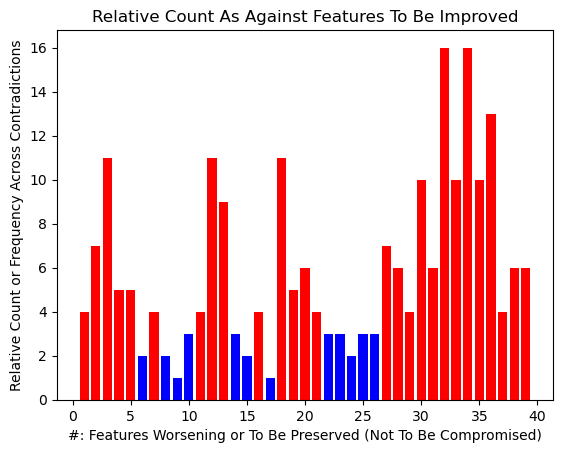
The 39 Engineering Parameters of the Contradiction Matrix: The 39 engineering parameters represent the most important characteristics of technical systems, and allow the technical contradiction to be formulated in a standardised way: 1. Mass of the moving object 2. Mass of the non-moving object 3. Length of the moving object 4. Length of the non-moving object 5. Area of the moving object 6. Area of the non-moving object 7. Volume of the moving object 8. Volume of the non-moving object 9. Speed 10. Force 11. Tension, Pressure 12. Shape 13. Stability of the object 14. Strength 15. Action time of the moving object 16. Action time of the non-moving object 17. Temperature 18. Brightness, Visibility 19. Energy consumption of the moving object 20. Energy consumption of the non- moving object 21. Power 22. Energy loss 23. Material loss 24. Information loss 25. Time loss 26. Amount of substance 27. Reliability 28. Accuracy of measurement 29. Accuracy of manufacturing 30. Harmful external factors 31. Harmful internal factors 32. Convenience of manufacturing 33. Convenience of use 34. Convenience of repair 35. Adaptability 36. Complexity of the structure 37. Complexity of control and measurement 38. Level of automation 39. Productivity.
The following contradictions can be resolved using the ‘Oxidation’ inventive principle:
Feature To Improve : [ List of One or Many Other Features Worsening ]
1: Mass of the moving object: [’13: Stability of the object’, ’18: Brightness, Visibility’, ’27: Reliability’, ’32: Convenience of manufacturing’]
2: Mass of the non-moving object: [‘4: Length of the non-moving object’, ’13: Stability of the object’, ’20: Energy consumption of the non-moving object’, ’29: Accuracy of manufacturing’, ’31: Harmful internal factors’, ’32: Convenience of manufacturing’, ’33: Convenience of use’, ’36: Complexity of the structure’, ’39: Productivity’]
3: Length of the moving object: [’11: Tension, Pressure’, ’12: Shape’, ’13: Stability of the object’, ’21: Power’, ’24: Information loss’, ’30: Harmful external factors’, ’32: Convenience of manufacturing’, ’34: Convenience of repair’, ’35: Adaptability’, ’36: Complexity of the structure’, ’37: Complexity of control and measurement’]
4: Length of the non-moving object: [’11: Tension, Pressure’, ’16: Action time of the non-moving object’, ’30: Harmful external factors’, ’35: Adaptability’, ’36: Complexity of the structure’]
5: Area of the moving object: [’30: Harmful external factors’, ’32: Convenience of manufacturing’, ’34: Convenience of repair’, ’36: Complexity of the structure’]
6: Area of the non-moving object: [’10: Force’, ’31: Harmful internal factors’, ’36: Complexity of the structure’]
7: Volume of the moving object: [‘3: Length of the moving object’, ‘5: Area of the moving object’, ’12: Shape’, ’13: Stability of the object’, ’27: Reliability’, ’31: Harmful internal factors’, ’32: Convenience of manufacturing’, ’36: Complexity of the structure’]
8: Volume of the non-moving object: [’34: Convenience of repair’, ’36: Complexity of the structure’]
9: Speed: [’13: Stability of the object’, ’28: Accuracy of measurement’, ’30: Harmful external factors’, ’32: Convenience of manufacturing’]
10: Force: [‘1: Mass of the moving object’, ‘2: Mass of the non-moving object’, ‘6: Area of the non-moving object’, ’20: Energy consumption of the non-moving object’, ’30: Harmful external factors’, ’32: Convenience of manufacturing’, ’33: Convenience of use’, ’34: Convenience of repair’]
11: Tension, Pressure: [‘4: Length of the non-moving object’, ’32: Convenience of manufacturing’, ’36: Complexity of the structure’]
12: Shape: [’13: Stability of the object’, ’28: Accuracy of measurement’, ’30: Harmful external factors’, ’31: Harmful internal factors’, ’32: Convenience of manufacturing’, ’34: Convenience of repair’, ’35: Adaptability’, ’36: Complexity of the structure’, ’38: Level of automation’]
13: Stability of the object: [‘2: Mass of the non-moving object’, ‘3: Length of the moving object’, ’12: Shape’, ’17:Temperature’, ’38: Level of automation’]
14: Strength: [‘1: Mass of the moving object’, ‘2: Mass of the non-moving object’, ‘3: Length of the moving object’, ’30: Harmful external factors’]
15: Action time of the moving object: [’32: Convenience of manufacturing’, ’35: Adaptability’]
16: Action time of the non-moving object: [‘4: Length of the non-moving object’, ’30: Harmful external factors’, ’33: Convenience of use’, ’34: Convenience of repair’, ’38: Level of automation’]
17:Temperature: [’13: Stability of the object’]
18: Brightness, Visibility: [‘1: Mass of the moving object’, ’19: Energy consumption of the moving object’, ’20: Energy consumption of the non-moving object’, ’22: Energy loss’, ’23: Material loss’, ’24: Information loss’, ’25: Time loss’, ’26: Amount of substance’, ’35: Adaptability’]
19: Energy consumption of the moving object: [’28: Accuracy of measurement’, ’30: Harmful external factors’, ’34: Convenience of repair’]
20: Energy consumption of the non-moving object: [’32: Convenience of manufacturing’, ’39: Productivity’]
21: Power: [‘3: Length of the moving object’]
22: Energy loss: [’18: Brightness, Visibility’, ’33: Convenience of use’]
23: Material loss: [‘7: Volume of the moving object’, ’18: Brightness, Visibility’, ’31: Harmful internal factors’]
24: Information loss: [‘3: Length of the moving object’, ’30: Harmful external factors’]
25: Time loss: [’18: Brightness, Visibility’, ’20: Energy consumption of the non-moving object’, ’34: Convenience of repair’]
26: Amount of substance: [’32: Convenience of manufacturing’]
27: Reliability: [’12: Shape’, ’29: Accuracy of manufacturing’, ’34: Convenience of repair’, ’36: Complexity of the structure’, ’39: Productivity’]
28: Accuracy of measurement: [’18: Brightness, Visibility’, ’27: Reliability’, ’33: Convenience of use’, ’34: Convenience of repair’]
29: Accuracy of manufacturing: [’27: Reliability’, ’33: Convenience of use’]
30: Harmful external factors: [‘3: Length of the moving object’, ‘4: Length of the non-moving object’, ‘5: Area of the moving object’, ’12: Shape’, ’14: Strength’, ’16: Action time of the non-moving object’, ’18: Brightness, Visibility’, ’19: Energy consumption of the moving object’]
31: Harmful internal factors: [‘2: Mass of the non-moving object’, ‘6: Area of the non-moving object’, ’10: Force’, ’12: Shape’, ’23: Material loss’, ’25: Time loss’, ’26: Amount of substance’, ’36: Complexity of the structure’, ’37: Complexity of control and measurement’]
32: Convenience of manufacturing: [‘2: Mass of the non-moving object’, ‘3: Length of the moving object’, ‘5: Area of the moving object’, ‘7: Volume of the moving object’, ‘9: Speed’, ’11: Tension, Pressure’, ’12: Shape’, ’13: Stability of the object’, ’14: Strength’, ’15: Action time of the moving object’, ’18: Brightness, Visibility’, ’19: Energy consumption of the moving object’, ’20: Energy consumption of the non-moving object’, ’21: Power’, ’26: Amount of substance’, ’28: Accuracy of measurement’, ’34: Convenience of repair’, ’36: Complexity of the structure’, ’37: Complexity of control and measurement’, ’38: Level of automation’, ’39: Productivity’]
33: Convenience of use: [‘2: Mass of the non-moving object’, ‘3: Length of the moving object’, ‘5: Area of the moving object’, ‘7: Volume of the moving object’, ’16: Action time of the non-moving object’, ’18: Brightness, Visibility’, ’19: Energy consumption of the moving object’, ’29: Accuracy of manufacturing’, ’34: Convenience of repair’, ’35: Adaptability’, ’38: Level of automation’, ’39: Productivity’]
34: Convenience of repair: [‘3: Length of the moving object’, ‘8: Volume of the non-moving object’, ’10: Force’, ’12: Shape’, ’14: Strength’, ’16: Action time of the non-moving object’, ’18: Brightness, Visibility’, ’19: Energy consumption of the moving object’, ’22: Energy loss’, ’25: Time loss’, ’27: Reliability’, ’32: Convenience of manufacturing’, ’33: Convenience of use’, ’35: Adaptability’, ’36: Complexity of the structure’, ’39: Productivity’]
35: Adaptability: [‘1: Mass of the moving object’, ‘3: Length of the moving object’, ‘4: Length of the non-moving object’, ’12: Shape’, ’15: Action time of the moving object’, ’18: Brightness, Visibility’, ’21: Power’, ’22: Energy loss’, ’28: Accuracy of measurement’, ’32: Convenience of manufacturing’, ’33: Convenience of use’, ’34: Convenience of repair’, ’37: Complexity of control and measurement’]
36: Complexity of the structure: [‘3: Length of the moving object’, ‘5: Area of the moving object’, ‘8: Volume of the non-moving object’, ’11: Tension, Pressure’, ’27: Reliability’, ’31: Harmful internal factors’, ’32: Convenience of manufacturing’, ’34: Convenience of repair’, ’38: Level of automation’]
37: Complexity of control and measurement: [‘2: Mass of the non-moving object’, ‘7: Volume of the moving object’, ’12: Shape’, ’21: Power’, ’23: Material loss’, ’35: Adaptability’]
38: Level of automation: [’12: Shape’, ’13: Stability of the object’, ’32: Convenience of manufacturing’, ’33: Convenience of use’, ’34: Convenience of repair’, ’35: Adaptability’]
39: Productivity: [’18: Brightness, Visibility’, ’20: Energy consumption of the non-moving object’, ’27: Reliability’, ’28: Accuracy of measurement’, ’29: Accuracy of manufacturing’, ’33: Convenience of use’, ’34: Convenience of repair’, ’35: Adaptability’]
EXAMPLE: Recognize the need for seamless transition between laptop and tablet modes. The detachable screen of a laptop that can be used as a tablet is a clear example of applying the Segmentation principle in product design. This design approach involves dividing the device into segments, each with a distinct function or mode of operation.
Contradiction: Design a device that serves as both a traditional laptop and a tablet but by addressing the (1) weight of the product versus (2) stability of the product for. different needs of productivity and portability.
Soluiton: Identify the primary functions of a laptop (productivity, keyboard input) and a tablet (portability, touch input). Divide the device into two main segments: the laptop segment with a keyboard and the tablet segment with a detachable screen (with a s soft keyboard). The laptop segment includes the keyboard, touchpad, and other components essential for traditional computing tasks. The tablet segment consists of the detachable touchscreen display, which can be used independently for touch-based activities. Design a robust yet easily detachable connection mechanism between the screen and the keyboard segments. Magnetic connectors or secure docking mechanisms can be implemented to allow users to detach the screen effortlessly and switch between laptop and tablet modes. This segmentation ensures a reliable and user-friendly transition.
Identify components such as batteries and processors that contribute to the weight and functionality of each segment. Optimize the laptop segment for extended productivity and the tablet segment for efficient portability. The laptop segment may contain a larger battery and more powerful processor to support longer usage times and demanding tasks. The tablet segment, on the other hand, can have a smaller, lightweight battery optimized for tablet applications. This segmentation enables users to choose the mode based on their specific needs without compromising performance.
Recognize that user interaction differs between laptop and tablet modes. Design the user interface and interaction elements to be optimized for touch in tablet mode and traditional keyboard/mouse input in laptop mode. The operating system or user interface can adapt based on the device mode. In tablet mode, touch gestures and a touch-friendly interface are prioritized, while laptop mode emphasizes keyboard and mouse interactions. This segmentation enhances the user experience in each mode.
By applying the Segmentation principle in the design of a laptop with a detachable screen, manufacturers create a versatile device that caters to different user needs and optimizing the laptop and tablet segments for specific functions, allows users to enjoy the benefits of both productivity and portability without compromising on either (or not increasing weight i.e. of two separate devices laptop with screen and an additional tablet equivalent to the weight of the laptop screen).