

9: PRIOR COUNTERACTION (PRELIMINARY ANTI-ACTION): (A) Perform additional useful or harmful action as a counter action (anti-action) to compensate (or prevent) excessive and undesirable effect or harmful effect later on, produced by an object or system (B) Create an action within an object or system such that it opposes undesireable inflluence of environment on its operation or working conditions.
EXAMPLE: Reinforced Concrete (adding steel reinforcements to concrete structures to strengthen and prevent cracking under stress, increasing durability), Masking Tapes for Painting, Pre- Stressed Bolts/Springs (applying tension to bolts before they are used to secure objects, ensuring they remain tightly fastened even under external forces), Pre-Shrunked Cloths (treating fabrics to reduce the likelihood of shrinking when washed, preventing unwanted changes in size and fit), Car’s Rear Window (creating tempered glass for a car’s rear window with pre-compressed surfaces under tension to enhance its strength and resistance to impact.), Buffering (lag or delayed streaming), Masking in X-Ray/Painting (using masking tape to cover surfaces before exposing to radiation or painting to prevent radiations or paint from seeping onto unintended areas or causing a harm).
SYNONYMS: PRELIMINARY ANTI-ACTION, Anticipatory Action
ACB:
“Prior Counteraction” is a principle that involves taking proactive steps to prevent or counteract potential problems or undesired effects before they actually occur. Instead of waiting for a problem to arise and then solving it, this principle focuses on anticipating and addressing issues in advance. By identifying and addressing potential challenges early in the design or problem-solving process, the goal is to eliminate or minimize the negative consequences that could occur later on. This proactive approach helps to prevent the need for corrective actions, reduces risks, and enhances the overall efficiency and effectiveness of a system, process, or product. Preliminary counteraction or anti-action or prior counteraction, is a proactive approach to mitigating risks, aiming to eliminate or minimize potential risks through initial preventive measures. The Failure Modes and Effects Analysis (FMEA) is a structured technique that is used to evaluate processes, identifying potential failure points and assessing the feasibility of implementing preventive measures. Similarly, SWOT analysis serves as another tool to assess the strengths, weaknesses, opportunities, and threats in a given context, process, or situation. Conducting a SWOT analysis serves as a form of preliminary counteraction. When a course of action yields both beneficial and detrimental outcomes, substituting anti-actions to manage the adverse effects is advisable. “Priro Counteraction” encourages engineers and innovators to think ahead and consider possible negative scenarios, weaknesses, or failures that could occur due to the nature of the problem or system at hand. By implementing preventative measures or design modifications, they can ensure a smoother operation and increase the likelihood of achieving the desired results without unexpected setbacks.
Preloading countertension (or counteraction or counter-stress) to an object in advance involves applying an opposing force or stress to the object before it experiences an excessive or undesirable stress, with the aim of compensating for or protecting it from the impending harm. Essentially, this principle involves proactively introducing a counterbalancing force to mitigate the effects of anticipated stress or pressure on the object. Preloading countertension is a proactive approach to engineering design that aims to anticipate and mitigate potential sources of stress or harm to objects or systems. By introducing counteracting forces or stresses in advance, engineers can enhance the resilience, stability, and safety of technical systems in a variety of applications. Here are a few examples of technical systems where this principle could be applied:
Bridge Construction: In the construction of bridges, engineers may preload countertension into support cables or beams to counteract the weight of vehicles and other loads that will be placed on the bridge. By tensioning the cables or beams in advance, engineers can ensure that the bridge structure remains stable and resilient under the expected loads. Building Foundations: When constructing buildings on unstable or shifting soil, builders may employ techniques such as preloading countertension to mitigate the risk of foundation settlement or structural damage. By applying downward pressure or compacting the soil before building, builders can help stabilize the foundation and prevent excessive settling or shifting over time. Automotive Safety Systems: In automotive safety systems, such as seat belts and airbags, preloading countertension is used to protect occupants in the event of a crash. For example, seat belts are designed to apply tension to restrain occupants and prevent them from being thrown forward in a collision, while airbags are preloaded with gas to rapidly inflate and cushion occupants upon impact. Industrial Machinery: In heavy machinery and equipment, preloading countertension may be used to protect components from excessive stress or vibration during operation. For example, in rotating machinery such as turbines or engines, counterweights or balancing mechanisms may be preloaded to offset the centrifugal forces generated by rotating parts and ensure smooth operation.
Reversing the system’s properties involves intentionally altering certain parameters, such as pressure, temperature, or volume, to adapt to extreme or excessive operating conditions. For instance, preemptively cooling a system if it will be exposed to extreme heat is a proactive approach aimed at maintaining optimal functionality and preventing damage due to overheating. Reversing the system’s properties to accommodate extreme operating conditions involves proactive measures to regulate temperature, pressure, or other parameters to maintain functionality and prevent damage. By preemptively adjusting system properties, engineers can enhance the resilience and reliability of technical systems in a variety of applications. Here are examples of technical systems where this principle could be applied:
Data Centers: In data centers where servers generate significant heat during operation, cooling systems are essential to maintain optimal operating temperatures. By preemptively cooling the data center environment using air conditioning or liquid cooling systems, operators can prevent overheating and ensure continuous operation of critical IT infrastructure. Aircraft Engines: Aircraft engines operate under extreme conditions, including high temperatures and pressures during takeoff and flight. To prevent overheating and maintain engine performance, advanced cooling systems are integrated into the engine design. These systems may involve the circulation of coolant fluids or the use of air-cooling mechanisms to dissipate heat effectively. Power Plants: Power generation facilities, such as thermal power plants, often operate at high temperatures and pressures to produce electricity. To prevent equipment failure and maintain efficiency, cooling systems are employed to regulate temperature and manage thermal stress. For example, heat exchangers and cooling towers are used to dissipate excess heat generated during power generation processes. Automotive Engines: In automotive engines, cooling systems are essential to prevent overheating and maintain optimal performance. Engine coolant circulates through the engine block and radiator, absorbing heat generated during combustion and dissipating it through the radiator. By preemptively cooling the engine before operating in extreme conditions, such as hot weather or heavy loads, drivers can prevent engine damage and ensure reliable vehicle operation.
Anticipate and mitigate the least probable or rare adverse effect or action, particularly if it poses a critical risk to or from the system: Anticipating and mitigating the least probable adverse effects is essential for ensuring the reliability, safety, and resilience of technical systems across various industries. By proactively addressing these risks, engineers can minimize the likelihood of catastrophic failures and protect both the system and its stakeholders from potential harm. This principle involves identifying and addressing potential rare or least probable adverse effects or actions that could pose significant risks to the system’s functionality, integrity, or safety. By proactively anticipating and mitigating these risks, engineers can enhance the robustness and reliability of technical systems. Here are examples of technical systems where this principle could be applied:
Spacecraft Design: In the design of spacecraft, engineers must anticipate and mitigate the least probable adverse effects to ensure mission success and crew safety. For example, spacecraft systems are designed with redundant components and fail-safes to mitigate the risk of critical failures due to rare events such as micrometeoroid impacts or solar flares. Nuclear Power Plants: Nuclear power plants operate under strict safety protocols to prevent accidents and mitigate the consequences of rare adverse events, such as reactor meltdowns or core breaches. Safety features, such as containment structures, emergency shutdown systems, and redundant cooling systems, are incorporated into plant design to minimize the risk of catastrophic failures. Medical Devices: Medical devices, such as pacemakers or implantable defibrillators, are designed to mitigate the least probable adverse effects to ensure patient safety and device efficacy. For example, these devices are equipped with diagnostic sensors and backup power sources to detect and respond to rare events such as device malfunctions or battery failures. Financial Systems: In financial systems, risk management strategies are implemented to anticipate and mitigate the least probable adverse effects that could lead to financial crises or market disruptions. For example, banks and investment firms employ stress testing and scenario analysis to identify and mitigate the risks associated with rare events such as market crashes or economic downturns.
The Prior Counteraction Principle in the context of war strategies involves taking preventive or preemptive actions to counteract potential threats before they materialize. A historical example of this principle can be seen in the Israeli military’s actions during the Six-Day War in 1967 – Operation Focus. In the lead-up to the Six-Day War, tensions were escalating in the Middle East. Egypt, under President Gamal Abdel Nasser, had deployed a significant number of troops and closed the strategic Straits of Tiran, blocking Israeli shipping routes. Israel perceived the concentration of Arab forces and the blockade of the Straits of Tiran as potential threats to its security. In response, Israel decided to launch a preemptive strike to neutralize the perceived threat posed by the Arab coalition. Israel’s Operation Focus, launched on June 5, 1967, aimed to achieve air superiority and cripple the air forces of Egypt, Jordan, and Syria in a rapid and decisive manner. The strategy was to counteract the potential threat posed by the combined Arab forces.
The preemptive strike was highly successful. The Israeli Air Force executed a well-coordinated attack on the airfields of Egypt, Jordan, and Syria, destroying a significant portion of their aircraft on the ground. This preemptive action provided Israel with air superiority and significantly weakened the military capabilities of the Arab states. The Six-Day War ensued, and Israel achieved a swift and decisive victory. The conflict resulted in significant territorial changes in the region, with Israel gaining control of the Sinai Peninsula, the West Bank, East Jerusalem, and the Golan Heights. This historical example illustrates the application of the Prior Counteraction Principle in military strategy, where preemptive action was taken to counteract perceived threats before they could materialize. The success of Operation Focus showcased the potential advantages of strategic planning and decisive action based on a preemptive approach to neutralize threats.
The concept of preemptive action is often associated with the idea of preventing an imminent threat before it materializes. Preemptive strikes, as a war strategy, have been employed by various countries throughout history in response to perceived threats. One well-known case involving the United States is the Iraq War in 2003. The U.S.-led coalition, including the United Kingdom and several other allies, justified the invasion of Iraq as a preemptive action to eliminate weapons of mass destruction (WMD) that were believed to be in possession of Saddam Hussein’s regime. However, the intelligence regarding WMDs in Iraq later proved to be inaccurate, leading to significant controversy and criticism of the preemptive military intervention. It’s essential to consider that the use of preemptive strikes is a complex and debated aspect of international relations and military strategy. Countries may justify such actions based on perceived threats to their national security, while critics may question the legitimacy of these actions and advocate for diplomatic solutions. The decision to employ preemptive strikes involves a careful balance between responding to potential threats and adhering to international norms and legal principles
The way “Prior Counteraction” is interpreted and applied can depend on the specific challenges, goals, and technologies relevant to each industry. However, the underlying principle of addressing potential issues before they escalate or occur is a common thread across different contexts.The “Prior Counteraction” principle can be applied to resolve various technical and business contradictions by taking proactive steps to prevent or compensate for potential issues before they occur.
The core concept of addressing potential issues or challenges proactively to prevent them from arising or worsening remains consistent, but the specific methods and strategies can vary based on the nature of the industry, the type of problems being addressed, and the available technologies. Different industries may have unique challenges and requirements that lead to diverse interpretations of how to implement “Prior Counteraction.” For example: In manufacturing, “Prior Counteraction” could involve designing products with built-in redundancies or fail-safe mechanisms to prevent potential failures. Engineers might apply this principle by using materials that are resistant to wear and tear, ensuring products can withstand anticipated stresses and strains. When striving for both high-quality products and quick time-to-market, applying the principle can involve integrating quality control processes and inspections into the production workflow to prevent defects. When designing a lightweight structure that still needs to be strong, the “Prior Counteraction” principle can be used by incorporating reinforcements or pre-stressed materials to prevent excessive stress or deformation under load. Balancing the need for a durable product with cost considerations can involve using materials with pre-stressed features, coatings, or treatments to enhance longevity without significantly increasing expenses. To meet high market demand while managing resource constraints, companies can implement proactive measures like pre-ordering raw materials or securing additional production capacity ahead of time. Implementing pre-stress and load testing on critical components during the development phase to identify weak points and potential failures before mass production.
In the software industry, “Prior Counteraction” could mean building comprehensive error or exception handling and debugging systems to catch and correct potential issues before they lead to crashes or data corruption. Developers might also implement security measures to prevent cyberattacks and data breaches. It could be about conducting regular security audits, penetration testing, and proactive vulnerability assessments to identify and address potential weaknesses before they can be exploited. They could invest in robust data security measures and conducted regular security audits to identify vulnerabilities, define encryption protocols, and secure payment gateways to prevent exploitation by malicious actors . By proactively addressing data security vulnerabilities, they could protect user information and prevent potential breaches.
In healthcare, “Prior Counteraction” could involve early disease detection and prevention strategies or cure, as well as implementing safety protocols to minimize the risk of medical errors. Hospitals might use predictive analytics to identify patients at risk of certain conditions and intervene before the conditions worsen. Preemptively diversifying medical suppliers and maintaining buffer stock of essential medical supplies to counteract delays caused by unexpected disruptions, ensuring consistent production. In environmental contexts, “Prior Counteraction” could mean implementing measures to prevent pollution and habitat degradation. Companies might proactively invest in sustainable practices to mitigate their impact on the environment. In the retai and financial industry, “Prior Counteraction” could involve risk assessment and mitigation strategies. Banks might implement robust fraud detection systems to prevent unauthorized transactions and protect customers’ financial assts. Implementing proactive measures such as hiring additional support staff and creating an automated ticketing system to handle customer inquiries efficiently, preventing customer dissatisfaction due to delayed responses. Developing an AI-powered chatbot or automated ticketing system to handle common customer inquiries, preventing a backlog of support requests during peak periods.
The mechanism in a chair, involves pre-elongated or stretched-out springs, typically known as a “spring suspension” or “spring-loaded seat.” This system is designed to provide a counteraction force in response to the person sitting on the chair, offering a more comfortable and controlled experience. The chair incorporates springs that are pre-elongated or stretched out when the chair is in its resting state. These springs are compressed when a person sits on the chair. The compression of the springs generates a counteraction force. As a person applies their weight to the chair, the springs resist the compression and exert an upward force. This upward force counteracts the gravitational force pulling the person down, creating a balance. This counteraction helps in providing support and ensuring a controlled descent of the seat. The pre-elongated springs contribute to a smoother and controlled descent of the seat, preventing a sudden drop or impact. This feature enhances the user experience by making the act of sitting more comfortable.
The counteraction force from the springs not only provides comfort but also contributes to the safety of the user. It helps absorb some of the impact when the person initially sits on the chair, reducing the stress on both the chair structure and the person. The concept of prior counteraction aligns with the idea that the springs are pre-elongated or pre-stretched before the person sits. In this sense, the system is designed in anticipation of the user’s action, providing a counteraction to the weight that will be applied. The spring suspension system in a chair addresses contradictions related to supporting the user’s weight while ensuring a smooth and controlled descent. It balances the need for support (counteracting the user’s weight) with the desire for a comfortable and controlled sitting experience.
The concept of prior counteraction is evident in the systems that are prepared and loaded in anticipation of an action (launching a rocket or firing a bullet), and the subsequent counteraction that involves the controlled release of energy to achieve the desired propulsion. These examples highlight the engineering principles of controlled energy release for specific applications, aligning with the idea of prior counteraction. Before a rocket is launched, there is a prior action in terms of fueling and preparing the rocket’s propulsion system. The counteraction involves the controlled release of energy from the rocket’s propellant system. This can include the ignition of rocket fuel, resulting in the expulsion of high-speed gases through a rocket nozzle. The prior action of fueling and preparing the rocket anticipates the need for controlled propulsion. The counteraction of releasing energy addresses the contradiction between the need for a powerful launch and the controlled application of force. In a firearm, the prior action involves loading a round into the chamber and preparing the firing mechanism. The counteraction occurs when the trigger is pulled, initiating the controlled release of energy from the propellant in the bullet casing. This results in the expulsion of the bullet from the barrel at high velocity. The prior action of loading and preparing the firearm anticipates the need for a controlled release of energy. The counteraction of firing the bullet addresses the contradiction between the need for a powerful projectile launch and the controlled use of force.
Parachutes are indeed used in certain military aircraft, particularly fighter jets, to assist in their landing. This system is known as a “tailhook” or “arresting gear,” and it is employed on aircraft carriers to facilitate the landing of high-speed aircraft on relatively short and confined deck spaces. The aircraft is equipped with a tailhook, a metal hook located on the underside of the rear fuselage. As the aircraft approaches the deck of the aircraft carrier for landing, the tailhook is deployed. The carrier deck is equipped with arresting gear, which consists of cables stretched across the deck. These cables are part of a complex system that includes machinery for rapidly stopping the movement of the cables. When the aircraft attempts to land on the carrier deck, the tailhook engages one of the arresting cables. The rapid engagement of the cable applies a strong decelerating force to the aircraft, helping it to quickly come to a stop. The use of arresting gear allows fighter jets to land on the relatively short deck of an aircraft carrier, where there is limited space for a conventional landing. It provides a controlled and rapid method for bringing high-speed aircraft to a stop. This application of parachute technology in military aviation aligns with two prominent principles: Cushioning: The arresting gear system acts as a cushion, absorbing and dissipating the kinetic energy of the landing aircraft. Prior Counteraction: The deployment of the tailhook and engagement with arresting gear represent a proactive counteraction to ensure a safe and controlled landing on the carrier deck.
A company in a hospitality industry with a business similar to Airbnb could use the “Prior Counteraction” principle to proactively address various challenges and potential issues in their business model. Ensuring the safety and security of both hosts and guests using the platform imply implementing advanced background checks and verification processes for hosts and guests, ensuring that users with suspicious records are identified and prevented from using the platform. They could also proactively screen listings for potential safety hazards and require hosts to meet specific safety requirements before listing their properties. This would enhance trust and safety on the platform. Setting specific listing requirements and conducting pre-listing inspections to ensure that properties meet the platform’s quality standards before they are listed. This could involve sending certified inspectors to verify the accuracy of property descriptions, photos, and amenities before they are published on the platform. This proactive approach would prevent misleading or inaccurate listings. This could prevent subpar listings and negative guest experiences. Requesting guests to provide a security deposit as a preventative measure against property damage. Additionally, they could have introduced insurance coverage for hosts to protect their properties from potential risks.
They could engage legal experts early on to identify potential regulatory hurdles and proactively develop compliance strategies for each location. This would prevent legal issues and regulatory challenges down the line. These strategies would proactively address local regulations and work to ensure that hosts on the platform are fully compliant with applicable laws, helping to prevent legal disputes and regulatory issues. They could implement strict guidelines for guest behavior and expectations, and communicated these clearly to both hosts and guests. This proactive approach and guidelines could proactively outline expectations for behavior, noise levels, and neighbor interactions. By educating users about responsible hosting and staying, Airbnb could prevent conflicts and disruptions.
The testing of such Prior Counteractions is also part of Prior Action that is directly related to extra loading or stress testing in the context of quality control or assurance testing stages (i.e. desiging and exposing the system to an extreme negative or harmful action beforehand, during the testing phase with a positive objective or intent). It involves anticipating potential problems with the prior counter measures before they occur in reality (during the usage or deployment phase). It includes testing the limits of these compensations so provided or designed as a counter meaures for safety when the system in actual or normal use. By subjecting the system to these tests, the weaknesses or vulnerabilities of counter measures can be identified proactively, allowing for corrective measures to be implemented before the product reaches the customer. The purpose of conducting stress tests to break the system (for instance simulating software behavior for a very large number of concurrent users or crash testing a vehicle) is to push the product beyond its normal operating limits to see how it performs under extreme conditions. Prior Action encourages organizations to anticipate potential failure points including the counter or safety meanures placed in the product or system and take preemptive actions to reinforce or redesign those components to withstand higher stress levels. By addressing these weaknesses before the product is released, the risk of failures in the field is minimized.
Risk compensation and the Peltzman effect are closely related concepts, but they are not exactly the same. Risk compensation is a broader concept that refers to the phenomenon where individuals adjust their behavior in response to changes in perceived risk. This adjustment often involves individuals engaging in riskier behaviors when they feel safer due to the presence of safety measures or interventions, thereby offsetting the intended safety benefits. Risk compensation can occur in various contexts beyond road safety, including health behaviors, sports, and technical systems. When safety measures or equipment are implemented in technical systems to mitigate risks, individuals may perceive themselves as being safer and consequently engage in riskier behaviors. For example, if a safety barrier is installed on a piece of machinery, workers might feel more comfortable taking shortcuts or not following safety protocols, assuming the barrier will protect them from harm. In systems where automation or technology is introduced to enhance safety, individuals may rely excessively on these systems and become complacent in their monitoring or oversight responsibilities. This overreliance can lead to reduced vigilance and an increased likelihood of errors or accidents, as individuals may assume that the technology will compensate for any mistakes.
The Peltzman effect, named after economist Sam Peltzman, specifically refers to the observation that the introduction of safety regulations or interventions in one area can lead to an increase in risky behavior that offsets the intended safety benefits. Peltzman originally studied this effect in the context of automobile safety regulations, observing that the increased use of seat belts and other safety features by drivers led to a decrease in the number of deaths and injuries per accident but also an increase in the number of accidents themselves. This suggests that drivers were compensating for the perceived increase in safety by driving more recklessly or taking greater risks. Peltzman effect is a specific application of risk compensation theory in the context of safety regulations, risk compensation itself is a broader concept that encompasses various behaviors and contexts where individuals adjust their behavior in response to changes in perceived risk.
Zero-risk bias is indeed a tendency for decision-makers to prioritize the complete elimination of a specific risk, even if other alternatives would result in greater overall risk reduction. This bias is particularly common in situations involving health, safety, and environmental concerns, where decision-makers may prioritize eliminating a single risk entirely, even if doing so is impractical or costly. In technical systems or problem-solving contexts, zero-risk bias can have significant implications for decision-making. Decision-makers may allocate resources disproportionately to eliminate a specific risk, neglecting other, potentially more significant risks. This bias can lead to suboptimal outcomes, as resources are not allocated efficiently to address the most critical risks. Addressing zero-risk bias requires promoting a balanced approach to risk management that considers the trade-offs between risk reduction, cost-effectiveness, and overall system performance. Decision-makers should critically evaluate proposed solutions, weighing the benefits and drawbacks of achieving zero risk versus more pragmatic risk mitigation strategies. By fostering a culture of risk awareness and informed decision-making, organizations can mitigate the impact of zero-risk bias and achieve better outcomes in technical systems and environments. Zero risk bias can influence regulatory decision-making processes, where policymakers may prioritize the elimination of a specific risk over broader considerations such as cost-effectiveness, feasibility, or unintended consequences. Hence, this bias can lead to the implementation of overly stringent regulations that impose unnecessary burdens on stakeholders without commensurate benefits.
Optimism Bias bias refers to the tendency of individuals to overestimate the likelihood of positive events happening to them while underestimating the probability of negative events. It’s a cognitive bias where people believe that they are less likely to experience negative outcomes compared to others, even when facing similar risks or uncertainties. Optimism bias can influence various aspects of decision-making, such as financial investments, health behaviors, and planning for the future.
In the context of cognitive biases, conservatism refers to the tendency of individuals to maintain existing beliefs or preferences, even in the face of new information that contradicts those beliefs. This cognitive bias is characterized by a reluctance to update one’s beliefs or opinions based on new evidence, leading to a preference for familiar or established ideas over novel or contradictory ones. Key aspects of conservatism bias include: Resistance to Change: Individuals affected by conservatism bias are resistant to changing their beliefs, attitudes, or behaviors, even when presented with compelling evidence or arguments that challenge their existing views. This resistance to change can stem from a desire for cognitive consistency and a reluctance to confront uncertainty or ambiguity. Confirmation Bias: Conservatism bias is often reinforced by confirmation bias, which is the tendency to seek out, interpret, and remember information in a way that confirms one’s pre-existing beliefs or hypotheses while ignoring or discounting contradictory evidence. Confirmation bias leads individuals to selectively attend to information that supports their existing views, further entrenching their conservative beliefs. Status Quo Bias: Conservatism bias is closely related to status quo bias, which is the preference for maintaining the current state of affairs or sticking with familiar options rather than making changes. Status quo bias can contribute to inertia and resistance to innovation or reform, as individuals are reluctant to deviate from established norms or practices. Influence on Decision-Making: Conservatism bias can have significant implications for decision-making processes, as it can lead individuals to make suboptimal choices or fail to adapt to changing circumstances. For example, investors may be slow to adjust their investment strategies in response to changing market conditions, leading to missed opportunities or excessive risk exposure.
To mitigate conservatism bias, individuals can: Foster a willingness to critically evaluate and update their beliefs in light of new evidence or information. Seek out diverse perspectives and actively engage with viewpoints that challenge their existing beliefs. Cultivate openness to change and flexibility in decision-making, rather than adhering rigidly to familiar or comfortable options. Practice mindfulness and metacognition to reflect on the underlying reasons for their beliefs and biases and consider alternative perspectives. By being aware of conservatism bias and actively working to mitigate its influence, individuals can make more informed decisions, adapt to changing circumstances, and foster intellectual curiosity and growth.
Pessimism bias refers to the tendency of individuals to overestimate the likelihood of negative outcomes or events. In a technical context, this bias might lead designers or decision-makers to focus excessively on potential technical failures or risks, resulting in overly conservative design choices or the rejection of innovative but unproven technologies. When solving technical problems, this bias might lead individuals to underestimate their ability to find effective solutions or overcome challenges, resulting in a defeatist attitude or lack of motivation.
Moral Credential Effect: The moral credential effect is a cognitive bias where individuals feel licensed to engage in morally questionable behavior after previously demonstrating moral behavior. In the context of designing a technical system, the moral credential effect might lead designers to overlook ethical considerations or risks associated with certain design decisions, assuming that their past moral actions absolve them of responsibility. For example, designers might prioritize cost-saving measures or efficiency improvements at the expense of user privacy or security, believing that their previous ethical decisions justify such compromises. Similarly, when solving technical problems, individuals affected by the moral credential effect may downplay ethical concerns or justify questionable decisions based on their perceived moral track record. To mitigate this bias, designers and problem solvers should remain vigilant about ethical considerations throughout the design and problem-solving process, seeking to uphold moral principles consistently rather than relying on past actions as moral credentials.
Outcome Bias: Outcome Bias is a cognitive bias where the outcome of a decision or action influences the evaluation of the decision-making process itself. In the context of designing a technical system, Outcome Bias might lead designers to judge the quality of design decisions based solely on the success or failure of the resulting system, rather than considering the decision-making process and rationale behind those decisions. For example, if a technical system performs well in the marketplace, designers may attribute its success to their design decisions without critically evaluating alternative design approaches that may have led to similar outcomes. Similarly, when solving technical problems, individuals affected by Outcome Bias may judge the effectiveness of problem-solving approaches based solely on the outcome achieved, rather than considering the appropriateness of the approach given the information available at the time. To mitigate this bias, designers and problem solvers should focus on evaluating the decision-making process itself, considering the rationale behind each decision and the information available at the time, rather than solely focusing on the outcome achieved.
2: Mass of the non-moving object: [’32: Convenience of manufacturing’]
5: Area of the moving object: [’27: Reliability’]
6: Area of the non-moving object: [‘4: Length of the non-moving object’]
7: Volume of the moving object: [’14: Strength’]
8: Volume of the non-moving object: [’14: Strength’]
10: Force: [‘3: Length of the moving object’, ‘7: Volume of the moving object’]
11: Tension, Pressure: [’14: Strength’]
12: Shape: [’15: Action time of the moving object’]
13: Stability of the object: [’14: Strength’]
14: Strength: [‘6: Area of the non-moving object’, ‘8: Volume of the non-moving object’]
15: Action time of the moving object: [‘3: Length of the moving object’]
17:Temperature: [‘3: Length of the moving object’, ‘4: Length of the non-moving object’]
19: Energy consumption of the moving object: [’14: Strength’]
20: Energy consumption of the non-moving object: [‘2: Mass of the non-moving object’]
22: Energy loss: [‘2: Mass of the non-moving object’]
27: Reliability: [‘3: Length of the moving object’]
29: Accuracy of manufacturing: [‘2: Mass of the non-moving object’]
32: Convenience of manufacturing: [’34: Convenience of repair’]
34: Convenience of repair: [‘9: Speed’, ’14: Strength’]
36: Complexity of the structure: [’33: Convenience of use’]
37: Complexity of control and measurement: [’25: Time loss’]
38: Level of automation: [’15: Action time of the moving object’]
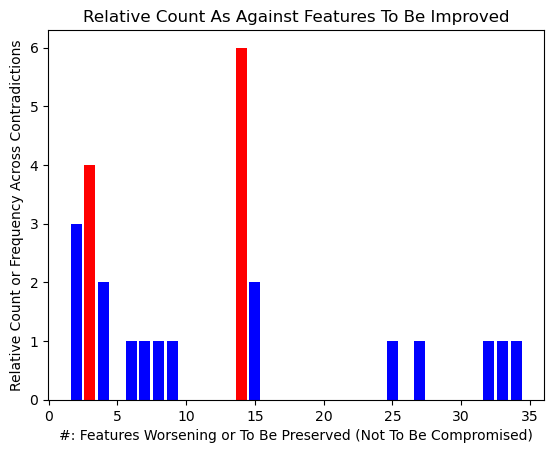
2/32 5/27 6/4 7/14 8/14 10/3 10/7 11/14 12/15 13/14 14/6 14/8 15/3 17/3 17/4 19/14 20/2 22/2 27/3 29/2 32/34 34/9 34/14 36/33 37/25 38/15
EXAMPLE: Use of elastic in socks. The primary purpose of using elastic in socks is to provide a snug and secure fit around the foot and leg. Traditional or socks without elastic (anti-action) may be comfortable but can lack stability, leading to slipping and bunching issues. The incorporation of elastic threads or bands in sock design provides the necessary stretchability to accommodate different foot sizes while maintaining a secure and stable fit.
Contradiction (12/15, 11/14, 15/3, 8/14) : There is a trade-off between providing comfort (looseness) and stability (snug fit) in sock design. Socks to conform to the shape of the foot while also ensuring a comfort, strength and secure fit.
Solution: It offers gentle compression, providing support to the foot and improving blood circulation. The use of elastic in socks aligns with the principle of transitioning from a rigid to a flexible structure or dynamicity and anti-action. The elastic allows the sock to dynamically adapt to the movement and shape of the foot. In the case of socks with elastic, the elastic material is strategically incorporated to anticipate and counteract the potential issue of a loose fit. The elastic serves as a proactive solution to maintain the sock’s position on the foot, preventing discomfort, slipping, or bunching that might arise if the sock were to fit loosely. This aligns with the concept of anticipating and addressing potential issues in advance, which is a key aspect of the Prior Anti-Action principle. Elastic materials are commonly used in various types of clothing to provide stretch, flexibility, and a snug fit. Sportswear, including leggings, compression shorts, and athletic tops, often incorporates elastic materials to offer flexibility and support during physical activities. Undergarments: Bras, panties, and other undergarments may use elastic components to ensure a comfortable and supportive fit. Swimsuits, particularly those designed for activities like scuba diving, may contain elastic materials for a secure fit and enhanced movement in the water. Elastic waistbands are commonly found in various types of bottoms, including pants, shorts, and skirts, providing comfort and flexibility. Compression garments or shapewear often use elastic components to contour and shape the body. Elastic materials are employed in medical garments like compression stockings to aid in improving blood circulation. Maternity pants and skirts may feature elastic panels or waistbands to accommodate a growing belly. In scuba diving suits specifically, elasticity is crucial for ease of movement underwater. Wetsuits and drysuits designed for scuba diving often incorporate neoprene, a material known for its flexibility and insulating properties, contributing to a snug yet stretchable fit.