

31: POROUS MATERIALS: (A) Make an object (or system) porous or add supplementary porous elements (inserts, covers, etc.). (B) Fill the pores (cavities holes or voids) in advance with some substance, if an object (or system) is already porous.
EXAMPLE: Foam Metals, Sponge Cleaners, Medicated Swabs, Gel Filled Porous Material (in seats, mattresses etc), Porous Metal Mesh (to wick excess of solder from the joint), Air FIlters, Bubble Wraps For Packing
SYNONYMS:
ACB:
At an abstract level, the principle menas introducing permeability or openness into a system. It involves creating a structure or environment with voids, openings, or channels, allowing the free flow or interaction of certain elements while maintaining the integrity of the system. Need for efficient information flow without compromising security. It involves finding the right balance between openness and control, adaptability and stability, and selective permeability to create innovative solutions in various domains. Implement a porous organizational structure that allows for flexibility and adaptation to change while maintaining consistent core values and strategic objectives. Designing a system with selective permeability, where certain elements are allowed to pass through or interact, while others are restricted. Creating organizational structures, processes, or technologies that selectively allow the flow of information, innovation, or resources based on strategic objectives. Creating collaboration platforms and frameworks that allow controlled interaction and information sharing among teams and departments, fostering a culture of innovation. Establishing symbiotic relationships within a system where elements mutually benefit from interactions. Seeking active customer engagement while respecting privacy concerns. Building partnerships and alliances where organizations, departments, or entities collaborate in a mutually beneficial manner, creating a porous network of shared resources.
Using materials with cavities, holes, or voids to enhance the functionality or properties of a system. Use porous materials to enhance absorption or filtration capabilities. Examples include water filters, air purifiers, and sponges. Introduce porosity to reduce overall weight while maintaining structural integrity. This principle is applicable in aerospace, automotive, and lightweight construction materials. Utilize porous materials to create insulating layers that trap air and reduce heat transfer. Applications include insulation in buildings and protective clothing. Incorporate porous materials to absorb sound and reduce noise levels. This is commonly seen in acoustic panels and soundproofing materials. Introduce porosity to increase the surface area available for reactions, such as in catalysis or adsorption processes. Use porous materials to facilitate smoother fluid flow. This is seen in water filters, fuel cells, and permeable pavements. Employ porous materials to create flexible and adaptable structures. This is applicable in areas like robotics, soft robotics, and flexible electronics. Introduce porosity strategically to enhance the material’s strength-to-weight ratio. This is employed in applications like lightweight structural components. Use porous materials to regulate moisture levels by absorbing or releasing water vapor. This is seen in moisture-wicking fabrics and building materials. Utilize porous materials to control the release of gases, liquids, or other substances. This principle is applied in drug delivery systems and controlled-release technologies.
Porous materials are characterized by the presence of voids or open spaces within their structure. These voids can be used for various purposes, including absorption, filtration, insulation, and more. Here are some examples of porous materials: Sponge, Activated Carbon, Zeolites, Pumice, Aerogels, Ceramic Foam, Porous Plastics, Foam Rubber, Silica Gel, Cork, Balsa Wood, Cotton, Metal-Organic Frameworks (MOFs) and Porous Concrete are some of the exmples.
The inventive principle is often applied to resolve contradictions by introducing materials with cavities, holes, or voids. Use a porous material like activated carbon. Activated carbon has a high surface area due to its porous structure, enabling effective absorption of gases and liquids without significantly increasing weight. Utilize materials with a porous structure, such as honeycomb structures made from materials like aluminum. This approach provides strength with reduced weight, addressing the contradiction between strength and weight. Apply aerogels, which are highly porous materials with low density. Aerogels provide excellent thermal insulation while being lightweight and less bulky compared to traditional insulating materials. Implement silica gel, a porous material that can absorb and hold moisture efficiently. Silica gel is compact and widely used in applications where moisture control is crucial without adding significant bulk. Employ porous materials in water and air filters. The porous structure allows for effective filtration while maintaining a reasonable flow rate, resolving the contradiction between filtration efficiency and flow rate. Use materials like cork, which have a porous structure that provides buoyancy while keeping overall weight low. This addresses the contradiction between buoyancy and weight. Introduce porous materials in acoustic panels. The porous structure of materials like foam or fiberglass enables effective sound absorption without the need for thick and heavy panels. Employ porous materials in controlled-release technologies. The porous structure allows for the controlled release of substances while keeping the overall system compact and efficient. Utilize porous materials like zeolites. The porous structure of zeolites provides a large surface area for catalysis and adsorption without significantly enlarging the system. Use materials with a porous structure in flexible structures. The introduction of porosity enhances flexibility while maintaining strength, addressing the contradiction between flexibility and strength.
The primary purpose of the net is not to control the flow of fluids through the material, as seen in some traditional porous material applications. Instead, the porosity of fishing nets serves the functional purpose of capturing and retaining aquatic organisms while allowing water to flow freely. Fishing nets exhibit a structure with openings or voids that allow water to pass through while capturing and retaining fish. The porous nature of fishing nets is integral to their functionality in the context of fishing and marine activities. The design of the net allows water to flow through while trapping and securing fish within its mesh. The mesh structure of the fishing net forms a network of openings or pores, allowing water to pass through. The size of the mesh can vary depending on the type of fish being targeted. Fishing nets are permeable to water, which allows them to be used effectively in aquatic environments. The open structure facilitates water flow, reducing resistance and drag. The pore size and design of the net contribute to selective capture, allowing smaller fish to escape while capturing the target species. This selectivity is essential for sustainable fishing practices. The choice of materials for fishing nets takes into account factors such as strength, flexibility, and resistance to abrasion. The porous structure is maintained through the specific arrangement of fibers or filaments.
Wet wipes exemplify several inventive principles, particularly those related to porous materials and the controlled delivery of active substances. The design considerations aim to address contradictions related to wetness, effectiveness, and user satisfaction. Wet wipes, commonly used for personal hygiene or cleaning purposes, can indeed incorporate the use of porous materials to deliver medications, moisturizers, or other beneficial substances. Packaging innovations, such as individual sachets or resealable packages, can help preserve the moisture and effectiveness of wet wipes. The inventive principles associated with wet wipes can be of Porous Materials, Segmentation, Cheap Short Living Objects and Taking out. Wet wipes are often made from porous materials, allowing them to hold and distribute liquid solutions evenly. The pores facilitate the absorption and retention of the liquid solution, ensuring effective delivery of moisture, cleaning agents, or medications to the target surface. Capillary action in porous materials helps distribute the liquid content evenly across the wipe. Capillary action enables the wet wipe to draw and distribute the solution effectively, ensuring uniform coverage during use. Wet wipes remain moist and ready for use while preventing drying or contamination. Designing wet wipes with a user-friendly interface, such as easy-to-dispense packaging or textured surfaces, enhances their usability. User-friendly design ensures that the wet wipes can be easily accessed, used, and disposed of, addressing user needs and preferences.
Wet wipes address the contradiction between the desire for a wet product and the need for effective cleaning or skincare. The use of porous materials and active ingredients ensures both wetness and functionality. Wet wipes may address the contradiction between the need for uniform distribution of moisture or medication and the desire for controlled release. The inventive use of porous materials and selective permeability allows for both aspects to be optimized.
The use of fibers in wet towels to increase surface area, porosity, and absorbency is a design strategy that enhances the functionality of the towel. This concept has been in use for a considerable time and is employed to address specific problems and contradictions associated with moisture absorption. The incorporation of fibers in the towel increases the overall surface area. Fibrous structures, such as loops or microfibers, create more contact points with the liquid, facilitating better absorption. The arrangement of fibers contributes to the creation of small interstitial spaces or pores within the towel. This increased porosity allows the towel to hold more liquid. The capillary action within the fibers enables them to draw moisture along their length, further aiding in the absorption process.
The primary benefit is the enhanced ability to absorb and retain moisture efficiently. The increased surface area and porosity not only facilitate absorption but also promote faster drying. Traditional materials without the fibrous structure might not absorb moisture effectively, leading to a less efficient drying experience. The challenge is to create a material that can efficiently absorb moisture while allowing quick drying to maintain usability. Advancements in textile technology, including the use of microfiber materials, have significantly improved the absorbent qualities of towels in recent decades.
There are various principles aligned with this concpet. The use of fibers segments the material, creating a structure with enhanced properties. The irregular and asymmetrical arrangement of fibers contributes to improved absorbency. The intentional introduction of pores enhances the absorbent properties (Principle of Porous Materials). The use of fibers in wet towels exemplifies innovative design to address the contradiction between absorbency and drying time. The incorporation of fibers enhances the towel’s performance, making it more effective in absorbing and retaining moisture.
1: Mass of the moving object: [’15: Action time of the moving object’, ’19: Energy consumption of the moving object’, ’21: Power’, ’23: Material loss’, ’26: Amount of substance’, ’31: Harmful internal factors’]
8: Volume of the non-moving object: [’36: Complexity of the structure’]
13: Stability of the object: [’21: Power’]
14: Strength: [’23: Material loss’]
15: Action time of the moving object: [‘1: Mass of the moving object’]
16: Action time of the non-moving object: [’26: Amount of substance’]
17:Temperature: [’23: Material loss’, ’37: Complexity of control and measurement’]
19: Energy consumption of the moving object: [‘1: Mass of the moving object’]
20: Energy consumption of the non-moving object: [’23: Material loss’, ’26: Amount of substance’]
21: Power: [‘1: Mass of the moving object’, ’13: Stability of the object’, ’27: Reliability’, ’30: Harmful external factors’]
23: Material loss: [‘5: Area of the moving object’, ‘6: Area of the non-moving object’, ‘8: Volume of the non-moving object’, ’14: Strength’, ’17:Temperature’, ’20: Energy consumption of the non-moving object’, ’22: Energy loss’, ’28: Accuracy of measurement’, ’29: Accuracy of manufacturing’]
26: Amount of substance: [‘1: Mass of the moving object’, ’16: Action time of the non-moving object’, ’20: Energy consumption of the non-moving object’, ’30: Harmful external factors’]
27: Reliability: [’21: Power’]
28: Accuracy of measurement: [’23: Material loss’]
29: Accuracy of manufacturing: [’23: Material loss’]
30: Harmful external factors: [’21: Power’, ’26: Amount of substance’, ’35: Adaptability’]
31: Harmful internal factors: [’15: Action time of the moving object’, ’36: Complexity of the structure’]
33: Convenience of use: [‘8: Volume of the non-moving object’]
34: Convenience of repair: [‘4: Length of the non-moving object’]
35: Adaptability: [’30: Harmful external factors’, ’32: Convenience of manufacturing’]
37: Complexity of control and measurement: [‘8: Volume of the non-moving object’]
39: Productivity: [‘5: Area of the moving object’]
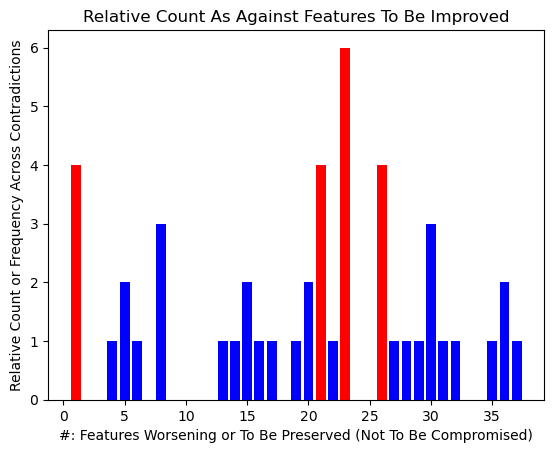
1/15 1/19 1/21 1/23 1/26 1/31 8/36 13/21 14/23 15/1 16/26 17/23 17/37 19/1 20/23 20/26 21/1 21/13 21/27 21/30 23/5 23/6 23/8 23/14 23/17 23/20 23/22 23/28 23/29 26/1 26/16 26/20 26/30 27/21 28/23 29/23 30/21 30/26 30/35 31/15 31/36 33/8 34/4 35/30 35/32 37/8 39/5
Example: Consider a company shipping delicate glassware, such as wine glasses, to customers. The challenge is to maximize the surface area covered for protection while avoiding a substantial increase in weight that could impact shipping costs. By using bubble wrap as a porous material in the packaging design, the company successfully resolves the contradiction between increasing the surface area covered for protection and minimizing the additional weight. The bubble wrap’s porous structure allows for efficient protection without compromising the practicality and cost-effectiveness of shipping delicate glassware.
Contradiction (26/1): Increase the surface area (amount of substance for packing – 26) covered for protection during shipping but avoid adding significant weight to the packaged object (mass of the moving object – 1).
Solution: Application of Porous Material Principle as utilize bubble wrap, a porous material, in the packaging design. Using dense and heavy materials for protection may add unnecessary weight to the package, increasing shipping costs and potentially risking breakage due to added stress. Bubble wrap, is a lightweight and porous material with pores filled with air and/or gel. The individual bubbles in the wrap create a network of voids, offering protection by absorbing shocks and impacts during transportation. The bubble wrap conforms to the shape of the delicate items, maximizing the coverage of the surface area needing protection. Bubble wrap is lightweight, adds minimal weight to the overall package. This is crucial for minimizing shipping costs and ensuring the package remains within weight restrictions.The air-filled bubbles act as a cushion, providing effective shock absorption and protection against impacts without adding significant weight. The lightweight nature of bubble wrap contributes to cost-efficient shipping, as the packaging material itself doesn’t substantially contribute to the overall weight. Bubble wrap is easy to handle and wrap around items of various shapes, providing flexibility in packaging. Some types of bubble wrap are made from recyclable materials or feature biodegradable options, aligning with environmental sustainability goals.