
36: PHASE TRANSITION: (A) Make use of the phenomena of phase change (of an object or system e.g., solid to liquid or process) or (B) Makes use to achieeve specific effects developed during such a change in the phase of a system or object (i.e., a change in the volume, the liberation or absorption of heat etc or during the gap or in-between or during the transition from one phase to another phase in a process)
EXAMPLE: Freezing Water (& using expansion as effect), Boiling (& using latent heat or different boiling points for desired effect e.g., liquid-liquid separation, heat pump uses the heat of vaporization and heat of condensation of a closed thermodynamic cycle to deliver useful function, Melting (& using physical effect or change in dimensions, volume as effect e.g., wax candles), Crystallization, Superconductivity
SYNONYMS:
ACB:
The Phase Transition refers to changes in the state of matter or the structure of a system. It can involve transitioning between solid, liquid, gas phases, or other structural changes. For instance: LED lamps use light-emitting diodes to produce light. When an electric current passes through the semiconductor material in the LED, it emits photons, creating visible light. LED lamps are highly energy-efficient, converting a larger percentage of electricity into light and producing minimal heat. LED lamps have an exceptionally long lifespan, often exceeding that of both incandescent and CFL lamps. LEDs are considered environmentally friendly as they contain no hazardous materials like mercury.
The transition from a solid to a liquid state (melting) and vice versa (solidification). For instance, the use of wax in a thermostat, which melts at a certain temperature to allow for the opening or closing of a valve. The transition from a liquid to a gas state (evaporation) and back to a liquid state (condensation) is seen in various applications, such as in cooling systems like refrigerators and air conditioners. The freezing and thawing of materials can be utilized in applications like freeze drying in the food industry or anti-icing systems. Some materials can undergo a change in crystal structure, known as polymorphic transformation. An example is the shape memory alloy, which can change shape based on temperature. Elements that exhibit different forms under different conditions, like carbon (diamond, graphite), demonstrate the Allotropic Transformation. Separation of different phases within a system, like the separation of oil and water, can be applied in various industries for purification purposes. Transition between amorphous (non-crystalline) and crystalline states, seen in applications like the development of certain types of glass.
Phase transitions are fundamental phenomena in nature that drive changes in the state and properties of substances. By understanding and harnessing these transitions, people can develop innovative solutions to a wide range of technological challenges in fields such as energy, materials science, climate control, and thermal management. A phase transition is a physical process in which a substance undergoes a change in its thermodynamic state, resulting in a transformation from one phase to another. These phases can include solid, liquid, gas, or more exotic states such as plasma or supercritical fluid. Phase transitions are characterized by changes in the substance’s properties, such as density, volume, entropy, and internal energy, as well as changes in its physical structure and arrangement of atoms or molecules. Examples of phase transitions include:
Melting: The transition from a solid phase to a liquid phase. For example, ice (solid water) melting into liquid water at its melting point of 0°C. Freezing: The reverse process of melting, where a liquid changes into a solid phase. For example, liquid water freezing into ice at its freezing point of 0°C. Evaporation: The transition from a liquid phase to a gas phase, occurring at the surface of a liquid. For example, water evaporating into vapor at temperatures below its boiling point. Condensation: The reverse process of evaporation, where a gas changes into a liquid phase. For example, water vapor condensing into liquid water droplets in the atmosphere to form clouds. Sublimation: The transition from a solid phase directly to a gas phase, bypassing the liquid phase. For example, dry ice (solid carbon dioxide) sublimating into carbon dioxide gas at room temperature.
Phase transitions occur due to changes in temperature, pressure, or both, which affect the balance of forces and interactions between atoms or molecules in the substance. The transition from one phase to another is driven by thermodynamic principles, such as minimizing the free energy of the system or achieving equilibrium between phases. We make use of phase transitions to solve various problems and develop technologies in numerous fields. Thermal Management: Phase change materials (PCMs) are substances with high heat storage capacity that undergo phase transitions at specific temperatures. They are used in thermal management systems to store and release thermal energy efficiently. For example, PCM-based cooling vests use the latent heat of fusion during the solid-liquid phase transition to absorb excess body heat and keep the wearer cool. Energy Storage: Reversible phase transitions, such as those occurring in rechargeable batteries or fuel cells, are used to store and release energy. For example, lithium-ion batteries rely on the reversible phase transition of lithium ions between electrode materials during charging and discharging cycles to store and deliver electrical energy. Climate Control: HVAC systems utilize phase transitions such as evaporation and condensation to control indoor humidity and temperature. For example, air conditioners cool indoor air by removing heat through the evaporation of refrigerant liquids and subsequently condensing them back into liquid form. Materials Science: Engineers and scientists leverage phase transitions to design and develop materials with specific properties for various applications. For instance, shape memory alloys undergo reversible phase transitions between martensitic and austenitic phases, allowing them to “remember” and recover their original shape after deformation. These materials find applications in medical devices, actuators, and aerospace components.
A second-order phase transition, also known as a continuous phase transition, is a type of phase transition that occurs without any abrupt change in the order parameter or the discontinuity in the first derivative of the free energy with respect to the order parameter. In simpler terms, during a second-order phase transition, there is a gradual change in the system’s properties as it transitions from one phase to another, without any sudden jump or discontinuity.
In the context of ferromagnetic materials, the transition beyond the Curie point represents a second-order phase transition. The Curie point, named after Pierre Curie, is the temperature at which a ferromagnetic material undergoes a transition from a ferromagnetic phase to a paramagnetic phase. Below the Curie point, the material exhibits spontaneous magnetization and retains its magnetic properties even in the absence of an external magnetic field. However, when the temperature exceeds the Curie point, thermal energy disrupts the alignment of magnetic moments within the material, causing the material to lose its ferromagnetic properties and become paramagnetic.
During this transition beyond the Curie point, there is no abrupt change in the magnetization or other thermodynamic properties of the material. Instead, as the temperature increases, the material gradually transitions from a ferromagnetic state to a paramagnetic state. This behavior is characteristic of a second-order phase transition, where the transition occurs smoothly without any sudden changes in the material’s properties. Above the Curie point, the material’s susceptibility to external magnetic fields increases, and it no longer exhibits spontaneous magnetization. The transition beyond the Curie point in ferromagnetic materials represents a second-order phase transition, where the material undergoes a gradual change from a ferromagnetic phase to a paramagnetic phase as the temperature increases. This transition is characterized by continuous changes in the material’s magnetic properties, without any abrupt discontinuities.
The Phase Transition Principle can be applied to resolve various technical and business contradictions.Electronic components generate heat during operation, requiring effective cooling systems to prevent overheating. Businesses aim for flexible supply chains to adapt quickly to changes in demand, but maintaining excess inventory for flexibility incurs costs. Flexibility in the supply chain conflicts with the desire to minimize inventory costs. Applying the Phase Transition Principle, businesses could adopt a more adaptive inventory management system. For instance, employing just-in-time inventory practices where materials transition between different storage states based on demand, allowing for flexibility without excessive holding costs.
While powdered milk can be a suitable alternative, it’s important to note that breastfeeding is often recommended whenever possible, as it offers unique health benefits for both the mother and the baby. The decision to use powdered milk may depend on various factors, including the mother’s circumstances and the baby’s specific needs. Using powdered milk for babies, often in the form of infant formula, is a common practice and can be beneficial in certain situations. Infant formulas are designed to mimic the nutritional composition of breast milk, providing essential nutrients required for a baby’s growth and development. Powdered milk is convenient and has a longer shelf life compared to liquid formulas. It is also easier to store and transport. The nutrient content in powdered formulas is consistent, ensuring that babies receive a standardized and balanced diet. Powdered formulas allow for flexibility in feeding schedules, as they can be prepared in advance and stored for later use. Fresh breast milk may vary in nutrient content, and its availability depends on the mother’s circumstances. Powdered formulas offer a consistent and controlled nutrient profile, addressing the need for reliability in infant nutrition. Fresh breast milk has a limited shelf life and requires immediate consumption. Powdered milk provides a longer shelf life, making it more accessible and suitable for situations where immediate breastfeeding is not possible. Powdered formulas are formulated to meet the nutritional needs of a broad population, addressing individual variations. The use of powdered milk for babies aligns with TRIZ principles such as Phase Transition and Continuity of Useful Action. It represents a transition from the variability and perishability of fresh breast milk to a more standardized and accessible powdered form. Additionally, alwasys available is evident in the consistent and controlled approach to providing essential nutrients to infants.
The use of water in an iron box aligns with “Phase Transition” and “Hydrodynamics/Pneumatics/Hydraulics.” The phase transition involves changing the state of water (liquid to steam), and hydrodynamics considers the application of fluids (steam) for better efficiency and performance. Using water in an iron box, commonly known as a steam iron, serves several purposes and offers benefits in the process of ironing clothes. Water is poured into a reservoir in the iron. When the iron is turned on, the heating element heats the water, converting it into steam. The steam is released through small vents on the soleplate of the iron when the user presses a button or activates a steam function. The combination of heat and moisture from the steam helps in relaxing the fabric fibers of the clothes. The relaxed fabric fibers make it easier to smooth out wrinkles and creases, resulting in effective and efficient ironing. The heat and moisture from the steam assist in removing wrinkles and creases from clothes more effectively than dry ironing. Steam ironing can be faster as the combination of heat and moisture aids in quicker and smoother ironing. Steam helps in preventing fabric damage by reducing the need for excessive heat. Some fabrics are sensitive to high temperatures, and steam ironing can be gentler on them. The steam can also be used to refresh clothes that have been stored or worn for a short period. Directly applying high heat is effective in removing wrinkles but may risk damaging delicate fabrics. The use of steam allows for effective ironing at lower temperatures, reducing the risk of fabric damage. Wrinkle removal may require spending more time ironing. Steam ironing can be more efficient, reducing the time needed to achieve satisfactory results. While steam ironing is beneficial for many fabrics, it’s essential to follow care instructions on clothing labels to avoid any potential damage. Additionally, some irons have specific features like adjustable steam settings and fabric selection options (addressed by increasing controlability or configurability using dynamicity principle) to cater to different types of fabrics.
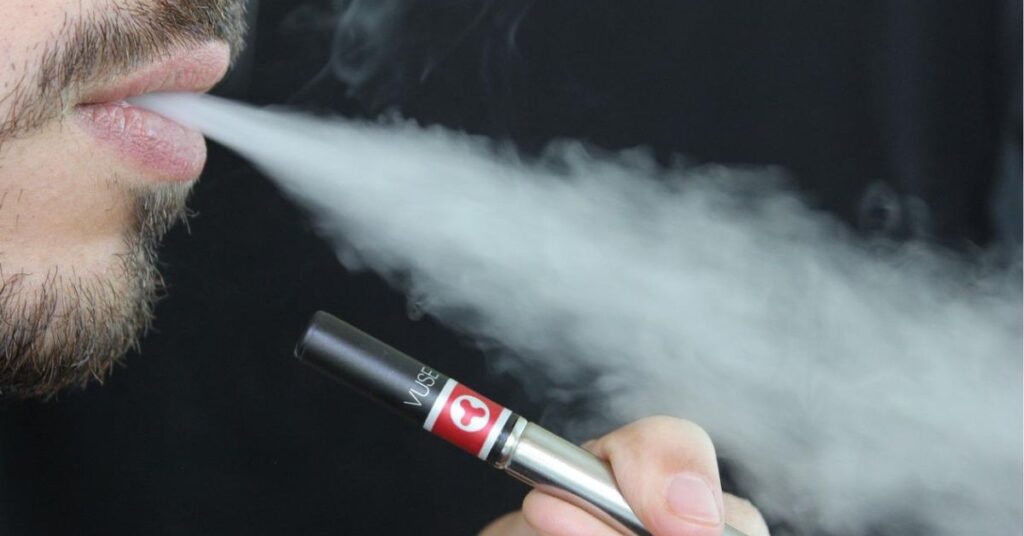
Vaping, also known as electronic cigarette (e-cigarette) use, involves inhaling and exhaling aerosol, often referred to as vapor, produced by an electronic device called a vape or e-cigarette. It is an alternative to traditional smoking and has gained popularity, especially among individuals looking for a potentially less harmful method of nicotine consumption. Unlike traditional cigarettes, vaping does not involve the combustion of tobacco. Instead, an e-cigarette heats a liquid (often containing nicotine, flavorings, and other chemicals) to produce vapor. While many people use e-cigarettes for nicotine delivery, there are also tobacco-free vaping options that deliver flavored vapor without nicotine. Some individuals perceive vaping as a potentially less harmful alternative to smoking traditional cigarettes. However, the long-term health effects are still under investigation.
A typical e-cigarette consists of a battery, a heating element (atomizer or coil), and a cartridge or tank containing the e-liquid. Vaping devices are powered by a rechargeable battery. Inside the vaping device is a heating element, commonly a coil made of resistance wire. When activated, the heating element heats up. Vaping devices contain a cartridge or tank filled with an e-liquid or e-juice solution. This solution typically consists of propylene glycol, vegetable glycerin, flavorings, and often nicotine. The battery provides the necessary electrical energy to heat the coil and produce vapor. Some vaping devices allow users to adjust settings such as wattage or temperature to customize their vaping experience.
The heat generated by the coil vaporizes the e-liquid, turning it into an aerosol or vapor. The user inhales this vapor through a mouthpiece. The user then inhales the produced vapor. The vaping market has seen significant growth globally, with a variety of devices and e-liquids available. The market includes both nicotine-based and non-nicotine-based products. The legal status of vaping varies globally. Some countries have legalized and regulated vaping, while others have imposed restrictions or outright bans. Examples of countries where vaping is legalized include the United Kingdom, parts of Europe, Canada, and New Zealand. Some countries, like Australia and several Asian nations, have imposed strict regulations or banned the sale and use of vaping products. Concerns often include health risks, youth uptake, and the potential gateway effect to smoking.
Unlike traditional smoking, which involves burning tobacco leaves to produce smoke, vaping does not involve combustion. Instead, vaping devices heat e-liquid to generate vapor, eliminating the harmful byproducts of combustion such as tar and carbon monoxide. Vaping e-liquids typically contain fewer harmful chemicals compared to tobacco smoke. However, they may still contain nicotine, which is addictive, as well as flavorings and other additives that could pose health risks when inhaled. Vaping produces aerosol with different characteristics than tobacco smoke. It often dissipates more quickly and leaves less lingering odor and residue compared to cigarette smoke.
Vaping is often perceived as less intrusive and more socially acceptable than smoking, as it produces less odor and secondhand exposure. Some individuals use vaping as a harm reduction strategy to quit or reduce cigarette smoking. Vaping provides a nicotine delivery method without the combustion and associated harmful byproducts of tobacco smoke. Vaping products are sometimes marketed as smoking cessation aids or tools to help individuals quit smoking traditional cigarettes. Some individuals use vaping products for recreational purposes, such as enjoying flavored e-liquids or participating in vaping competitions. Vaping products often contain nicotine, which is highly addictive and can lead to dependence. While vaping is generally considered less harmful than smoking, it is not risk-free. Inhaling aerosol from vaping products can still pose health risks, including respiratory issues, cardiovascular problems, and potential long-term effects that are still being studied.
There are concerns about the appeal of vaping to youth and non-smokers, leading to initiation of nicotine use and potential gateway to tobacco smoking. Vaping works by heating e-liquid to produce vapor, offering an alternative to traditional smoking with potential harm reduction benefits. However, vaping is not without risks, and further research is needed to fully understand its long-term health effects. The need or purpose of vaping products varies, with some individuals using them as smoking cessation aids or recreational alternatives, while others may be drawn to them for social or cultural reasons. It’s essential to weigh the potential benefits and harms of vaping and make informed decisions about its use. Some countries are concerned about the potential health risks of vaping and the lack of long-term studies on its effects. The appeal of vaping among youth has raised concerns in many countries, leading to stricter regulations or bans to prevent underage use. Critics argue that vaping could serve as a gateway to smoking traditional cigarettes, especially among young people. Supporters of vaping emphasize individual choice, harm reduction for current smokers, and the potential for smoking cessation.
The use of a spray or mist for applying perfumes involves the principle of dynamicity and phase transition, and it addresses contradictions related to controlled dispensing and spreading the fragrance efficiently.Perfume bottles are equipped with spray nozzles that release the liquid perfume as fine droplets or mist. The spray mechanism atomizes the liquid perfume into tiny particles, creating an aerosol effect. These small droplets allow for better dispersion in the air. The spray mechanism provides control over the amount of perfume applied, preventing excessive use and allowing users to target specific areas. The law of “Transition to a Micro-Level” is also applicable as it involves transforming a substance or process into finer particles or components. In the case of perfumes: The liquid perfume transitions from a macro-level (liquid in the bottle) to a micro-level (fine droplets or mist during spraying). The use of a spray mechanism in perfumes resolves several contradictions. It allows for efficient dispersion of the fragrance in the air while maintaining control over the application. Users can achieve even coverage without using excess amounts of perfume. The spray mechanism balances the ease of application with the precision of where the perfume is applied. By employing these principles of dynamicity and phase transition and law of transitioning to a micro-level, perfumes achieve better controlled phase transition and efficient application process.
Cataract surgery is a common and highly effective procedure to treat cataracts, which is the clouding of the natural lens in the eye. During cataract surgery, the cloudy lens is removed and replaced with an artificial intraocular lens (IOL) to restore clear vision. While it is generally safe to perform cataract surgery on both eyes, there are reasons why doctors may recommend a phased approach, doing one eye at a time. Performing cataract surgery on one eye at a time allows the surgeon and the patient to assess the outcomes and manage any potential complications before proceeding with the second eye. This phased approach helps ensure safety and optimal results. By observing the results of the first eye surgery, the surgeon can make any necessary adjustments in the surgical plan or lens selection for the second eye. This helps tailor the procedure to the specific needs and responses of the individual patient. After cataract surgery, the eye needs time to heal and adjust to the new intraocular lens. Doing one eye at a time allows the patient to adapt to the changes in vision and minimize the impact on daily activities during the recovery period.
Some patients may feel more comfortable and less anxious about the procedure if they have the opportunity to experience the process and recovery with one eye before proceeding to the second eye. The typical cataract surgery procedure involves the following steps: The surgeon conducts a thorough eye examination to determine the extent of the cataract and assess the overall health of the eye (prior action). Local anesthesia is administered to numb the eye, and the patient may also receive a mild sedative to help relax (prior action). A small incision is made in the cornea or the clear front part of the eye. The cloudy natural lens is broken up using ultrasound (phacoemulsification) or laser and then removed from the eye. An artificial intraocular lens (IOL) is inserted to replace the removed natural lens. The IOL is selected based on the patient’s vision needs (e.g., distance or multifocal vision). The incision is closed, and no sutures are typically required.
Patients are monitored in a recovery area for a short time before being allowed to go home. Eye drops are prescribed for postoperative care. Cataract surgery is generally safe and has a high success rate in restoring clear vision. The decision to proceed with surgery on both eyes simultaneously or in a phased manner depends on the patient’s overall health, individual preferences, and the surgeon’s recommendation based on a comprehensive evaluation.
1: Mass of the moving object: [’11: Tension, Pressure’, ’21: Power’, ’32: Convenience of manufacturing’, ’36: Complexity of the structure’]
5: Area of the moving object: [’11: Tension, Pressure’, ’37: Complexity of control and measurement’]
6: Area of the non-moving object: [’10: Force’, ’11: Tension, Pressure’, ’29: Accuracy of manufacturing’, ’36: Complexity of the structure’]
7: Volume of the moving object: [’10: Force’, ’11: Tension, Pressure’, ’23: Material loss’]
9: Speed: [’17:Temperature’]
10: Force: [‘3: Length of the moving object’, ‘6: Area of the non-moving object’, ‘8: Volume of the non-moving object’, ’20: Energy consumption of the non-moving object’, ’25: Time loss’, ’26: Amount of substance’, ’29: Accuracy of manufacturing’, ’31: Harmful internal factors’, ’37: Complexity of control and measurement’]
11: Tension, Pressure: [‘1: Mass of the moving object’, ‘3: Length of the moving object’, ‘5: Area of the moving object’, ‘6: Area of the non-moving object’, ‘9: Speed’, ’10: Force’, ’22: Energy loss’, ’23: Material loss’, ’25: Time loss’, ’26: Amount of substance’, ’37: Complexity of control and measurement’]
12: Shape: [’26: Amount of substance’]
16: Action time of the non-moving object: [’17:Temperature’]
17:Temperature: [‘1: Mass of the moving object’, ‘9: Speed’, ’16: Action time of the non-moving object’, ’23: Material loss’]
20: Energy consumption of the non-moving object: [’10: Force’, ’27: Reliability’]
21: Power: [‘1: Mass of the moving object’, ’10: Force’]
22: Energy loss: [’10: Force’]
23: Material loss: [‘7: Volume of the moving object’, ’11: Tension, Pressure’, ’17:Temperature’]
25: Time loss: [’10: Force’, ’11: Tension, Pressure’]
26: Amount of substance: [’11: Tension, Pressure’]
27: Reliability: [’20: Energy consumption of the non-moving object’]
29: Accuracy of manufacturing: [‘6: Area of the non-moving object’, ’10: Force’, ’30: Harmful external factors’]
32: Convenience of manufacturing: [‘2: Mass of the non-moving object’]
36: Complexity of the structure: [‘1: Mass of the moving object’, ‘6: Area of the non-moving object’]
37: Complexity of control and measurement: [’11: Tension, Pressure’]
39: Productivity: [’10: Force’]
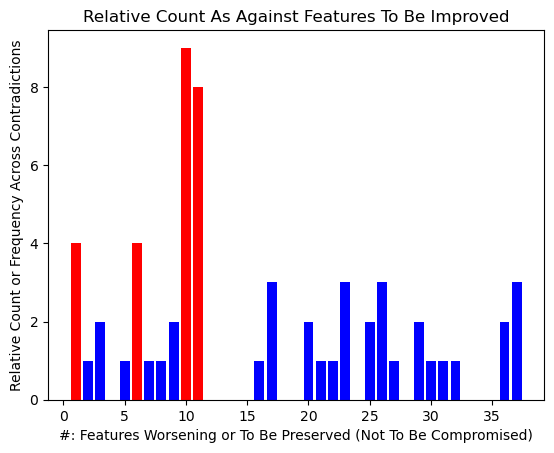
1/11 1/21 1/32 1/36 5/11 5/37 6/10 6/11 6/29 6/36 7/10 7/11 7/23 9/17 10/3 10/6 10/8 10/20 10/25 10/26 10/29 10/31 10/37 11/1 11/3 11/5 11/6 11/9 11/10 11/22 11/23 11/25 11/26 11/37 12/26 16/17 17/1 17/9 17/16 17/23 20/10 20/27 21/1 21/10 22/10 23/7 23/11 23/17 25/10 25/11 26/11 27/20 29/6 29/10 29/30 32/2 36/1 36/6 37/11 39/10
EXAMPLE: Liquefied Petroleum Gas (LPG) is a common fuel used for cooking and heating, and it is stored in cylinders in its liquid state. The process involves compressing and cooling the gas to transform it into a liquid, and this has several benefits. A continuous and controlled release of gas is required for cooking purposes, but storing it in gaseous form poses challenges. In short, the storage of LPG in liquid form resolves contradictions related to storage efficiency, transportation, safety, and controlled release.
Contradiction (7/11, 29/30, 37/11): Gaseous fuels have a low density, making storage in large quantities inefficient. Gaseous fuels are challenging to transport in large quantities due to their low density.Gaseous fuels can be hazardous during handling and transportation. Storing LPG in liquid form simplifies handling and reduces the risk of leaks or accidents. The liquid state allows for controlled release as needed for various applications.
Solution: The Phase Transition principle emphasizing transitions between different states of matter, aligns with the process of converting LPG from gas to liquid and vice versa to address these contradictions. Converting the gas to a liquid increases its density, allowing for more fuel to be stored in a relatively small space. This aligns with the TRIZ principle of “Phase Transition”, where the transition between gas and liquid states addresses the contradiction between storage efficiency and gas density. By liquefying the gas, it becomes more compact, making transportation more practical and cost-effective. LPG stored in liquid form can be easily converted to gas when needed. This allows for controlled and regulated release, ensuring a steady and controllable flame for cooking. It aligns with the TRIZ principle of “Phase Transition”, facilitating the transition between liquid and gas states to meet specific needs.