

7: NESTING: (A) Place (embed or position or put or insert) an object (or system) inside another object and so on in a recursive manner, (B) Pass an object (or system) through the cavity of another object (or system).
EXAMPLE: Door-within-a-door, Stacked Chairs, Telescoping/Extendable Antenna, Suspended oil storage reservoir (that stores different products in a single unit), Nested Doll, Zoom Lens, Sewing Thread, Needle, Key Ring, Lead Pencil, Capillary Action (e.g., in candles), Toilet Roll, Catheter is passed through sheath during angioplasty, Seat-Belt Retraction Mechanism, Retractable Aircraft landing Gear/Seat Belt, Mercury Thermometer, Measuring Cups, Folding Umbrella/Handle, Malls (shops within a shop), File Storage Structure (Folder Within A Folder).
SYNONYMS: NESTED DOLL, Hierarchical, Multi-Level, Multi-Layer, Recursion, Loops, Insertion
ACB:
The Nesting or Nested Doll principle refers to the idea of enclosing one object within another, similar to the way nested dolls fit into each other. At an abstract level, the Nesting or Nested Doll inventive principle involves organizing and arranging components or objects in a hierarchical or nested structure, where one element fits within another. This principle aims to optimize space, enhance efficiency, and facilitate multifunctionality by carefully nesting elements within each other. In engineering and design, this principle is applied to create nested structures or components, allowing for space-saving, modular design, and protection of inner elements. The nesting principle is about maximizing the use of space and resources by placing one element within another in a systematic and efficient manner. The concept draws inspiration from the nesting dolls (Matryoshka dolls) where smaller dolls are placed inside larger ones. In problem-solving, applying the Nesting principle involves considering how components or functionalities can be organized in a nested manner to achieve compactness, resource efficiency, and streamlined design.
Matryoshka Dolls is an example of nesting, where a set of wooden dolls of decreasing size is placed one inside the other. Some other popular examples of this principle are nesting of containers or boxes to save space during transportation and storage, designing components that fit within each other to create compact and space-efficient electronic devices. multi-tools or Swiss Army knives that have various tools nested within a single compact unit, Antennas, tripods, or other structures that can be extended or nested based on the need, tables or chairs that can be folded and nested to save space when not in use, collapsible drinking cups that can be collapsed or nested to reduce their size when empty, designing software modules or functions in a nested or recursive manner for efficient code organization, hierarchical organization of information in documents or databases for efficient retrieval, architectural designs inspired by the nesting concept for efficient use of space etc.
In the context of solving business problems, the Nesting or Nested Doll inventive principle can be applied to optimize organizational structures, processes, and resource utilization. Applying the Nesting principle in these examples can contribute to efficiency, organization, and cost-effectiveness within various aspects of a business :
Organizational Hierarchy: A large corporation can adopt a nested organizational hierarchy where each department is nested within larger divisions. This helps in streamlining communication, decision-making, and resource allocation. Project Management: When managing complex projects, a nested approach can be used with smaller sub-teams or work packages fitting within larger project phases. This enhances project coordination and efficiency. Product Packaging: In product packaging, consider designing packaging components that can nest within each other, allowing for space-efficient storage and transportation. This reduces packaging waste and logistics costs. Supply Chain Management: Apply nesting to the supply chain by organizing suppliers, manufacturers, and distributors in a nested structure. This can improve coordination, reduce lead times, and enhance overall supply chain efficiency. Information Systems: In database design, nesting can be applied by organizing data in a hierarchical manner. This is commonly seen in hierarchical databases where data is structured in a tree-like format. Training Programs: Design training programs with nested modules, where each module builds upon the knowledge gained in the previous one. This structured approach enhances learning efficiency. Marketing Campaigns: Develop nested marketing campaigns where individual tactics or channels are nested within a broader campaign strategy. This ensures a cohesive and integrated marketing approach. Financial Structures: Design financial structures with nested components, such as budgets allocated for departments within an organization. This provides clarity in financial planning and accountability. Product Design: In the design of modular products, components can be nested together, allowing for easy assembly and disassembly. This simplifies manufacturing processes and facilitates upgrades or repairs. Innovation Programs: Implement nested innovation programs where smaller innovation initiatives are nested within a broader innovation strategy. This allows for focused efforts aligned with overall business goals.
The Lotus Blossom Technique is often associated with Japanese author and creativity expert Yasuo Matsumura. Matsumura introduced this method in his book titled “Idea Generation Techniques” published in 1996. The book outlines various creative thinking techniques, and the Lotus Blossom Technique is one of the methods featured. Yasuo Matsumura’s work has contributed to the field of creativity and idea generation, and the Lotus Blossom Technique has gained popularity as a structured and visual approach to brainstorming and problem-solving.
The Lotus Blossom Technique is named for its resemblance to a lotus flower, with the central idea as the seed and the surrounding petals representing the unfolding layers of ideas. It is a valuable tool for creative thinking and idea generation in a structured manner. It has been used in various contexts, including business, design, and innovation processes, to facilitate creative thinking and explore multiple dimensions of a central idea. It’s worth noting that while Matsumura is often credited with introducing the Lotus Blossom Technique in the context of idea generation, the method itself draws on principles of brainstorming and mind mapping, which have been utilized by various thinkers and educators over the years.
The Lotus Blossom Technique is a structured brainstorming and idea generation method that helps explore multiple facets and perspectives related to a central idea or problem. It is a visual and systematic repetitive or recursive approach that encourages creative thinking and the development of interconnected ideas. The technique is often used in product development, problem-solving, and innovation processes. Here’s an overview of how the Lotus Blossom Method works: (1) Begin with a central idea or problem statement placed in the center of a grid or diagram. This central idea is often depicted as a circle or a square. (2) Around the central idea, create a set of “petals” (smaller circles or squares) that represent related aspects, subproblems, or dimensions of the central idea. These surrounding petals are connected to the central idea. (3) For each surrounding petal, further expand by adding additional petals around it. Each new set of petals represents more detailed aspects or ideas related to the surrounding petal. (4) Within each petal, participants generate ideas, keywords, or concepts related to the specific aspect represented by that petal. Encourage participants to think creatively and expansively. (5) Explore interconnections between different petals and ideas. This can involve drawing lines, arrows, or other visual elements to illustrate relationships or dependencies between various aspects. (6) The process can now be iterative, with participants diving deeper into specific petals or expanding further as needed. New petals can be added to represent additional dimensions or details.
The Lotus Blossom Technique provides a structured and systematic approach to brainstorming, helping to generate and organize thoughts and ideas in a sequentially recursive manner. The visual nature of the technique aids in understanding relationships and connections between different aspects of the central idea. Participants can explore a wide range of ideas and perspectives, fostering creativity and generating innovative solutions. The method allows for flexibility and adaptability, making it suitable for various problem-solving scenarios. It can be used in individual or group settings, encouraging collaboration and diverse contributions.
Cloud computing is a paradigm that provides on-demand access to a shared pool of computing resources (such as servers, storage, and applications) over the internet. It allows users to access and use computing resources without the need for significant upfront investment in infrastructure. Cloud services are typically offered by third-party providers and can be easily scaled based on demand. The concept of cloud computing began to take shape in the early 2000s. Amazon Web Services (AWS), launched in 2006, is often considered one of the pioneers in the modern cloud computing era. Other major players, including Microsoft Azure and Google Cloud Platform, have since entered the market. Cloud Cloud computing aligns with the principle of Nested Doll as it places one system inside another (virtualized instances within the cloud infrastructure) and preliminary action i.e. performing necessary actions in advance to prevent the occurrence of undesired effects like providing resources on-demand without incremental investments of time and effort in scaling up or down optimally.
3: Length of the moving object: [‘7: Volume of the moving object’, ’22: Energy loss’]
4: Length of the non-moving object: [‘6: Area of the non-moving object’, ’12: Shape’, ’39: Productivity’]
5: Area of the moving object: [‘7: Volume of the moving object’]
6: Area of the non-moving object: [‘4: Length of the non-moving object’, ’22: Energy loss’, ’39: Productivity’]
7: Volume of the moving object: [‘3: Length of the moving object’, ‘5: Area of the moving object’, ’14: Strength’, ’22: Energy loss’, ’26: Amount of substance’]
8: Volume of the non-moving object: [’12: Shape’]
9: Speed: [‘7: Volume of the moving object’]
12: Shape: [‘4: Length of the non-moving object’, ‘8: Volume of the non-moving object’]
14: Strength: [‘7: Volume of the moving object’]
22: Energy loss: [‘3: Length of the moving object’, ‘4: Length of the non-moving object’, ‘6: Area of the non-moving object’, ‘7: Volume of the moving object’, ‘8: Volume of the non-moving object’, ’17:Temperature’, ’25: Time loss’, ’26: Amount of substance’, ’36: Complexity of the structure’]
26: Amount of substance: [’22: Energy loss’]
34: Convenience of repair: [’35: Adaptability’, ’38: Level of automation’]
35: Adaptability: [‘5: Area of the moving object’, ’34: Convenience of repair’]
39: Productivity: [‘4: Length of the non-moving object’, ‘6: Area of the non-moving object’, ’33: Convenience of use’]
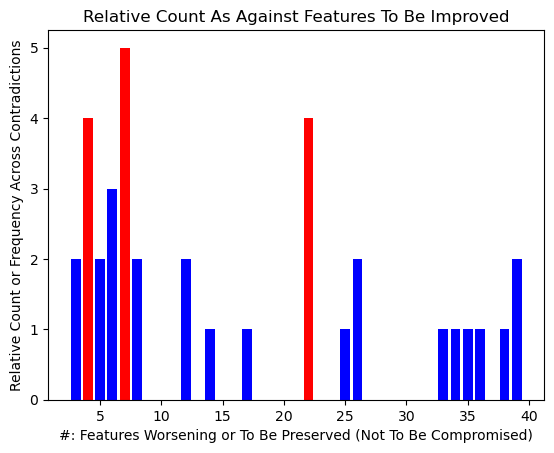
3/7 3/22 4/6 4/12 4/39 5/7 6/4 6/22 6/39 7/3 7/5 7/14 7/22 7/26 8/12 9/7 12/4 12/8 14/7 22/3 22/4 22/6 22/7 22/8 22/17 22/25 22/26 22/36 26/22 34/35 34/38 35/5 35/34 39/4 39/6 39/33
EXAMPLE: The goal is to increase the length of the crane arm (boom) to reach higher or farther distances while keeping the overall volume of the crane within specific limits for easy transportation and operational efficiency. Let’s consider a practical example where the nesting principle helps improve the Length of a moving object without compromising the Volume of the moving object. Imagine you are designing an extendable crane for construction purposes. It demonstrates how nesting can be a valuable inventive principle in resolving contradictions related to the dimensions of a moving object, enabling improvements in specific aspects without compromising others.
Contradiction (3/7): Increase the “Length of a moving object (3)” for enhanced reach or coverage and also “Maintain the Volume of the moving object (7)” within a specific limit, for instance, due to space constraints or weight considerations.
Solution: Implement a telescopic design for the crane arm. The crane arm consists of nested sections that can extend and retract, allowing for variations in length based on operational requirements. Design the crane arm with multiple nested sections that can slide out to extend the length. Incorporate a secure locking mechanism for each section to ensure stability during operation.When fully retracted, the nested sections occupy less space, maintaining the overall volume of the crane within acceptable limits. The crane can achieve a longer reach when the telescopic arm is fully extended. Compact Transportation: When not in use or during transportation, the telescopic sections nest within each other, reducing the overall volume of the crane. The nesting principle, applied through a telescopic design, allows the crane to achieve an increased Length for extended reach while maintaining a compact Volume for convenient transportation and efficient use of space.