

3: LOCAL QUALITY: (A) Change an object’s (or system’s) structure or property from uniform (or homogeneous) to non-uniform (or heterogeneous), (B) Change an object’s (or system’s) external environment from uniform (or homogeneous) to non-uniform (or heterogeneous), Make each (different) part of an object (or system) perform a different useful function, (C) Make a part of an object (or system) perform a direct opposite function (in time or space) or with respect to its other parts, (D) Make each part of a system to function in a locally optimized condition, Let each part of an object (or system) to be placed in conditions most suitable for its function/action.
EXAMPLE: Grip support on tools, Bakelite holders in heating utensils, Aerodynamics protrusions, using water for sharpening or contouring glass edges, Corrosion Protection Coatings, Swiss-Army Knife, Color Box, Pencil with eraser, Hammer with nail puller, Photo chromatic Lenses, Night-vision viewfinder, Refrigerated drugs or medicines. Lunch box with compartments optimized for different types of food (hot or cold, solid or liquid etc), Multifunction tools like screwdrivers (multi-head), Ultrasonic drills etc
SYNONYMS:
ACB:
The concept of “local quality” refers to the application of specific improvements or enhancements to individual components, features, or aspects of an object or system to achieve better performance, functionality, or efficiency. It involves focusing on making targeted modifications or additions to address specific challenges or opportunities within a particular context. Local quality aims to optimize specific attributes without necessarily altering the overall structure or design. At an abstract level, local quality can be used as an approach to problem-solving by analyzing the components or features of an object or system, you can identify the key areas where improvements or enhancements are most needed. These areas may be identified based on their importance to the overall function, performance, or user experience. Local quality encourages targeted innovation in specific areas, fostering a culture of problem-solving and improvement within organizations. It allows for effective problem-solving while minimizing disruption and optimizing resources. This approach aligns well with the principle of addressing challenges and opportunities in a precise, efficient, and contextually relevant manner.
It addresses contradictions related to the improvement of specific qualities or characteristics within a particular area or part of a system without negatively impacting the system as a whole. This principle aims to optimize or enhance certain features in a localized manner without causing detrimental effects on other aspects. The desire to improve a specific feature or quality in a localized area conflicts with the need to maintain or enhance the overall performance of the entire system. It allows for targeted enhancements in a specific region without compromising the system’s global efficiency or effectiveness. One can specialize or optimize particular features within a localized domain while preserving the system’s general functionality. It enables the intensification of specific features in a focused region while minimizing or mitigating any negative consequences in other parts of the system. It allows for the identification and improvement of efficiency or effectiveness within a localized scope, aligning with the broader objectives of the system. Improvements can be made in a localized context without disrupting the overall equilibrium or functionality of the system. It enables the optimization of specific features with an emphasis on resource efficiency within the targeted area. To conclude, the “local quality” principle allows for targeted improvements, optimizations, or intensifications in specific regions or components of a system, addressing contradictions that arise when trying to enhance certain features without negatively impacting the system as a whole.
“Local Quality” focuses on addressing contradictions that arise from trying to improve a particular parameter or attribute of a system while negatively impacting other parameters. It aims to find solutions that enhance a specific aspect without causing detrimental effects on other aspects. The concept of local quality as an approach to problem-solving involves making targeted enhancements or modifications to specific components, features, or attributes of an object or system.
This principle is often applied in both technical and business contexts to overcome challenges and contradictions. A business might face a contradiction between reducing costs and maintaining product/service quality. Applying this principle involves finding ways to optimize certain cost-intensive processes or materials without compromising the overall quality that customers expect. A company might want to expand its market reach while still providing a personalized customer experience. The principle could be applied by identifying segments within the broader market and tailoring marketing strategies to address their specific needs, thereby maintaining quality interactions. It could be the implementation of specialized customer service teams for different product lines or services within a company. The business could establish separate customer service teams, each specializing in a specific product or service or based on the customer segment or class or loyalty ratings. The localized teams can provide tailored assistance, addressing customer queries or concerns in a more specialized and efficient manner. The focus on localized expertise improves the overall quality of customer service, leading to higher satisfaction and a positive perception of the brand. Balancing operational efficiency with employee satisfaction is common. This principle can be used to optimize processes without overwhelming employees, leading to a work environment where both efficiency and job satisfaction are achieved.
In engineering, a contradiction between the strength and weight of a structure might arise. The principle could be used to find materials or designs that enhance strength in specific load-bearing areas without adding excessive weight. In developing technology, there might be a trade-off between speed and energy efficiency. Applying the principle involves designing components or systems where high-speed operation is achieved without significant energy consumption increases. Products might need to be both durable and flexible, but these attributes can sometimes conflict. By employing this principle, solutions could involve designing components with selective reinforcement to maintain flexibility while ensuring durability in critical areas.
Products and systems that implement the “local quality” principle focus on enhancing specific features or characteristics in localized areas without compromising the overall system’s performance. These examples demonstrate how this rinciple is applied across various industries to achieve targeted improvements and optimizations within specific components or aspects of a larger system:
In noise-canceling headphones, this principle is applied to reduce or eliminate ambient noise in a specific localized area around the user’s ears without degrading the overall sound quality. Data centers employ targeted cooling systems to specific server racks or components, optimize cooling efficiency in critical areas without overcooling the entire facility. Smart home climate control systems leverage the “local quality” principle by allowing users to set different temperatures for individual rooms or zones, optimizing comfort levels based on localized preferences. Variable Valve Timing (VVT) in Automobiles optimize the timing of valve openings and closings in specific cylinders, improving fuel efficiency and performance without sacrificing overall engine dynamics. Adaptive Lighting in Automotive Headlights in cars use the “local quality” principle to adjust the direction and intensity of headlights based on factors such as steering input, speed, and environmental conditions, enhancing visibility without affecting the entire lighting system. Precision agriculture systems using sensors and actuators to provide targeted irrigation to specific areas of a field, optimizing water usage and promoting crop health without wasting resources. Drug delivery systems with targeted or localized drug release mechanisms, allowing medications to be administered directly to specific tissues or organs while minimizing side effects on the rest of the body. Hearing aids allows users to customize sound profiles based on their specific hearing needs, optimizes auditory experiences without compromising overall hearing aid functionality. Precision agriculture techniques to deliver fertilizers selectively to specific areas of a field based on soil conditions and crop requirements, improving nutrient utilization efficiency. Smartphones by incorporating segmented vibration motors that provide localized haptic feedback, enhancing user experience without affecting the entire device’s vibration system.
Instead of overhauling the entire object or system, the local quality approach suggests applying solutions to the identified key areas. This focused approach allows for efficient problem-solving by addressing specific pain points or limitations. The local quality approach involves improving the specific functionalities or attributes that contribute significantly to the overall value of the object or system. This can result in enhanced user satisfaction, increased efficiency, or better performance. Unlike comprehensive redesigns, local quality interventions focus on making changes that integrate seamlessly into the existing structure. This minimizes disruption and reduces the need for extensive modifications. Local quality solutions often optimize existing resources, features, or components. This approach can be more resource-efficient compared to starting from scratch or completely reengineering a system. The local quality approach acknowledges that different contexts or environments may require tailored enhancements. Local quality solutions can be applied incrementally, allowing for continuous improvement over time. This aligns well with an iterative problem-solving approach where small enhancements are made as needed. Instead of introducing complexity at the overall system, local quality addresses complexity on a component level. This balance between simplicity and sophistication can lead to more sustainable solutions.
The underlying principle is to introduce variations or specific functionalities in different parts of an object or system, ensuring that each part operates optimally under its unique conditions. This can lead to enhanced efficiency, versatility, and adaptability in the design and functionality of objects or processes. Local Quality is associated non-Uniformity involves changing an object’s structure or the external environment from uniform to non-uniform, allowing each part to function in conditions most suitable for its operation. Change in Structure from Uniform to Non-Uniform: Ex: Instead of maintaining a constant temperature, introduce a temperature gradient across a material or system. This variation in temperature can be utilized to trigger specific responses or reactions in different parts of the system. Make Each Part Fulfill a Different and Useful Function: xample: Ex: A lunch box with special compartments for hot and cold solid foods and liquids. Each compartment serves a unique purpose, maintaining the temperature or preventing mixing, thereby optimizing the conditions for different types of food. Objects with Multiple Functions: Ex: A pencil with an eraser. The pencil serves the primary function of writing, while the eraser fulfills a different but complementary role, allowing for corrections. Ex: A hammer with a nail puller. The hammer is used for driving nails, and the nail puller on the opposite side allows for the removal of nails. Multi-Function Tool: A multi-function tool with various features like scaling fish, acting as pliers, a wire stripper, a flat-blade screwdriver, a Phillips screwdriver, and a manicure set. Each component of the tool serves a distinct purpose, making the tool versatile and efficient for various tasks.
The construction of wells for water storage dates back to ancient civilizations, and it was a common practice in various cultures around the world. Wells were crucial for ensuring a reliable water supply for communities, particularly in arid or semi-arid regions where surface water sources were scarce. Wells served a multifunctional purpose (universality) by providing a local and reliable source of water for the community. They were not only used for drinking water but also for irrigation, domestic activities, and possibly as a safeguard against drought. Wells were a localized solution to the specific need for water in a given area (local qualiity). The quality of the water source was localized to the community using the well, ensuring a consistent and accessible water supply. The decision to construct a well involved prior action in response to the need for a stable and sustainable water source. Identifying the need for water storage and taking action to dig a well exemplifies the principle of prior action. Wells were typically constructed using materials available in the local environment, such as stones, bricks, or other suitable materials. This aligns with the principle of homogeneity, as the construction materials were adapted to the local conditions. The cylindrical or circular shape of traditional wells aligns with the principle of spheroidality. This shape helps distribute the load evenly and enhances the stability of the well structure. Overall, the construction of wells for water storage aligns with multuple principles in action that emphasize adaptability, efficiency, and the localized resolution of specific needs within a given environment. The principles highlight the inventive and problem-solving nature of the communities that developed and refined well construction techniques over the centuries.
Total Knee Replacement (TKR) is a surgical procedure to replace a damaged knee joint with an artificial implant, often due to conditions like osteoarthritis or rheumatoid arthritis. The damaged cartilage and bone are removed, and the artificial components (metal and plastic implants) are inserted to recreate the joint. Arthroscopic Knee Surgery is a minimally invasive procedure to diagnose and treat issues within the knee joint, such as torn ligaments or damaged cartilage. Small incisions are made, and a tiny camera (arthroscope) is inserted to guide miniature surgical instruments.
Total Hip Replacement (THR) is a procedure to replace a damaged hip joint with a prosthetic implant, typically performed for conditions like osteoarthritis or hip fractures. The damaged bone and cartilage are removed, and an artificial hip joint, consisting of a metal stem and ball with a plastic socket, is implanted. Arthroscopic hip surgery is used to diagnose and treat various hip conditions, including labral tears or impingements. Similar to knee arthroscopy, small incisions are made for the arthroscope and instruments to visualize and address issues within the hip joint.
Surgical procedures often segment the affected joint, allowing precise interventions without affecting surrounding healthy tissues. Balancing the need for intervention in a specific area (segment) while minimizing impact on adjacent healthy structures. Joint replacements restore the dynamic function of the joint, allowing for improved mobility and reduced pain. Enhancing the dynamic performance of the joint without compromising stability or longevity. Preoperative diagnostics, such as imaging, help surgeons plan and take preliminary actions before the actual surgery. Balancing the need for thorough preoperative assessment with minimizing the invasiveness of diagnostics. Minimally invasive techniques (arthroscopy) involve transitioning to a micro-level for precise interventions. Achieving detailed interventions while minimizing the size of incisions and trauma.
Focusing on enhancing the quality of the joint locally during replacement or repair. Improving the local function and durability of the joint while maintaining the overall stability and functionality. Joint surgeries aim to resolve several contradictions using mutliple inventive principles at work related to restoring function and mobility while minimizing invasiveness and preserving healthy tissues. Advances in surgical techniques and materials contribute to addressing these contradictions, enhancing ideality i.e. patient outcomes and recovery.
In the case of the Von Restorff effect, making certain components or information locally distinct within a system can enhance their salience and facilitate their recognition and recall. This could involve using contrasting colors, shapes, or other visual cues to highlight critical elements within a technical system. he Von Restorff effect, also known as the isolation effect, is a principle in psychology that describes the phenomenon where items that are distinctive or stand out from their surrounding context are more likely to be remembered. This effect was first observed by German psychiatrist and pediatrician Hedwig von Restorff in the 1930s. Key points about the Von Restorff effect include: Distinctiveness: The Von Restorff effect occurs when one item in a list or set is different or unique compared to the others. This distinctiveness can be in terms of color, shape, size, or any other perceptual characteristic that makes the item stand out. Memory Recall: Items that are distinctive or isolated are more likely to be recalled from memory compared to items that are similar to one another. This effect suggests that our memory is biased towards remembering information that deviates from the norm or is salient. Attention and Encoding: The Von Restorff effect is influenced by attention and encoding processes. When an item stands out, it captures the individual’s attention more effectively, leading to deeper encoding and better retention in memory.
Applications: The Von Restorff effect has implications in various fields, including marketing, advertising, and education. Marketers often use distinctive visuals or messages to make their products or advertisements memorable. In educational settings, teachers may highlight key information in a distinctive way to enhance students’ retention and recall. In complex technical systems, certain components or parameters may be more critical or have a higher impact on overall performance or safety. By making these critical components visually distinct or highlighting them in documentation, diagrams, or interfaces, engineers and technicians can ensure that they receive appropriate attention during design, operation, and maintenance. When diagnosing problems or faults in technical systems, the Von Restorff effect can help identify anomalous or unusual behavior that stands out from the normal operation. Anomalies that deviate from the expected patterns may indicate potential issues that require further investigation, enabling quicker detection and resolution of problems.
Cognitive dissonance refers to the psychological discomfort or tension that arises when individuals hold conflicting beliefs, attitudes, or behaviors. This discomfort motivates individuals to seek consistency and reduce the dissonance by either changing their beliefs or justifying their existing beliefs through rationalization. To address cognitive dissonance reduction in technical problem-solving, it is essential to promote critical thinking, openness to alternative perspectives, and a willingness to reconsider initial assumptions or decisions. By encouraging individuals to confront and resolve cognitive dissonance through objective evaluation and consideration of diverse viewpoints, teams can enhance their problem-solving effectiveness and promote innovation. Cognitive dissonance can occur in various contexts beyond purchasing decisions, including attitudes, values, and interpersonal relationships. Cognitive dissonance reduction is a psychological phenomenon where individuals seek to alleviate the discomfort or tension (cognitive dissonance) that arises from holding conflicting beliefs, attitudes, or behaviors. Individuals may selectively seek out information that confirms their chosen solution or course of action while ignoring or dismissing contradictory evidence. This confirmation bias serves to reduce cognitive dissonance by reinforcing their initial beliefs or decisions. This reduction typically involves rationalizing or justifying one’s choices, beliefs, or actions to restore consistency and reduce psychological discomfort.
When significant time, effort, or resources have been invested in a particular approach or solution, individuals may feel compelled to justify their investment by rationalizing its effectiveness or dismissing alternative options. This justification of effort helps reduce cognitive dissonance by affirming the value of their chosen course of action. After implementing a solution to a technical problem, individuals may engage in post-purchase rationalization by emphasizing its positive aspects and downplaying any shortcomings or failures. This Post-Purchase Rationalization helps alleviate cognitive dissonance by reaffirming the wisdom of their decision and minimizing feelings of regret or doubt. Individuals may anchor their judgments or evaluations of a solution based on their initial beliefs or expectations, even in the face of contradictory evidence. This anchoring bias serves to reduce cognitive dissonance by maintaining consistency between their preconceived notions and subsequent judgments. Individuals may actively avoid or dismiss information that challenges their existing beliefs or decisions, preferring to remain in a state of cognitive consonance rather than confronting conflicting viewpoints. This avoidance helps reduce cognitive dissonance by shielding individuals from uncomfortable or challenging information.
Authority bias is a cognitive bias where individuals tend to attribute greater accuracy or credibility to the opinions and actions of an authority figure, even when those opinions or actions may not be justified. This bias can influence decision-making and perceptions, leading individuals to defer to authority figures without critically evaluating their expertise or the validity of their statements. Authority bias can manifest in various situations, including: Expert opinions: People may give more weight to the opinions of individuals perceived as experts or authorities in a particular field, even if those opinions are not supported by evidence or sound reasoning. Leadership: Followers may unquestioningly accept the directives or decisions of leaders or authority figures without independently assessing their merit. Group dynamics: Authority figures within a group setting may influence group members’ opinions and behavior, leading to conformity and a reluctance to challenge the authority figure’s views. Media and information sources: Individuals may be more inclined to believe information presented by authoritative sources, such as news organizations or public figures, without critically evaluating its accuracy or bias.
Authority bias can have both positive and negative consequences. While it can facilitate efficient decision-making in situations where genuine expertise is present, it can also lead to errors in judgment when individuals blindly trust authority figures without questioning or verifying their claims. To mitigate authority bias, it’s essential to encourage critical thinking, independent analysis, and skepticism, even when information comes from trusted or authoritative sources. Individuals should evaluate the credentials, evidence, and reasoning behind authoritative statements rather than relying solely on the authority figure’s reputation or position. Additionally, fostering a culture of open dialogue and constructive dissent can help counteract the influence of authority bias within organizations and social groups.
The contrast effect is a cognitive bias that influences perception by magnifying differences between two or more stimuli when they are presented close together in time or space. This bias causes individuals to overestimate the differences between stimuli, leading to distorted perceptions and judgments. The contrast effect can manifest in various situations: Perception of Size or Magnitude: When presented with two objects of different sizes consecutively, individuals may perceive the second object as larger or smaller than it actually is due to the contrast with the first object. Perception of Value: In sales or marketing, presenting a higher-priced item before a lower-priced item can make the lower-priced item seem like a better value than it actually is, leading to increased sales. Evaluation of Performance: Comparing someone’s performance to that of a highly competent individual can make the person’s performance seem worse by contrast, even if their performance would be considered good in isolation. Judgments of Attractiveness: When individuals are presented with images of people of varying attractiveness, the perceived attractiveness of each person may be influenced by the order in which the images are presented, with the second person appearing more or less attractive depending on the contrast with the first person.
To mitigate the impact of the contrast effect, individuals can: Consider stimuli or options independently before comparing them to others. Be aware of the potential for bias and consciously try to evaluate each stimulus on its own merits. Use objective criteria or benchmarks for evaluation rather than relying solely on comparisons with other stimuli. Take breaks between evaluations to minimize the influence of recent comparisons on judgments. By being aware of the contrast effect and implementing strategies to mitigate its effects, individuals can make more accurate and objective judgments and decisions.
1: Mass of the moving object: [’23: Material loss’, ’26: Amount of substance’, ’27: Reliability’, ’33: Convenience of use’, ’39: Productivity’]
2: Mass of the non-moving object: [’27: Reliability’]
4: Length of the non-moving object: [’17:Temperature’, ’18: Brightness, Visibility’, ’28: Accuracy of measurement’, ’34: Convenience of repair’]
5: Area of the moving object: [’14: Strength’, ’15: Action time of the moving object’, ’28: Accuracy of measurement’]
6: Area of the non-moving object: [’28: Accuracy of measurement’]
8: Volume of the non-moving object: [’26: Amount of substance’]
9: Speed: [’14: Strength’, ’15: Action time of the moving object’, ’37: Complexity of control and measurement’]
10: Force: [’27: Reliability’, ’31: Harmful internal factors’, ’33: Convenience of use’, ’39: Productivity’]
11: Tension, Pressure: [’14: Strength’, ’15: Action time of the moving object’, ’23: Material loss’, ’29: Accuracy of manufacturing’]
12: Shape: [‘2: Mass of the non-moving object’, ’23: Material loss’]
13: Stability of the object: [’16: Action time of the non-moving object’, ’18: Brightness, Visibility’, ’39: Productivity’]
14: Strength: [‘5: Area of the moving object’, ’10: Force’, ’11: Tension, Pressure’, ’15: Action time of the moving object’, ’25: Time loss’, ’27: Reliability’, ’28: Accuracy of measurement’, ’29: Accuracy of manufacturing’, ’32: Convenience of manufacturing’, ’34: Convenience of repair’, ’35: Adaptability’, ’37: Complexity of control and measurement’]
15: Action time of the moving object: [‘5: Area of the moving object’, ‘9: Speed’, ’11: Tension, Pressure’, ’13: Stability of the object’, ’14: Strength’, ’23: Material loss’, ’26: Amount of substance’, ’28: Accuracy of measurement’, ’29: Accuracy of manufacturing’]
16: Action time of the non-moving object: [’13: Stability of the object’, ’26: Amount of substance’]
17:Temperature: [‘5: Area of the moving object’, ’10: Force’, ’19: Energy consumption of the moving object’, ’26: Amount of substance’, ’27: Reliability’, ’37: Complexity of control and measurement’]
18: Brightness, Visibility: [’13: Stability of the object’, ’29: Accuracy of manufacturing’]
19: Energy consumption of the moving object: [’17:Temperature’, ’28: Accuracy of measurement’]
20: Energy consumption of the non-moving object: [’26: Amount of substance’]
22: Energy loss: [’21: Power’, ’37: Complexity of control and measurement’]
23: Material loss: [‘8: Volume of the non-moving object’, ’11: Tension, Pressure’, ’12: Shape’, ’15: Action time of the moving object’, ’26: Amount of substance’]
25: Time loss: [’13: Stability of the object’, ’14: Strength’]
26: Amount of substance: [’10: Force’, ’11: Tension, Pressure’, ’15: Action time of the moving object’, ’16: Action time of the non-moving object’, ’17:Temperature’, ’20: Energy consumption of the non-moving object’, ’23: Material loss’, ’27: Reliability’, ’31: Harmful internal factors’, ’35: Adaptability’, ’36: Complexity of the structure’, ’37: Complexity of control and measurement’, ’39: Productivity’]
27: Reliability: [‘1: Mass of the moving object’, ‘2: Mass of the non-moving object’, ‘7: Volume of the moving object’, ’10: Force’, ’15: Action time of the moving object’, ’17:Temperature’, ’26: Amount of substance’, ’28: Accuracy of measurement’]
28: Accuracy of measurement: [‘4: Length of the non-moving object’, ‘5: Area of the moving object’, ‘6: Area of the non-moving object’, ’19: Energy consumption of the moving object’, ’21: Power’, ’31: Harmful internal factors’]
29: Accuracy of manufacturing: [’11: Tension, Pressure’, ’14: Strength’, ’15: Action time of the moving object’, ’18: Brightness, Visibility’]
30: Harmful external factors: [’12: Shape’, ’38: Level of automation’]
31: Harmful internal factors: [‘9: Speed’, ’26: Amount of substance’, ’28: Accuracy of measurement’]
32: Convenience of manufacturing: [’14: Strength’]
33: Convenience of use: [’14: Strength’, ’15: Action time of the moving object’, ’38: Level of automation’]
34: Convenience of repair: [‘4: Length of the non-moving object’]
35: Adaptability: [’14: Strength’, ’17:Temperature’, ’26: Amount of substance’]
36: Complexity of the structure: [’26: Amount of substance’]
37: Complexity of control and measurement: [‘9: Speed’, ’14: Strength’, ’17:Temperature’, ’22: Energy loss’, ’26: Amount of substance’]
38: Level of automation: [’33: Convenience of use’]
39: Productivity: [‘2: Mass of the non-moving object’, ’13: Stability of the object’]
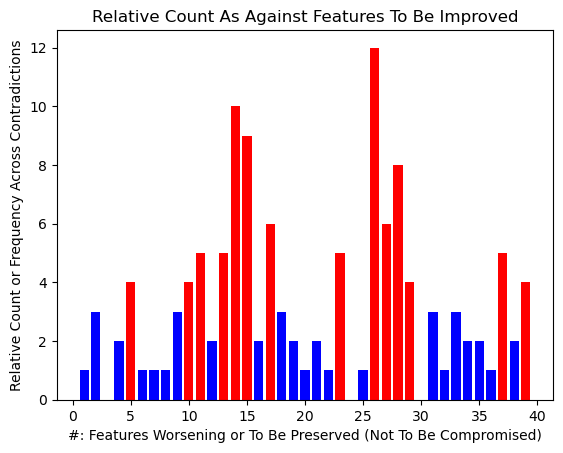
1/23 1/26 1/27 1/33 1/39 2/27 4/17 4/18 4/28 4/34 5/14 5/15 5/28 6/28 8/26 9/14 9/15 9/37 10/27 10/31 10/33 10/39 11/14 11/15 11/23 11/29 12/2 12/23 13/16 13/18 13/39 14/5 14/10 14/11 14/15 14/25 14/27 14/28 14/29 14/32 14/34 14/35 14/37 15/5 15/9 15/11 15/13 15/14 15/23 15/26 15/28 15/29 16/13 16/26 17/5 17/10 17/19 17/26 17/27 17/37 18/13 18/29 19/17 19/28 20/26 22/21 22/37 23/8 23/11 23/12 23/15 23/26 25/13 25/14 26/10 26/11 26/15 26/16 26/17 26/20 26/23 26/27 26/31 26/35 26/36 26/37 26/39 27/1 27/2 27/7 27/10 27/15 27/17 27/26 27/28 28/4 28/5 28/6 28/19 28/21 28/31 29/11 29/14 29/15 29/18 30/12 30/38 31/9 31/26 31/28 32/14 33/14 33/15 33/38 34/4 35/14 35/17 35/26 36/26 37/9 37/14 37/17 37/22 37/26 38/33 39/2 39/13
EXAMPLE: The problem addressed by the design of a frying pan handle with a heat-resistant coating and ergonomic shaping is related to user safety and comfort during cooking. When a frying pan is placed on a hot burner, the handle can absorb heat, becoming uncomfortably hot to touch. This can lead to burns or discomfort for the person handling the pan. The application of this principle solves this problem. The heat-resistant coating prevents the handle from becoming uncomfortably hot. By ensuring that the heat resistance is localized to the handle, the overall integrity and functionality of the frying pan are preserved, allowing users to cook safely without compromising the pan’s performance.
Contradictions (30/12, 33/14, 32/14): The design of a frying pan handle with a heat-resistant coating and ergonomic shaping addresses the contradiction between the need for a hot pan to cook food effectively and the desire to ensure user safety and comfort by keeping the handle cold. Users want a safe and comfortable cooking experience without the risk of burns. Traditional frying pan handles can become excessively hot during cooking, causing discomfort and, in some cases, burns to the user’s hands (30). In addition to heat, the design of the handle should also considers the ergonomics for better grip and handling during cooking (12 & 14). Implementing heat-resistant features should not compromise the overall functionality of the frying pan.
Solution: The heat-resistant coating is applied specifically to the handle, addressing the need for localized improvement in the context of high-temperature exposure during cooking. This ensures a more comfortable cooking experience and minimizes the risk of injury. The handle is the primary point of contact for the user, and it needs to be optimized for safe and comfortable use. By localizing the heat-resistant coating to the handle, the design preserves the pan’s ability to conduct heat for cooking purposes. The rest of the pan can function as intended without being affected by the heat-resistant modification.
The shape of the handle is designed for better grip and handling. The ergonomic shaping of the handle provides a comfortable and secure grip, making it easier for users to control the pan while cooking. This enhances overall user experience and reduces the likelihood of accidents or spills. The design of the frying pan handle with a heat-resistant coating and ergonomic shaping solves the problem of user discomfort and potential burns during cooking. It does so by selectively improving the handle’s properties without compromising the overall functionality of the frying pan, aligning with the principles of user safety and convenience. This approach allows for the targeted improvement of features without negatively impacting the overall functionality of the frying pan.