

13: DO IT IN REVERSE : (A) Implement an opposite action (i.e. heating instead of cooling or vice-a-versa) as against the desired action dictated by the problem, (B) Make the moveable part of an object (or system) or external environment, stationary (or fixed) – and the stationary (or fixed) part moveable, (C) Turn an object (or system or process) upside-down or inside-out or use other side or property or function than it is originally designed for (D) Swap operands and operators (or their roles) with other or make environment fixed and sub-system or object movable (or vice-a-versa).
EXAMPLE: Home Delivered Food (bring mountain to Mohammed instead of bringing Mohammed to the mountain), Battery Driven Screw Drivers, Moving Sidewalk (transporting standing people), Process of Emptying Containers By Investing Them, Double-sided Wears or Linens (can be used inside-out), Heat Inner and Cool Outer Part (to unlock the stuck parts), Rotate Clockwise (instead of anti-clockwise, vice-a-versa), Treadmill, Travelators, Escalator, Reverse Counting (for launches), Turn Down Assembly Upside-Down, Reversible Wears/Belts etc.
SYNONYMS: The Other Way Around, Inversion, Upside-Down, Inside-Out (THE OTHER WAY AROUND, Inversion, Upside-Down, Inside-Out, Outside-In, Inversion, Reverse)
ACB:
The “Inversion” principle isi a concept that involves reversing or inverting a process or an action to achieve a beneficial outcome. The principle suggests looking at a situation from a different perspective, often by reversing the usual cause-and-effect relationship or challenge the assumptions. It encourages a shift in perspective by exploring the opposite of traditional approaches, cause-and-effect relationships, or assumptions. By reversing the usual steps or sequence, one may discover new and inventive solutions. Considering the opposite of conventional actions or processes to explore unconventional alternatives. Identify the cause-and-effect relationships in a problem and explore what happens when these relationships are inverted. This shift in perspective may lead to breakthrough ideas. Invert parameters or characteristics of a system. For example, consider making something that is usually flexible rigid, or vice versa, and explore the potential benefits. Consider the space or elements that are typically ignored or considered negative. Inverting the attention to these aspects may reveal opportunities for improvement.
By questioning established norms, inventors can uncover unconventional and effective solutions. Identify trends or patterns in a system and explore what happens when those trends are reversed. This can lead to ideas for improvements or innovative solutions. The “Inversion” principle is part of the inventor’s toolbox, which aims to guide problem-solving and innovation by leveraging principles derived from patterns observed in inventive solutions across various domains. Applying inversion helps inventors break away from conventional thinking and discover creative solutions to complex problems.
At an abstract level, the “Inversion” principle involves the act of reversing or inverting elements, processes, or relationships to achieve innovative solutions or overcome problems. Inversion aims to challenge conventional thinking and uncover new possibilities by considering scenarios that are typically overlooked. Examining the cause-and-effect relationships within a system and exploring what happens when these relationships are reversed or inverted. Focusing on elements or aspects that are often considered negative or ignored, and finding value or opportunities within those neglected areas. Using inversion to resolve contradictions by examining how reversing certain elements or processes can eliminate conflicts between conflicting requirements. Identifying trends or patterns in a system and exploring the implications and opportunities that arise when those trends are reversed. At its core, inversion serves as a cognitive tool to break free from linear thinking and explore unconventional solutions that may lead to breakthrough innovations. It encourages inventors and problem solvers to consider the unexpected and challenge the status quo in order to discover novel approaches to challenges and contradictions.
The “Inversion” principle can be applied to resolve contradictions in both technical systems and business scenarios. Instead of focusing on making the structure stronger and more durable, invert the approach by considering an inflatable structure. This involves using lightweight materials that can be inflated when needed, providing both portability and strength.Rather than attempting to reduce costs by cutting corners on product quality, invert the approach by investing in preventive measures and quality control processes. This ensures that defects are minimized, reducing the overall cost associated with rework and customer dissatisfaction.
Instead of attempting to improve energy efficiency by compromising performance, invert the approach by exploring renewable energy sources. Integrate solar panels or other renewable energy technologies to power the system without sacrificing performance. Rather than sacrificing testing thoroughness for speed in product development, invert the approach by implementing continuous testing throughout the development process. Adopt agile methodologies that incorporate testing at every stage, ensuring both speed and quality.
Instead of attempting to increase storage capacity within a compact design, invert the approach by exploring cloud-based storage solutions. This allows for offloading storage requirements to external servers while maintaining a compact device design. Rather than viewing innovation and stability as mutually exclusive, invert the approach by establishing innovation as a core value for maintaining stability. Foster a culture of continuous improvement and adaptability to ensure stability through ongoing innovation.
There is a technique known as “bolter” or “wave-off” that is used during an aircraft carrier landing. Instead of reducing the engine power, the pilot increases it in the event of a bolter. This maneuver is part of the complex process of landing on an aircraft carrier and is done for specific safety and operational reasons. A bolter occurs when the aircraft is unable to make a successful landing on the carrier deck. It could be due to various reasons such as the aircraft approaching too high, too low, or at an incorrect angle. In a bolter, the pilot immediately applies full power to the aircraft engines. This is essentially a go-around or missed approach procedure. By rapidly increasing engine power, the pilot ensures that the aircraft has enough thrust to climb away from the carrier deck. Having maximum power provides a safety margin, allowing the aircraft to rapidly climb and maneuver as needed. It’s a precautionary measure to handle any unexpected situations during the landing attempt. Aplying full power during a bolter is a standard and critical procedure in carrier-based aircraft operations. It provides the pilot with the necessary thrust to execute a missed approach and make a subsequent landing attempt.
The difference in driving on the left or right side of the road is a matter of historical convention and local tradition. The choice of driving on one side or the other is influenced by various factors, including historical practices, the dominant hand of the population, and sometimes political decisions. The majority of the world’s countries follow either the left-hand or right-hand driving rule. Some countries, especially former British colonies, drive on the left side of the road. Examples include the United Kingdom, Australia, India, Japan, and South Africa. Historical reasons are often cited, including the tradition of keeping the right hand—the dominant hand for the majority of people—free for activities such as saluting or wielding a weapon. Many countries, particularly in Europe, the Americas, and Asia, drive on the right side of the road. Examples include the United States, Canada, China, Germany, and France. Historical reasons, cultural practices, and sometimes political decisions have influenced the choice of driving on the right side. Right-hand driving is more prevalent worldwide. Approximately two-thirds of the world’s population drives on the right side of the road. Some countries have switched from left-hand to right-hand driving or vice versa. For example, Sweden switched from left to right in 1967, and Samoa switched from right to left in 2009. International conventions do not prescribe a specific side for driving. However, within a region or country, traffic regulations are standardized to maintain consistency and safety. It’s important to note that the choice of driving on the left or right side is not an indicator of a country’s development or political system. It is primarily a historical and cultural practice that has persisted over time.
The Assumption Reversal is a creativity technique used in problem-solving and ideation. It involves challenging and reversing existing assumptions related to a problem or situation. While the term “Assumption Reversal” may not have a single originator, it aligns with the broader principles of creative thinking and problem-solving. The concept is inherent in various creativity methodologies and brainstorming approaches. The practice of challenging assumptions to stimulate creativity has likely evolved over time with contributions from multiple thinkers and practitioners in the field of creativity and innovation. Basic Steps of Assumption Reversal: List the assumptions commonly held about a problem, situation, or a given context. Challenge each assumption by considering its opposite or reversing it. Explore what happens if the opposite were true. Use the reversed assumptions as a springboard for generating new and unconventional ideas or solutions.
Assumption Reversal helps break mental barriers by encouraging individuals to question established norms and beliefs. By flipping assumptions, this technique stimulates creative thinking, fostering the generation of novel and innovative ideas. It encourages individuals to see problems from different angles and consider possibilities they may not have initially explored. The method aids in reframing the problem, offering fresh perspectives that can lead to more effective and unconventional solutions. Assumption Reversal promotes divergent thinking, allowing for the exploration of various alternatives and viewpoints.It encourages individuals to take risks and explore ideas that might be considered unconventional or initially counterintuitive.
Opposite or reverse of inventive principles such as “partial or excessive action” or “rushing through” will be carefully planned and execution of operation or activity (having “prior action” involved for disciplined execution). For instance, LASIK (Laser-Assisted In Situ Keratomileusis) surgery is a carefully planned and precise procedure designed to correct refractive errors in the eye, such as myopia (nearsightedness), hyperopia (farsightedness), and astigmatism. The surgery involves reshaping the cornea using an excimer laser to improve the way light is focused onto the retina, thus correcting vision.
It involves thorough examination of the patient’s eyes to determine candidacy for LASIK, considering factors such as corneal thickness, refractive error, and overall eye health. Either a microkeratome or a femtosecond laser is used to create a thin, hinged flap on the cornea, exposing the underlying tissue. An excimer laser precisely removes a predetermined amount of corneal tissue based on the patient’s refractive error, reshaping the cornea to improve vision. The corneal flap is carefully repositioned, where it naturally adheres without the need for stitches.
Patients undergo a period of postoperative care to ensure proper healing and recovery. Follow-up appointments are scheduled to monitor progress. While LASIK surgery involves the use of advanced technology and is performed relatively quickly, it is not a hasty or rushed procedure. The precision and planning involved contribute to its success in providing effective vision correction. LASIK exemplifies careful execution and strategic application of technology to achieve the desired outcome without compromising safety or efficacy.
The reverse countdown, often referred to as a countdown sequence, is a standard procedure in various activities, including space launches, and serves several important purposes. The countdown allows for a systematic reduction in successful checks of all systems involved in the launch. It ensures that various components of the rocket, spacecraft, ground support systems, and communication systems are functioning correctly. Leading up to the launch, the countdown sequence includes various preparations, such as fueling the rocket, configuring systems, and aligning navigation equipment. These tasks are conducted in a specific order to ensure that everything is ready for liftoff. Countdowns often include built-in holds or pauses at certain points. These holds allow for additional checks, assessments, or adjustments to be made if necessary. They provide flexibility to address any last-minute issues that may arise.
The countdown also serves a psychological purpose, building anticipation and focus as the launch approaches. The final seconds of the countdown create a dramatic and memorable moment leading to liftoff. In the context of space launches, the countdown typically starts from a predefined time (e.g., T-10 minutes) and counts down to zero when the launch vehicle is ignited. The use of a countdown is a structured and organized approach to ensure a safe and successful launch, taking into account the complexities and critical nature of space missions.
The bandwagon effect is a cognitive bias where people tend to adopt certain behaviors, beliefs, or trends simply because many others are doing the same, regardless of their own beliefs or preferences. This bias can lead individuals to conform to popular opinions or follow trends without critically evaluating them. In the context of the bandwagon effect, designers can introduce mechanisms that encourage individuals to critically evaluate trends or opinions rather than simply following them or crowd or mass or group or general or wider thinking. The “Principle of Self-Service” emphasizes empowering individuals to make informed decisions based on their own needs and preferences rather than blindly following others. Designers can incorporate features or tools that facilitate independent decision-making and encourage individuals to assess information critically rather than succumbing to the bandwagon effect. Mitigate the influence of the bandwagon effect by promoting more thoughtful and independent decision-making among users.
The bandwagon effect can create a sense of unity or belonging among individuals who share common beliefs or behaviors. In some cases, the bandwagon effect can lead to the widespread adoption of behaviors that benefit society as a whole. The bandwagon effect can drive consumer demand and market momentum, leading to increased sales and profitability for businesses. However, this herd mentality inherent to the bandwagon effect can lead to situations, where individuals or systems could harm themselves for blindly adopting universality or beliefs or behaviors imposed upon them i.e. not doing critical evaluation could potentially stifle independent thinking, creativity and distinctiveness.
In group settings, the bandwagon effect can exacerbate groupthink, where dissenting opinions are suppressed in favor of conformity, leading to poor decision-making. The bandwagon effect can contribute to the formation of bubbles in financial markets or other domains, where asset prices become detached from their intrinsic value, leading to market instability and eventual crashes. To mitigate the negative consequences of the bandwagon effect, encourage critical thinking skills and independent decision-making among individuals to help them resist the influence of social pressure and make informed choices. Encourage individuals to seek information from diverse sources and consider multiple perspectives but forming its own opinions or making decisions. Create an environment where individuals feel comfortable expressing dissenting opinions and engaging in constructive debate, reducing the likelihood of groupthink. Raise awareness about cognitive biases, including the bandwagon effect, and educate individuals about the importance of independent thinking and decision-making. Develop tools or frameworks that help individuals evaluate information objectively and make decisions based on evidence rather than social influence. By implementing these strategies, organizations and individuals can mitigate the negative impact of the bandwagon effect and promote more thoughtful and independent decision-making.
The type of moving walkway where a person stands and is transported along a flat or gently inclined surface, is commonly known as a “travelator” or “moving walkway.” Travelators are a form of horizontal transportation designed to move people efficiently within buildings, such as airports, train stations, shopping malls, and transit hubs. Unlike escalators, where steps move in a loop, travelators have a continuous, flat surface that moves in one direction (also a use case of another dimension, periodic action, continuity of useful action). Travelators are typically automatic and operate continuously during business hours. They start and stop based on sensors detecting the presence of passengers. Travelators are designed to make it easier for passengers to cover large distances within a building without physically walking. They are especially useful in airports to assist passengers in moving quickly between terminals or concourses. Some travelators have a dual pathway, allowing passengers to stand on both sides, while others may have a designated standing side and a walking side for faster movement. Travelators usually operate at a constant speed, providing a smooth and comfortable journey for passengers. Travelators are part of the broader category of horizontal transportation systems, along with escalators and conventional elevators. They contribute to the overall efficiency of passenger flow within busy public spaces, offering a convenient and time-saving means of transportation.
Automation bias refers to the tendency of individuals to rely excessively on automated systems or technology, even when they have evidence that the automation is flawed or incorrect. This bias occurs when people place too much trust in the outputs or recommendations of automated systems, leading them to overlook or discount contradictory information provided by their own judgment or external sources. One common example of automation bias occurs in aviation, where pilots may become overly reliant on automated flight systems and fail to intervene when the system makes errors or malfunctions. In healthcare, clinicians may defer too much to computerized diagnostic tools or decision support systems, even if they have doubts about the accuracy or relevance of the system’s recommendations. People may assume that automated systems are infallible or more reliable than human judgment, leading them to trust the system’s outputs without question. When individuals are busy or under pressure, they may prefer to rely on automated systems to simplify decision-making and reduce cognitive effort, even if it means ignoring conflicting information. If automated systems are opaque or poorly understood, users may be more likely to trust their outputs without critically evaluating their accuracy or reliability.
To mitigate automation bias, it’s essential to promote awareness and critical thinking among users of automated systems. This can involve providing training on the limitations and capabilities of automation, encouraging skepticism and independent verification of system outputs, and designing systems with clear interfaces and feedback mechanisms to enhance transparency and user understanding. Additionally, fostering a culture of accountability and human oversight can help ensure that automated systems are used as tools to support decision-making rather than replace human judgment entirely.
The concept of automation bias, particularly in the context of replacing mechanical systems with automated ones, can relate to doing reverse of it i.e. instead of entirely relying on the automated system, also involve human operators and do not underutilize their judgment. When replacing mechanical systems with automated ones, engineers and designers often focus on improving efficiency, reducing costs, and enhancing performance. However, solely relying on automation without considering the broader context can lead to automation bias, where individuals overestimate the capabilities of automated systems and underutilize their own judgment, especially in case of system malfunctions or failures.
This prinicple encourages engineers and designers to also consider the larger system or environment including the human operator under which the automation operates. Instead of viewing automation as a standalone solution, they should integrate it into a broader system that includes human operators, organizational processes, and external factors. By adopting this principle, engineers can design automated systems that complement human capabilities rather than replacing them entirely. This approach ensures that automation enhances human performance, improves decision-making, and minimizes the risk of automation bias by leveraging the strengths of both humans and machines.
Duration neglect is a cognitive bias where the duration or length of an event or experience has little influence on the overall evaluation or perception of that event. In other words, people tend to focus more on the peak intensity or the ending of an experience rather than its duration when forming judgments or memories about it. This bias can lead individuals to overlook or downplay the significance of the duration of an experience when reflecting on its overall impact. By being aware of duration neglect bias and its effects, individuals can make more informed evaluations and decisions, leading to better outcomes and a more accurate understanding of their experiences. Here’s how duration neglect may manifest in various situations:
Pain Perception: Studies have shown that individuals may rate a painful experience as equally negative regardless of whether it lasted for a short or long duration. For example, someone may rate a brief but intense dental procedure as equally unpleasant as a longer but less intense medical treatment. Vacation Satisfaction: When recalling a vacation, people may focus more on memorable moments, such as exciting activities or scenic views, rather than the length of the trip. As a result, individuals may rate a shorter vacation with memorable experiences as more enjoyable than a longer vacation with fewer memorable moments. Waiting Time: In service settings, customers may evaluate their experience based on factors such as waiting time, service quality, and the resolution of their needs, rather than the total duration of the wait. For instance, a customer may perceive a shorter wait with excellent service as more satisfactory than a longer wait with poor service. Educational Experiences: Students may judge the quality of a course or learning experience based on the most memorable lessons, assignments, or interactions with instructors, rather than the length of the course. A shorter course with engaging content may be perceived as more valuable than a longer course with less engaging material.
Duration neglect has implications for decision-making, memory formation, and the evaluation of experiences. To address this bias and improve decision-making processes, individuals can: Reflect on the entire duration of an experience rather than focusing solely on peak moments or endings. Consider the cumulative impact of events or experiences over time, especially in long-term evaluations. Use objective measures, such as time logs or journaling, to track the duration and intensity of experiences accurately. Recognize the potential for duration neglect bias in their own judgments and decisions, and consciously strive to evaluate experiences more holistically.
The sunk cost fallacy is a cognitive bias where individuals continue to invest time, money, or resources into a project, decision, or endeavor solely because they have already invested significant resources into it, even when the future prospects for success are poor or the investment is no longer rational. Irrelevance of Past Investments: Sunk costs are costs that have already been incurred and cannot be recovered. In rational decision-making, sunk costs should be ignored when considering future actions because they cannot be changed or recouped. Focus on Past Investments: Despite the irrelevance of sunk costs, individuals often become emotionally attached to past investments and feel compelled to continue investing to justify or “recoup” those costs, even if it is not in their best interest to do so. Failure to Consider Opportunity Costs: In focusing on past investments, individuals may fail to consider the opportunity costs—the potential benefits that could be gained by allocating resources elsewhere. This can lead to inefficient resource allocation and missed opportunities for better outcomes. Escalation of Commitment: The sunk cost fallacy can lead to an escalation of commitment, where individuals become increasingly invested in a failing course of action, hoping to turn things around or avoid admitting failure. Rationalization: Individuals may rationalize their continued investment in a project by convincing themselves that they have already come too far to quit or that success is just around the corner, despite evidence to the contrary. Examples of the sunk cost fallacy include: Continuing to pour money into a failing business venture because of the large financial investment already made. Staying in a dysfunctional relationship because of the time and effort invested in the relationship, even if it is not fulfilling or healthy. Continuing to pursue a degree or career path that no longer aligns with one’s interests or goals because of the time and money already invested in education and training. To avoid the sunk cost fallacy, individuals should focus on future costs and benefits when making decisions, ignore past investments that cannot be recouped, consider opportunity costs, and be willing to cut their losses and move on when necessary.
Avoiding the sunk cost fallacy requires conscious awareness of its influence and adopting strategies to make decisions based on future costs and benefits rather than past investments. Recognize sunk costs: Be aware of the distinction between sunk costs (those that have already been incurred and cannot be recovered) and future costs or benefits. Train yourself to identify when past investments are influencing your decisions. Focus on future outcomes: When making decisions, consider only the potential future costs and benefits. Evaluate whether continuing with the investment or course of action is likely to lead to desirable outcomes, regardless of past investments. Consider opportunity costs: Assess the opportunity costs of continuing with the current course of action. Ask yourself what other opportunities or alternatives you could pursue with the resources (time, money, effort) that would otherwise be invested. Seek objective advice: Consult with others who are not emotionally invested in the decision. Seek objective advice from trusted friends, colleagues, or mentors who can offer a fresh perspective and help you see beyond sunk costs. Set clear criteria for decision-making: Establish clear criteria or benchmarks for evaluating decisions. Base your decisions on objective criteria and evidence rather than emotional attachment to past investments. Practice detachment: Emotionally detach yourself from past investments and be willing to accept losses when necessary. Recognize that admitting failure or cutting your losses is not a sign of weakness but a rational response to changing circumstances. Reframe the decision: Consider reframing the decision by asking yourself, “If I were starting from scratch today, would I make the same decision?” This can help you focus on the current situation and avoid being influenced by past investments. By applying these strategies, you can mitigate the influence of the sunk cost fallacy and make more rational, forward-thinking decisions that are based on future outcomes rather than past investments.
Semmelweis reflex refers to the tendency of rejecting new evidence or knowledge because it contradicts established beliefs or practices. It is named after Dr. Ignaz Semmelweis, a Hungarian physician who made significant contributions to the field of medical hygiene in the mid-19th century. Semmelweis discovered that the high mortality rate from puerperal fever (childbed fever) among women giving birth in hospitals could be drastically reduced by implementing handwashing practices among medical staff. Despite his compelling evidence and successful outcomes, Semmelweis faced strong resistance and ridicule from the medical community of his time. The Semmelweis reflex highlights the reluctance of individuals or institutions to accept new ideas or change existing practices, particularly when they challenge established norms, traditions, or authority figures. It illustrates the cognitive bias known as confirmation bias, where people tend to favor information that confirms their existing beliefs and dismiss or ignore evidence that contradicts them. The Semmelweis reflex is a cautionary tale emphasizing the importance of maintaining open-mindedness, critical thinking, and evidence-based practices in fields such as medicine, science, and innovation. It serves as a reminder to question prevailing assumptions, consider new perspectives, and be receptive to change, even in the face of resistance or skepticism.
Semmelweis reflex is a complex phenomenon driven by a combination of cognitive, social, emotional, and institutional factors. Overcoming this reflex requires active efforts to foster open-mindedness, critical thinking, humility, and a commitment to evidence-based practices. It involves challenging ingrained biases, promoting a culture of continuous learning and improvement, and fostering collaboration and dialogue among individuals and institutions. The Semmelweis reflex, or the resistance to accepting new evidence or knowledge that contradicts established beliefs or practices, can occur for several reasons:
Cognitive Bias: People are prone to cognitive biases, such as confirmation bias, which predispose them to seek and interpret information in a way that confirms their existing beliefs or hypotheses. When presented with evidence that challenges these beliefs, individuals may instinctively reject or ignore it to maintain cognitive consistency. Fear of Change: Humans often prefer familiarity and routine over uncertainty and change. Introducing new ideas or practices can disrupt established norms and routines, leading to feelings of discomfort or insecurity. Fear of change may drive individuals or institutions to resist adopting new evidence or knowledge, even if it promises potential benefits. Social Dynamics: Beliefs and practices are often deeply ingrained within social and cultural contexts. Individuals may conform to group norms or defer to authority figures, such as senior professionals or leaders, to maintain social cohesion or preserve their status within the group. Challenging established beliefs or practices may be met with resistance or ostracism from peers or superiors. Ego Protection: Admitting that one’s beliefs or practices are incorrect or outdated can be psychologically challenging, as it may be perceived as a personal failure or a threat to one’s expertise or competence. Individuals may defensively cling to their existing beliefs to protect their ego or professional reputation. Institutional Inertia: Institutions, organizations, and systems often exhibit inertia, or resistance to change, due to bureaucratic processes, hierarchical structures, and entrenched interests. Institutional inertia can make it difficult to implement new evidence or knowledge, especially if it requires significant organizational restructuring or resource allocation. Lack of Awareness: Sometimes, individuals may simply be unaware of new evidence or knowledge due to limited exposure, access to information, or education. Ignorance of alternative perspectives or emerging research can perpetuate adherence to outdated beliefs or practices.
Overcoming the Semmelweis reflex in technical systems requires proactive efforts to foster a culture of innovation, adaptability, and continuous improvement. This involves promoting open communication, collaboration, and knowledge-sharing among stakeholders, encouraging experimentation and learning from failures, and providing support for exploring and implementing new technologies and methodologies. By embracing change and challenging established practices, technical systems can evolve to meet evolving needs, drive innovation, and stay competitive in a rapidly changing technological landscape.
The Semmelweis reflex can also apply to technical systems, albeit in a slightly different context. In the realm of technology and engineering, the reflex manifests as a resistance to adopting new technologies, methodologies, or solutions that challenge established practices or norms within a technical system or industry. Here’s how it applies: Technological Innovation: In fields such as engineering, software development, or manufacturing, there may be reluctance to adopt new tools, processes, or technologies that diverge from traditional methods or systems. This resistance can stem from concerns about disruption, unfamiliarity, or perceived risks associated with the new technology. Legacy Systems: Technical systems often rely on legacy infrastructure, software, or equipment that has been in place for years or even decades. Upgrading or replacing these legacy systems with newer, more efficient alternatives may face resistance due to factors such as compatibility issues, training requirements, and the perceived costs and risks of migration. Industry Standards: Established industry standards and best practices can become entrenched within technical systems, shaping the way organizations design, develop, and operate their products and services. Introducing alternative standards or practices that challenge the status quo may encounter resistance from stakeholders who are invested in the existing framework. Organizational Culture: Technical systems are embedded within organizational contexts, where culture, norms, and leadership play influential roles in decision-making. Organizational cultures that prioritize stability, hierarchy, or risk aversion may exhibit resistance to change, hindering the adoption of new technologies or methodologies that could improve efficiency or competitiveness. Regulatory Compliance: Compliance with regulatory requirements and industry standards is essential for technical systems operating in regulated environments such as healthcare, aerospace, or finance. While regulations are intended to ensure safety, security, and reliability, they can also create barriers to innovation and change, particularly when compliance efforts focus on maintaining the status quo rather than embracing new approaches.
Ambiguity aversion, is a cognitive bias where individuals tend to avoid options or situations that involve uncertainty, ambiguity, or lack of information. Ambiguity aversion contrasts with risk aversion, which involves avoiding options with known probabilities of outcomes that are unfavorable. Key characteristics of ambiguity aversion include: Preference for Certainty: Ambiguity-averse individuals tend to prefer options with known outcomes or probabilities over options with uncertain or ambiguous outcomes, even if the expected value or utility of the uncertain option is equal or higher. Emotional Discomfort: Ambiguity aversion can be driven by feelings of discomfort, anxiety, or unease associated with uncertainty and lack of clarity. Individuals may seek to minimize these negative emotions by avoiding ambiguous situations or choices. Information Processing Bias: Ambiguity aversion can lead to biases in information processing and decision-making, such as selective attention to known or familiar information and avoidance of novel or uncertain information. Impact on Decision-Making: Ambiguity aversion can influence various aspects of decision-making, including investment choices, financial decisions, and risk assessment. Individuals may be more conservative and less willing to take risks in situations where the level of ambiguity is high. Ambiguity aversion has important implications for economics, psychology, and decision science. It can affect how individuals perceive and respond to uncertainty, influence their risk preferences and behaviors, and impact the outcomes of decision-making processes. Recognizing ambiguity aversion is essential for understanding human decision-making under uncertainty and designing strategies to promote informed and effective choices in ambiguous situations.
Reverse psychology is a persuasive technique where an individual encourages someone to do something by suggesting the opposite of what they actually want them to do. Instead of directly advocating for a particular action, reverse psychology involves subtly influencing behavior by appealing to contrarian tendencies or challenging the individual’s autonomy. Key characteristics of reverse psychology include: Indirect Persuasion: Reverse psychology operates by presenting a reverse or counterintuitive argument to influence behavior indirectly. By suggesting the opposite of what is desired, the persuader aims to provoke a reaction that aligns with their true intentions. Reactance Reduction: Reverse psychology can be effective in reducing reactance, which is the tendency to resist or react negatively to perceived attempts to control one’s behavior. By framing the request in a way that appears to respect the individual’s freedom of choice, the persuader may mitigate resistance and increase compliance. Perceived Autonomy: Reverse psychology often appeals to individuals’ desire for autonomy and independence. By presenting a suggestion as if it were a choice rather than a directive, the persuader may increase the likelihood of the individual voluntarily adopting the desired behavior. Strategic Communication: Reverse psychology is commonly used in interpersonal interactions, parenting, advertising, and negotiation. It requires careful consideration of the target audience and the context in which it is employed to be effective. While reverse psychology can be a persuasive tool in certain situations, it is important to use it ethically and responsibly. Overuse or misuse of reverse psychology can lead to manipulation, mistrust, or unintended consequences. Additionally, individuals may become resistant to reverse psychology tactics if they perceive them as insincere or manipulative. Therefore, practitioners should exercise discretion and consider the ethical implications when employing reverse psychology techniques.
Irrational escalation, also known as escalation of commitment or sunk cost fallacy, refers to the tendency of individuals or groups to continue investing resources (such as time, money, or effort) into a project, decision, or course of action, even when it is no longer rational to do so. This bias occurs when individuals become overly attached to their initial investment or decision, leading them to persist in their current course of action despite evidence indicating that it is unlikely to succeed or is no longer the best option. Key characteristics of irrational escalation include: Sunk Costs: Individuals often feel a need to justify their past investments, even if those investments cannot be recovered or are irrelevant to future outcomes. This leads them to continue investing additional resources in the hope of recouping their losses or proving the initial decision right. Loss Aversion: Irrational escalation is driven by a reluctance to accept losses or admit failure. Individuals may prioritize avoiding the psychological discomfort associated with acknowledging failure over making rational decisions based on current information. Selective Attention: People may selectively focus on information that confirms their existing beliefs or justifies their past decisions, while ignoring or downplaying contradictory evidence. This confirmation bias reinforces their commitment to their chosen course of action. Resistance to Change: Irrational escalation can be influenced by a resistance to change or a fear of regretting alternative choices. Individuals may perceive the abandonment of their current course of action as a sign of weakness or incompetence, leading them to persist despite mounting evidence against it. Irrational escalation can have significant consequences in various domains, including business, finance, and personal relationships. It can result in wasted resources, missed opportunities, and negative outcomes. Recognizing and mitigating irrational escalation is essential for making informed decisions and avoiding the trap of continuing to invest in failing endeavors simply because of past investments or emotional attachment.
The frequency illusion, also known as the Baader-Meinhof phenomenon or the “recency illusion,” is a cognitive bias in which individuals perceive something as being more common or frequent after encountering it for the first time. This phenomenon occurs because once people notice something new or unfamiliar, they tend to become more attuned to it, leading to a heightened awareness of its occurrence. For example, suppose you learn about a rare species of bird for the first time and then start noticing references to that bird in news articles, television programs, and conversations with others. It may seem as though the bird has suddenly become much more prevalent, even though its actual frequency has not changed. This is the frequency illusion at work. The frequency illusion can occur with various types of information, including words, names, symbols, and even products or brands. It often leads people to overestimate the significance or prevalence of the thing they’ve recently encountered. Understanding the frequency illusion can help individuals recognize when their perceptions may be biased by recent experiences. By being aware of this phenomenon, people can better evaluate the actual frequency or prevalence of events or concepts and avoid making decisions based solely on their heightened awareness of them.
Third Person Effect: The third person effect occurs when individuals believe that media messages or influences have a greater impact on others than on themselves. In a technical context, this bias might lead designers or engineers to underestimate the potential impact of their designs or technologies on end users or society, resulting in a lack of consideration for ethical, social, or cultural implications. When solving technical problems, individuals might overlook the potential consequences of their actions or decisions, leading to unintended negative outcomes or harm.
Declinism: Declinism is the belief that society or civilization is in a state of decline or deterioration. In designing a technical system, this bias might lead designers or engineers to resist innovation or change, assuming that current systems or technologies are inherently superior to new developments. When solving technical problems, individuals might be pessimistic about the prospects of finding effective solutions, leading to a lack of motivation or initiative in problem-solving efforts.
Survivorship Bias: Survivorship bias occurs when individuals focus on the successes or survivors of a process while overlooking the failures or non-survivors. In designing a technical system, this bias might lead to the adoption of design principles or strategies based solely on successful outcomes without considering the failures or lessons learned from unsuccessful attempts. When solving technical problems, individuals might emulate the strategies of successful projects without accounting for factors that contributed to their success, leading to unrealistic expectations or misguided efforts.
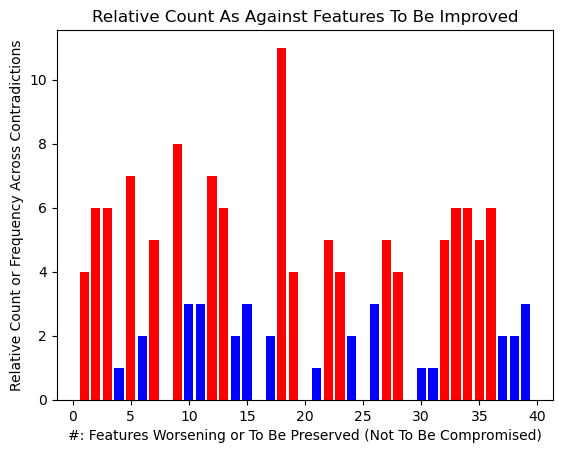
2: Mass of the non-moving object: [‘6: Area of the non-moving object’, ’11: Tension, Pressure’, ’12: Shape’, ’23: Material loss’, ’33: Convenience of use’]
3: Length of the moving object: [‘9: Speed’]
4: Length of the non-moving object: [’12: Shape’]
5: Area of the moving object: [’13: Stability of the object’, ’18: Brightness, Visibility’, ’26: Amount of substance’, ’32: Convenience of manufacturing’, ’33: Convenience of use’, ’34: Convenience of repair’, ’36: Complexity of the structure’]
7: Volume of the moving object: [’18: Brightness, Visibility’, ’21: Power’, ’22: Energy loss’, ’33: Convenience of use’]
9: Speed: [‘1: Mass of the moving object’, ‘3: Length of the moving object’, ’10: Force’, ’18: Brightness, Visibility’, ’23: Material loss’, ’24: Information loss’, ’32: Convenience of manufacturing’, ’33: Convenience of use’]
10: Force: [‘2: Mass of the non-moving object’, ‘9: Speed’, ’27: Reliability’, ’31: Harmful internal factors’]
11: Tension, Pressure: [‘2: Mass of the non-moving object’, ’27: Reliability’]
12: Shape: [‘4: Length of the non-moving object’, ’18: Brightness, Visibility’, ’34: Convenience of repair’, ’37: Complexity of control and measurement’]
13: Stability of the object: [‘3: Length of the moving object’, ‘5: Area of the moving object’, ’15: Action time of the moving object’, ’19: Energy consumption of the moving object’, ’28: Accuracy of measurement’]
14: Strength: [‘9: Speed’, ’13: Stability of the object’, ’36: Complexity of the structure’]
15: Action time of the moving object: [’13: Stability of the object’, ’27: Reliability’, ’35: Adaptability’]
17:Temperature: [’15: Action time of the moving object’]
18: Brightness, Visibility: [‘7: Volume of the moving object’, ‘9: Speed’, ’22: Energy loss’, ’23: Material loss’, ’34: Convenience of repair’, ’36: Complexity of the structure’]
19: Energy consumption of the moving object: [‘7: Volume of the moving object’, ’13: Stability of the object’, ’35: Adaptability’]
21: Power: [‘6: Area of the non-moving object’]
22: Energy loss: [‘3: Length of the moving object’, ’18: Brightness, Visibility’]
23: Material loss: [‘9: Speed’, ’18: Brightness, Visibility’, ’37: Complexity of control and measurement’]
24: Information loss: [’39: Productivity’]
26: Amount of substance: [’28: Accuracy of measurement’, ’36: Complexity of the structure’, ’39: Productivity’]
27: Reliability: [’18: Brightness, Visibility’, ’35: Adaptability’, ’36: Complexity of the structure’, ’38: Level of automation’]
28: Accuracy of measurement: [‘7: Volume of the moving object’, ‘9: Speed’, ’13: Stability of the object’, ’33: Convenience of use’, ’34: Convenience of repair’, ’35: Adaptability’]
29: Accuracy of manufacturing: [‘1: Mass of the moving object’, ’22: Energy loss’]
30: Harmful external factors: [‘2: Mass of the non-moving object’, ’10: Force’, ’18: Brightness, Visibility’, ’39: Productivity’]
32: Convenience of manufacturing: [‘2: Mass of the non-moving object’, ‘3: Length of the moving object’, ‘5: Area of the moving object’, ‘7: Volume of the moving object’, ‘9: Speed’, ’12: Shape’, ’13: Stability of the object’, ’33: Convenience of use’, ’35: Adaptability’]
33: Convenience of use: [‘1: Mass of the moving object’, ‘2: Mass of the non-moving object’, ‘3: Length of the moving object’, ‘5: Area of the moving object’, ‘9: Speed’, ’10: Force’, ’17:Temperature’, ’18: Brightness, Visibility’, ’19: Energy consumption of the moving object’, ’22: Energy loss’, ’28: Accuracy of measurement’]
34: Convenience of repair: [‘5: Area of the moving object’, ’11: Tension, Pressure’, ’12: Shape’, ’18: Brightness, Visibility’, ’28: Accuracy of measurement’, ’36: Complexity of the structure’, ’38: Level of automation’]
35: Adaptability: [’15: Action time of the moving object’, ’19: Energy consumption of the moving object’, ’23: Material loss’, ’27: Reliability’, ’32: Convenience of manufacturing’]
36: Complexity of the structure: [‘5: Area of the moving object’, ’12: Shape’, ’14: Strength’, ’17:Temperature’, ’18: Brightness, Visibility’, ’22: Energy loss’, ’26: Amount of substance’, ’27: Reliability’, ’32: Convenience of manufacturing’, ’34: Convenience of repair’]
37: Complexity of control and measurement: [‘1: Mass of the moving object’, ‘2: Mass of the non-moving object’, ‘5: Area of the moving object’, ’12: Shape’]
38: Level of automation: [‘3: Length of the moving object’, ‘5: Area of the moving object’, ‘7: Volume of the moving object’, ’11: Tension, Pressure’, ’12: Shape’, ’14: Strength’, ’19: Energy consumption of the moving object’, ’26: Amount of substance’, ’32: Convenience of manufacturing’, ’34: Convenience of repair’]
39: Productivity: [’24: Information loss’, ’30: Harmful external factors’]
2/6 2/11 2/12 2/23 2/33 3/9 4/12 5/13 5/18 5/26 5/32 5/33 5/34 5/36 7/18 7/21 7/22 7/33 9/1 9/3 9/10 9/18 9/23 9/24 9/32 9/33 10/2 10/9 10/27 10/31 11/2 11/27 12/4 12/18 12/34 12/37 13/3 13/5 13/15 13/19 13/28 14/9 14/13 14/36 15/13 15/27 15/35 17/15 18/7 18/9 18/22 18/23 18/34 18/36 19/7 19/13 19/35 21/6 22/3 22/18 23/9 23/18 23/37 24/39 26/28 26/36 26/39 27/18 27/35 27/36 27/38 28/7 28/9 28/13 28/33 28/34 28/35 29/1 29/22 30/2 30/10 30/18 30/39 32/2 32/3 32/5 32/7 32/9 32/12 32/13 32/33 32/35 33/1 33/2 33/3 33/5 33/9 33/10 33/17 33/18 33/19 33/22 33/28 34/5 34/11 34/12 34/18 34/28 34/36 34/38 35/15 35/19 35/23 35/27 35/32 36/5 36/12 36/14 36/17 36/18 36/22 36/26 36/27 36/32 36/34 37/1 37/2 37/5 37/12 38/3 38/5 38/7 38/11 38/12 38/14 38/19 38/26 38/32 38/34 39/24 39/30
EXAMPLE: A reversible belt is a type of belt that features two distinct surfaces or colors on either side, allowing the wearer to switch between different styles or appearances. The primary difference between a reversible belt and a traditional one lies in the ability to use both sides of the belt, providing more versatility and flexibility in matching with various outfits.
Contradiction (33/1 , 36/26, 32/33): The reversible belt addresses the problem of having to own and manufacture/store multiple belts (32,33) to complement various clothing styles. It provides a practical and efficient solution for individuals who want to simplify their wardrobe and make the most out of a single accessory (1,26).
Solution: A reversible belt typically has two different colors, textures, or patterns on each side (also a use case for “change of colors” and “another dimension”). This design enables the wearer to easily flip the belt to match different clothing styles. The main advantage of a reversible belt is its versatility. With just one belt, the wearer can achieve multiple looks, making it a practical and space-saving accessory, especially during travel. Reversible belts often come with a buckle that can be easily rotated, allowing the user to switch between the two sides without detaching the buckle. This adds to the convenience and ease of use. For individuals who want to minimize the number of accessories they own or save on closet space, a reversible belt offers a cost-effective solution. It reduces the need to purchase multiple belts to match different outfits. Additionally, reversible belts offer a quick and easy way to coordinate with different outfits, making them suitable for individuals who value both style and functionality in their accessories.